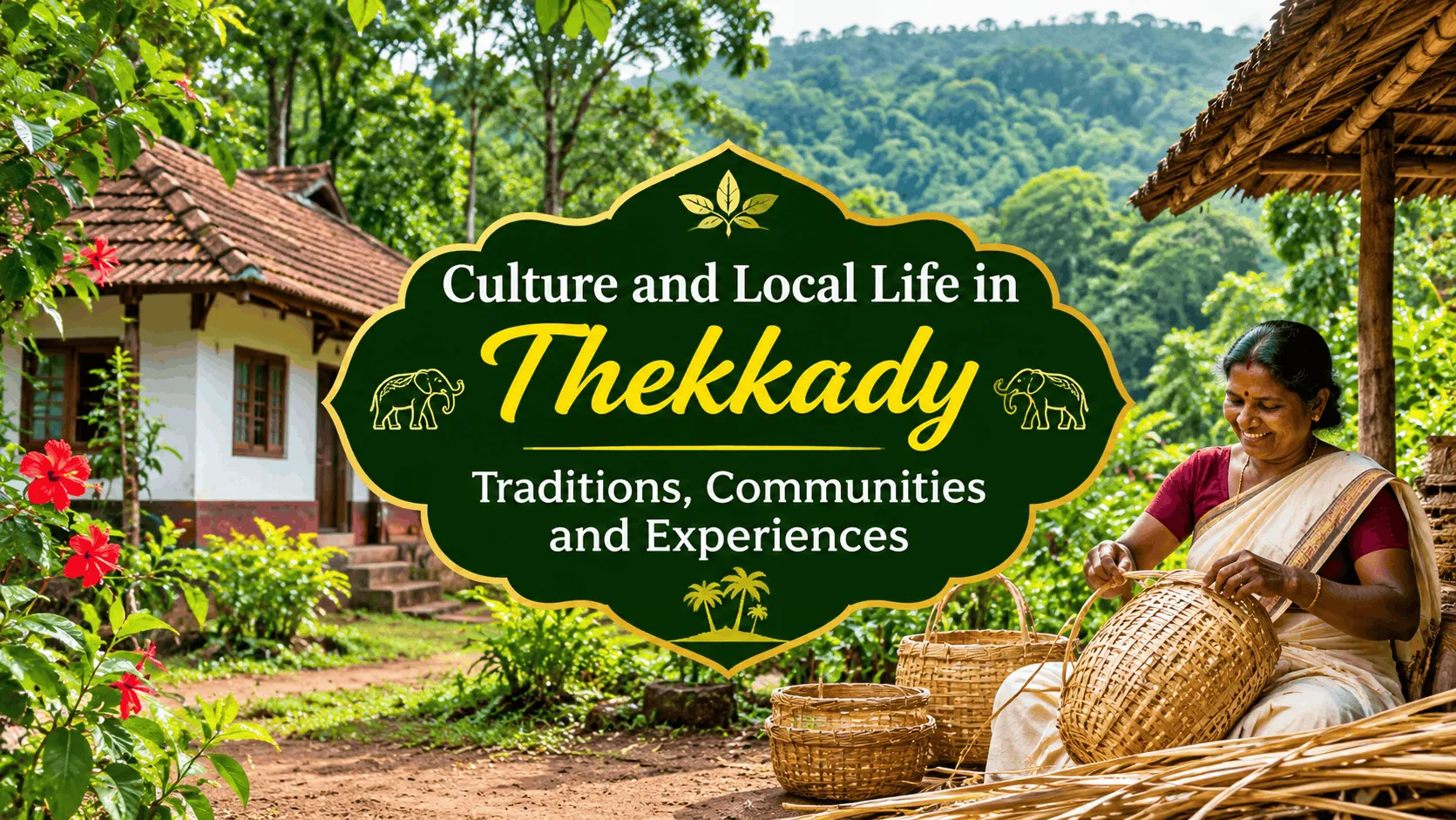
Most people arrive in Thekkady for the Periyar Tiger Reserve, the lake and the spice-scented hills. Behind those landmarks is a living region where families farm, run shops, work on estates, guide visitors and keep festivals going year after year. Thekkady culture and traditions are shaped by Kerala's wider heritage, by the Tamil Nadu border a short drive away, and by communities who have lived around these forests for generations.
This article offers background and context. It does not present people as attractions. Where something is documented, we say so, and where an experience depends on community consent, season or official permission, we say that too. If you are still planning the practical side of your trip, our Thekkady travel guide covers routes, seasons and logistics, and this piece can help you arrive with better understanding.
The cultural character of Thekkady and Kumily
Thekkady is the name most visitors know, but daily life centres on Kumily, the busy town at the reserve's gate. Kumily is a market and transport hub, where hotels, spice shops, tea stalls, bus stands and small family businesses sit side by side. Malayalam is the main local language, and Tamil is widely heard because the border is close.
The hill setting has long drawn farmers, traders and estate workers from different parts of Kerala and neighbouring Tamil Nadu. As a result, you will see temples, churches and mosques within a short distance of one another, and hear more than one language in a single street. Visitors often notice that the pace changes from the bustle of town to the quiet of the lanes beyond it.

Everyday life in the local region
Local life here follows the farming calendar and the seasons. Many households depend on cardamom, pepper, coffee, tea or rubber, either as owners of small plots or as workers on larger estates. Others work in tourism, as drivers, guides, hotel staff, cooks and shopkeepers. Mornings start early, with tea shops opening before dawn and schoolchildren in uniform filling the roads.
Spice farming is part of this rhythm, and if you want to understand how it works on the ground, our article on spice plantation tours in Thekkady explains what a plantation visit involves. The key point for visitors is that these are working farms and livelihoods, so a polite question and a little patience go a long way.
Kerala's cultural traditions and regional influences
Kerala is known for a layered culture that has absorbed influences from trade, religion and migration over many centuries. Several traditions of Kerala show up in the Thekkady area, even though most of them belong to the state as a whole and are not unique to this hill region.
- Classical and ritual arts such as Kathakali, Mohiniyattam and Kalaripayattu, the martial art, are associated with Kerala generally. Shows in Kumily town commonly present them for visitors.
- Festivals such as Onam, Vishu, Christmas and Eid are celebrated by different communities, and all form part of ordinary life in the district.
- The Tamil influence appears in temple traditions, festival customs, language and food, and is especially visible near the border.
It helps to keep this distinction clear. A Kathakali performance in Kumily is a Kerala art form presented in a tourism setting. It does not represent the culture of the indigenous communities who live around the forest, which is a separate subject covered below.
Indigenous communities in the wider region: background and context
Several indigenous (Adivasi) communities live in and around the Periyar Tiger Reserve. Sources differ slightly on how many. Kerala Tourism lists five communities settled in the Kumily panchayat: the Mannan, Paliyan, Urali, Mala-araya (Malayarayan) and Malampandaram. Documents on the reserve itself list six, adding the Ulladan. The communities have separate histories, languages, practices and ways of life, so it is not accurate to speak of one shared "tribal culture."
Some background from published sources may help. Many families now live on the fringes of the reserve, and a large share practise settled farming. Earlier forest management policies were enforced in ways that affected the livelihoods of forest-dependent people. In 1996, Periyar became one of seven protected areas in India chosen for the World Bank supported India Eco-development Project, which ran until 2004. It set up village eco-development committees and created paid roles in conservation and eco-tourism, including for former poachers who became forest protectors.
Researchers continue to study how that project affected health, education, income and infrastructure for tribal households, and the findings are mixed and still debated. We mention this so readers understand that today's community-based programmes have a history, and that fairness and consent matter in how they work.
What we do not attempt here is to describe the beliefs, rituals or ceremonies of any community. Those belong to the communities themselves, and they are best learned from members who choose to share them.
Traditional knowledge connected with forests and nature
Forest-dependent communities have long built their livelihoods around the landscape. Published material on the Periyar area mentions activities such as collecting forest produce including honey, community pepper farming and guiding visitors through the forest. Several people from these communities now work as guides and staff in the reserve's eco-tourism programmes.
When you walk with a guide, you may hear identifications of birds, trees, tracks and sounds that come from years of living close to the forest. This knowledge deserves the same respect as any other expertise. Ask questions, listen to the answers and credit the guide. Do not ask for sacred or private knowledge, and do not assume every guide belongs to a particular community.
Local food, hospitality and everyday customs
Food is one of the easiest ways to meet local culture. Meals in Kumily and the surrounding villages are built on rice, coconut, vegetables, fish and local spices, and hospitality often means being offered tea, a banana or a plate of something freshly cooked. For a full look at dishes and eating tips, see our guide to food in Thekkady.
A few everyday customs are worth knowing. Remove your shoes before entering a home, temple or many small shops. Eat and pass food with your right hand where possible. Greet people with a smile or a folded-hands gesture. A modest, quiet manner is usually appreciated more than a loud one.
Traditional art forms and cultural performances
Visitors may find several kinds of performance in the region, and it helps to know what each one is.
Kerala art shows in Kumily town present forms like Kathakali and Kalaripayattu to tourist audiences. These are professional performances, usually with a ticket and fixed timings that you should confirm locally.
The Kerala Tourism programme for Periyar lists a community-based eco-tourism performance of Mannan and Paliyan dances, with an introduction to the communities and their instruments and costumes. It has been run at an auditorium in the Periyar area in the evening. Because schedules, prices and venues change, check the current details with the reserve's eco-tourism office rather than relying on this article.
Treat such performances as an arranged programme that the community has chosen to offer. A performance on a stage is not an invitation to visit homes or ritual spaces, and applause, patience and permission before photographing people are the right response.
Festivals and community celebrations
Festivals here are mostly shared occasions that belong to the people celebrating them. Onam, Vishu, Christmas and Eid are observed by different communities across Kerala, and visitors may see decorations, special meals and gatherings in town during these times.
One notable local event is the Chithra Pournami festival at the Mangala Devi Kannagi temple. The ancient shrine stands on a hilltop in the Periyar Tiger Reserve on the Kerala and Tamil Nadu border, around 13 to 15 kilometres from Kumily. It is dedicated to Kannagi, a figure from the Tamil epic Silappatikaram. Worship is permitted only on one day a year, on Chithra Pournami in April or May, and pilgrims from both states take part. Entry is managed by the authorities, with rules on vehicles, timings and permits, and recent notices have restricted photography, videography and drones.
If you hope to attend, check the official announcements for the year, follow the forest department's rules, and join as a respectful guest rather than a spectator.
How visitors can engage respectfully with local communities
Respectful engagement begins before you arrive and rests on a few habits.
- Choose programmes that are run by or with community members, and ask how the income is shared.
- Go with a guide when visiting a settlement, and never walk into homes, farms, shrines or burial places uninvited.
- Ask before you take photographs, and accept a no without argument.
- Dress modestly, speak calmly and avoid comments about poverty, clothing or lifestyle.
- Do not hand out sweets, pens or money to children. If you want to help, use a recognised local organisation or buy services and products directly.
- Remember that you are a guest, and that a visit is not owed to you.
Our guide to responsible tourism in Thekkady explains more about how to travel in ways that support both people and the forest.
Supporting local livelihoods through responsible tourism
Tourism can bring useful income to local families, as long as the money reaches them. Several simple choices help.
Hire local guides through the official eco-tourism programmes, where income is shared with community committees. Stay in locally owned homestays and small hotels, and eat in family-run restaurants. Buy spices, tea, honey or crafts directly from the people who produce them, and pay a fair price instead of bargaining hard over small amounts. Ask where an item was made, and avoid goods that appear to be mass produced.

If you join a craft demonstration or workshop, ask whether it is arranged with the artisan's agreement, stay a respectful distance, and buy something if you can. Value the skill, not just the photograph.
Cultural etiquette and photography considerations
Good manners cover most situations here.
- Dress modestly at temples, churches, mosques and in villages, with shoulders and knees covered.
- Remove footwear where it is expected, and follow the signs at religious sites.
- Ask permission before photographing people, especially women, children and elders, and respect refusals.
- Do not photograph rituals, shrines or private homes without clear consent.
- Avoid drones. Their use is restricted in and around the reserve and can be punishable.
- Keep your voice low in villages and near places of worship.
- Do not share location details or names of individuals online without their permission.
When in doubt, ask your guide or host. A short conversation takes little time and prevents misunderstandings.
Frequently asked questions
What are the main cultural influences in Thekkady?
Thekkady's culture draws on Kerala traditions, Tamil influences from the nearby border, the farming and estate life of the hills, and the heritage of indigenous communities living around the Periyar forests.
Which indigenous communities live near Thekkady?
Published sources list communities such as the Mannan, Paliyan, Urali, Malayarayan and Malampandaram, with the Ulladan included in some lists. They have distinct histories and customs and should not be described as one group.
Can I visit tribal settlements near Thekkady?
Visits should happen only through arranged programmes with community involvement and a guide. Do not enter settlements on your own, and follow the guidance of community members.
Is it appropriate to photograph local people?
Always ask first. Some people will agree, some will not, and the choice is theirs. Never photograph rituals or private spaces without clear consent.
Are the dance performances available to visitors authentic?
Community-based programmes are arranged by the people who perform in them, and the Kerala Tourism listing describes Mannan and Paliyan dances. They are presented for visitors in a stage setting, so they show only a part of a community's culture. Check the current schedule locally.
What is the Mangala Devi temple festival?
It is the Chithra Pournami festival, held once a year in April or May at the ancient Kannagi temple within the Periyar Tiger Reserve. Entry rules and photography limits apply, so check the official announcements for the year.
What should I wear when exploring local villages and temples?
Choose modest, comfortable clothing that covers shoulders and knees, and carry something to cover your head or shoulders if needed. Be ready to remove footwear at temples and homes.
How can I support local communities while travelling?
Use official community-based programmes, hire local guides, stay in locally owned accommodation, eat at family-run restaurants and buy directly from producers and artisans at fair prices.
Conclusion
The culture of Thekkady is lived rather than staged. It shows up in a farmer's early morning, a shared pot of tea, a festival on a forested hilltop and the knowledge of guides who grew up beside the reserve. Visitors who arrive curious, ask permission, and listen more than they speak will see far more than those who arrive with a checklist.
Travel here with patience and good manners, spend your money where it supports local people, and leave places as you found them. That is the best way to take part in Thekkady's culture and traditions while respecting the people who keep them alive.