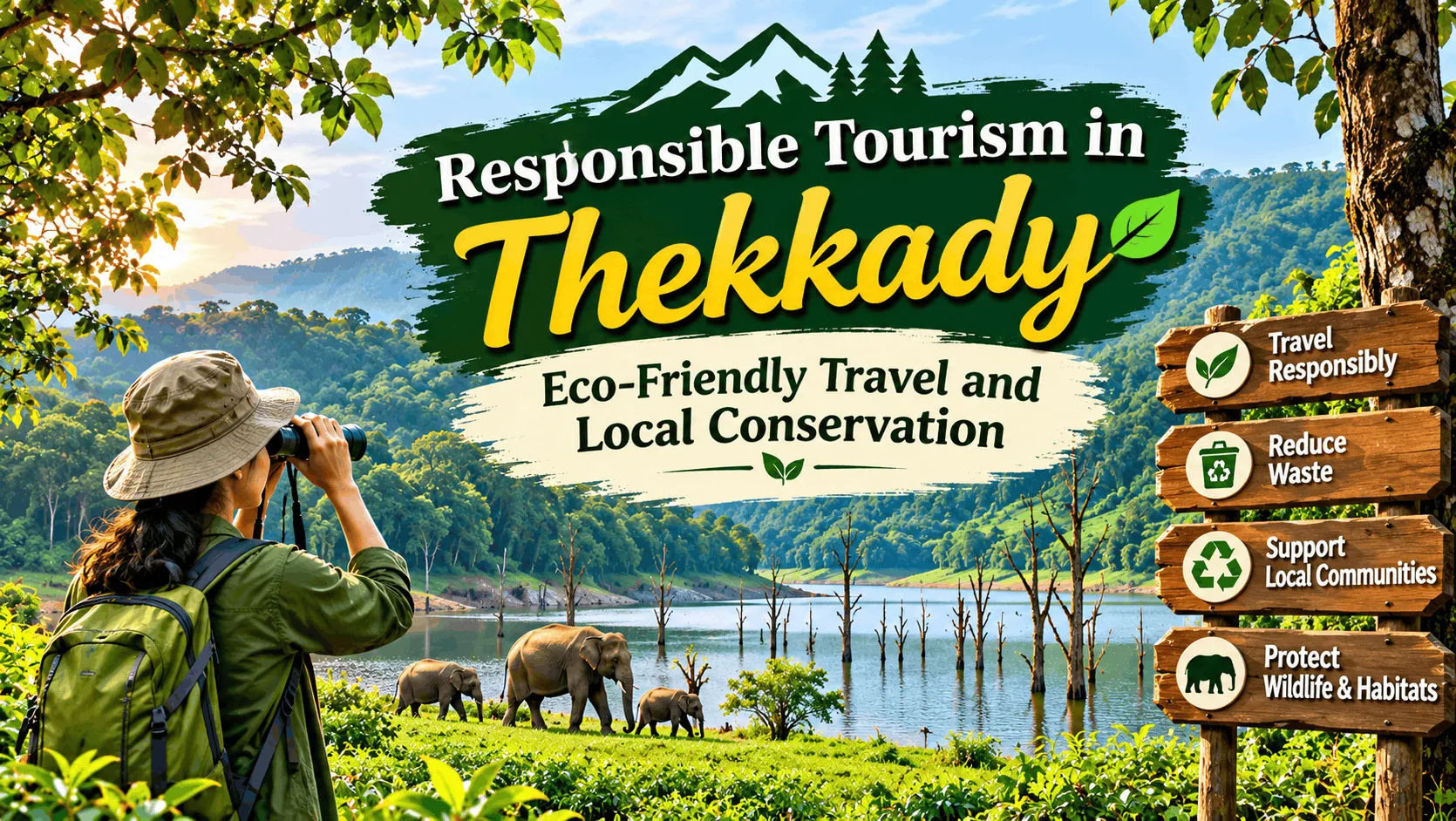
Thekkady draws visitors because it is still green, quiet and full of wildlife. That appeal depends on the forest staying healthy and on the people who live around it continuing to make a living there. Responsible tourism in Thekkady comes down to small, practical habits: how you behave near animals, what you do with your waste, who you hire and where you stay.
This guide offers clear actions rather than vague promises. It separates general good practice from conservation work that is actually documented in the area, and it avoids claims we could not verify. If you are still planning your overall trip, our Thekkady travel guide covers the basics, and this article will help you travel more thoughtfully once you are there.
Tourism does not automatically help a place or its people. It can, when visitors choose well and when programmes are managed fairly. The advice below is meant to push in that direction.
Understanding Thekkady's natural environment
Thekkady is the visitor gateway to the Periyar Tiger Reserve in the southern Western Ghats. A published ecological profile describes the reserve as having nearly 75 percent of its area under tropical wet evergreen and semi-evergreen forest, with moist deciduous forest and some grassland making up much of the rest. It became Kerala's only tiger reserve in 1978, and it is the catchment of the Periyar river and its lake.
This matters for visitors because forest, water and wildlife are closely connected. Litter that reaches a stream ends up in the lake. Noise and crowding at the water's edge disturb animals that come to drink. Thinking of the reserve as a living system rather than a scenic backdrop is the first step toward behaving well in it.
Responsible behaviour around forests and wildlife
Wild animals are not performers, and sightings are never guaranteed. A good guide will tell you the same. Your role is to observe without changing what the animals do.
A few habits help in any forest setting:
- Keep your distance and never approach, chase or try to attract an animal.
- Do not feed wildlife. Human food harms animals and makes them lose their natural caution.
- Stay on marked trails and in permitted areas. Leaving the path can damage vegetation and put you at risk.
- Keep your voice low, switch off music and avoid sudden movements.
- Do not pick plants, collect souvenirs from the forest or disturb nests and burrows.
- Never use fire or smoke, and do not carry anything that could start one.
If an animal reacts to your presence by stopping, staring or moving away, you are too close. Back off quietly and let it settle.
Following official park and activity guidelines
Forest and activity rules exist to protect both visitors and animals, and they are set by the authorities that manage the reserve. Entry to the Periyar Tiger Reserve and its eco-tourism programmes is organised by the Forest Department, and published travel guides note that guided programmes such as treks and rafting should be booked in advance through official channels or the eco-tourism centre in Thekkady. Rules, timings, fees and group sizes change, so confirm current details with the official source before you go.
Some principles apply across the board. Enter protected areas only with the required permission, follow the instructions of forest staff and nature guides, and take part only in programmes that the reserve has approved. Do not try to enter restricted forest zones, shortcut a trail or arrange private forest access. Unofficial activities can harm wildlife, put you at risk and undermine the community-run programmes that the reserve depends on.
If a guide asks you to stop, move back or stay quiet, do it without argument. Their experience keeps everyone safe.

Avoiding litter and reducing plastic waste
Plastic is one of the clearest issues, and Thekkady has a documented history on it. Kerala Tourism newsletters describe a plastic ban inside the forest area of the Periyar Tiger Reserve, introduced as part of a Responsible Tourism project, with the ban also extended to the Kumily panchayat. They also describe daily collection of plastic discarded by tourists, carried out with the help of local Eco-Development Committees, including a committee created in Kumily for plastic collection alone. Those reports are several years old, so check current rules locally, but they show that waste has long been taken seriously here.
What you can do:
- Carry a reusable water bottle and refill it at your accommodation instead of buying bottled water.
- Bring a cloth bag and say no to plastic carry bags.
- Pack snacks in reusable containers and take every wrapper with you.
- Do not burn or bury rubbish. National guidelines for tiger reserve eco-tourism call for a complete ban on burying, burning or otherwise disposing of non-biodegradable waste in and around reserves.
- Use bins where they are provided, and carry waste out when they are not.
Small items count too. Cigarette ends, sachets, wet wipes and plastic straws are easy to overlook and slow to break down.

Respecting local communities and cultural practices
Thekkady and Kumily are home to families, farmers, estate workers and indigenous communities. They are not part of the scenery. Published sources note that several indigenous communities live around the Periyar reserve, with distinct histories and ways of life, and that some members now work in the reserve's eco-tourism programmes.
Respectful behaviour is simple. Ask before photographing people, dress modestly at temples, churches and mosques, and keep your voice down in villages. Do not enter homes, farms or ritual places without an invitation, and do not treat cultural performances as a chance for intrusive photography. Avoid handing out sweets, pens or money to children, which can encourage begging. If you want to help, buy services and products directly from local people at fair prices.
For more background on the people and traditions of the area, see our article on culture and local life in Thekkady.
Supporting local businesses and livelihoods
Tourism money helps most when it stays local. Hire local guides, drivers and cooks, eat at family-run restaurants, stay in locally owned homestays and small hotels, and buy directly from producers and artisans. Pay a fair price and avoid bargaining hard over small amounts.
Research on the Periyar area has described community-based ecotourism, run through Eco-Development Committees and the Periyar Foundation, as delivering benefits for local communities. Studies of the wider India Eco-development Project also report mixed outcomes for tribal households, so the picture is not simple. The practical takeaway is to prefer programmes where income is shared with local committees, and to ask how a business benefits the community rather than assuming it does.
If you visit a working farm, our guide to spice plantation tours in Thekkady explains what to expect and how to buy responsibly there.
Choosing nature-based experiences responsibly
Not every activity has the same impact. Before you book, ask a few questions.
Is the activity run or approved by the forest authorities? Is the group size limited? Do guides brief you on behaviour before you go? Are local people employed and paid fairly? Is wildlife left undisturbed, with no feeding, baiting or chasing?
Be cautious about anything that offers close contact with wild animals, promises guaranteed sightings or takes you into forest areas that are not part of an official programme. Official programmes in the Periyar area include guided treks, nature walks and community-based activities, and details such as price and timing vary, so check them with the eco-tourism office.
Choose quieter options when you can. Smaller groups, early starts and slower walks disturb wildlife less and often give better experiences.
Responsible wildlife photography and observation
A good photograph is never worth stressing an animal. Use a zoom lens rather than moving closer, and turn off flash, which can startle or disorient animals. Do not use drones. Rules around the reserve restrict them, and recent notices for events inside the reserve describe drone use as punishable.
Do not play recorded calls or make noises to attract animals, and avoid blocking an animal's path. Accept that some outings will produce few photographs. Patience is part of watching wildlife.
Birdwatchers can follow the same principles, keeping to trails, staying quiet and avoiding nests. For species and ideas on where to look, see our guide to birdwatching in Thekkady.
Water, energy and resource conservation
Hill destinations often have limited water in the dry season, and resources are shared with local residents. Take short showers, reuse towels, and report leaks. Switch off lights, fans and air conditioning when you leave your room, and avoid leaving chargers plugged in.
Choose local, seasonal food, which tends to travel less and support nearby farmers. Do not waste food, and ask for smaller portions if you cannot finish a full plate. When you travel between places, share vehicles when possible and avoid unnecessary idling.
Choosing accommodation with responsible practices
We cannot confirm that any particular hotel, homestay or operator in Thekkady is eco-certified, and we do not make such claims. Instead, look for evidence you can check yourself.
Ask what the property does about waste and plastic, whether it filters or refills drinking water, how it manages water and energy, and whether it employs and buys from local people. Look for specifics, such as refill stations, composting or locally sourced food, rather than general statements like "eco-friendly." Be sceptical of claims that cannot be explained. If a property cites a certification, ask which scheme and verify it with the issuing body.
Small, locally owned stays often have a lighter footprint and keep more money in the community, but this is not guaranteed, so ask questions either way.
Practical checklist for responsible travellers
- Book official forest and eco-tourism programmes through approved channels.
- Follow guides and forest staff at all times.
- Keep a respectful distance from wildlife and never feed animals.
- Carry a reusable bottle and bag, and take all litter with you.
- Ask permission before photographing people, and avoid drones.
- Dress modestly and behave quietly near homes and places of worship.
- Hire local guides and buy directly from local producers.
- Choose accommodation that can show how it manages waste, water and energy.
- Save water and electricity in your room.
- Check current rules, timings and fees before you travel.
Frequently asked questions
Is plastic allowed in the Periyar Tiger Reserve?
Kerala Tourism publications describe a plastic ban inside the forest area, supported by waste collection through local committees. Rules can change, so confirm current requirements with the reserve before your visit.
How can I avoid disturbing wildlife in Thekkady?
Keep your distance, stay quiet, remain on marked trails, never feed animals, and follow your guide. Do not use flash or drones, and never try to attract animals with sounds or food.
Can I enter the forest on my own?
Entry to protected areas requires permission and usually a guide. Join official programmes instead of trying to enter on your own, and do not enter restricted areas.
Does tourism benefit local communities in Thekkady?
It can, particularly through community-based programmes and local employment, but benefits are not automatic and are debated by researchers. Choose local guides, stays and producers, and ask how income is shared.
Are there eco-certified hotels in Thekkady?
We do not claim that any particular property is certified. If a hotel mentions a certification, ask which scheme it belongs to and verify it with the issuing organisation.
What should I pack for responsible travel?
A reusable water bottle, a cloth bag, reusable food containers, a zoom lens or binoculars, modest clothing and a small bag for your own litter.
Can I guarantee seeing wildlife?
No. Sightings depend on season, weather and luck. Responsible operators will not promise sightings, and you should avoid anyone who does.
How can I support conservation while I travel?
Follow the rules, reduce waste, spend your money locally and choose programmes approved by the authorities. Do not volunteer for conservation work or enter forest areas without official permission.
Conclusion
Responsible tourism in Thekkady does not require perfection. It asks for attention: to the animals you are watching, to the waste you are carrying, and to the people who live and work here. Follow official guidelines, choose local businesses, keep your impact small and be honest about what you do not know.
If every visitor does a few of these things well, the forest, the lake and the communities around them will be in better shape for the next traveller.