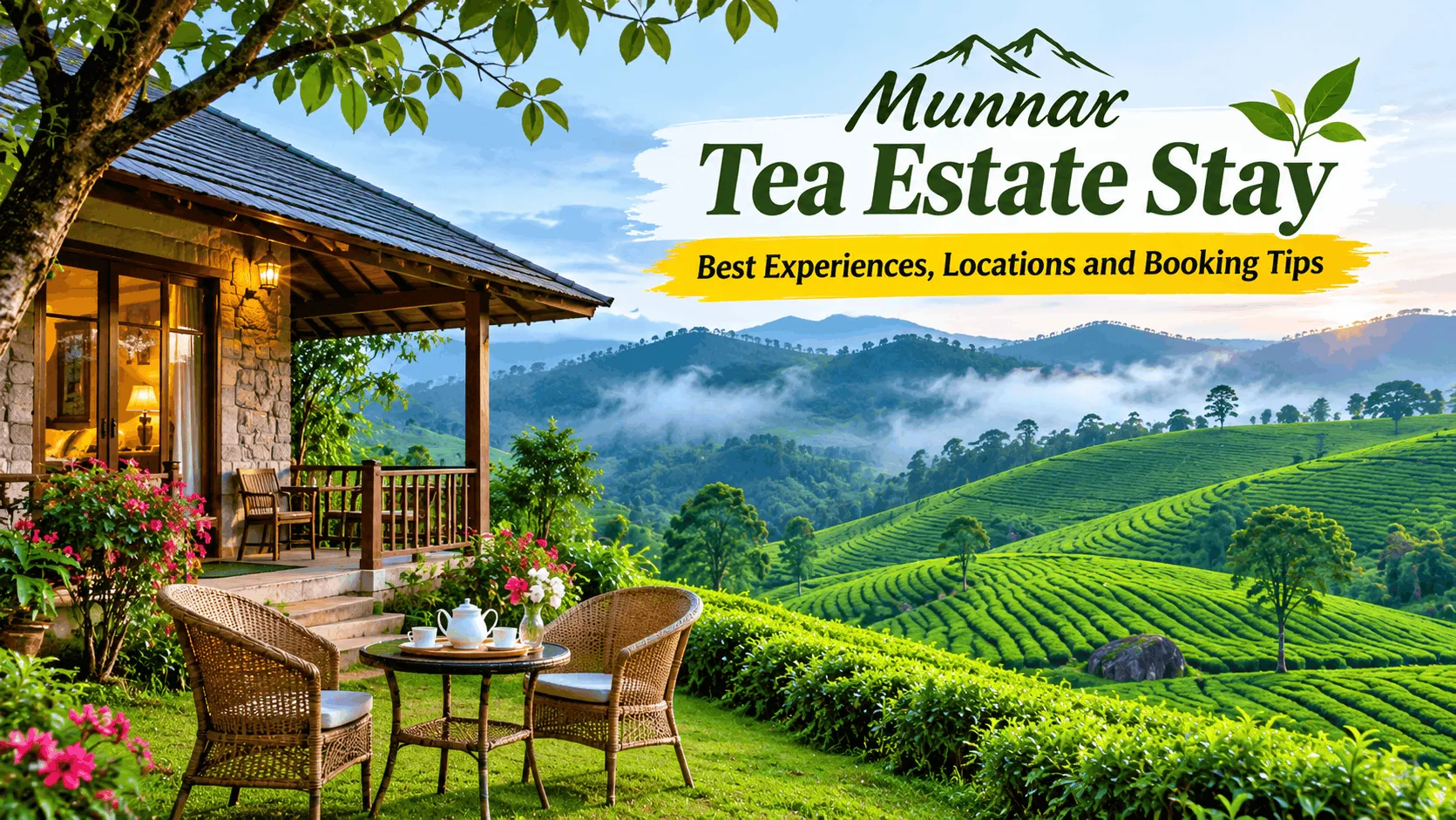
Waking up to rows of tea bushes running down a hillside is the main reason travellers search for a Munnar tea estate stay. It is a fair reason, but the search results can mislead. Many listings use words like "tea estate" and "plantation" for properties that are near tea, overlook tea or sit on a private plot beside an estate. Very few are inside a working plantation, and the difference affects where you can walk, what you can do and what you should expect on arrival.
This guide is about the booking decision. It explains the three kinds of plantation stay, the accommodation types you will meet, the areas worth considering, the experiences that are realistic, and what to check before you pay. It names no properties and quotes no prices, because those change and must be confirmed with each host. General sightseeing advice for Munnar is covered in our other guides, so the focus here stays on staying near tea.
Why stay near Munnar's tea plantations
Tea shapes the landscape around Munnar, and many of the roads in and around the town run past plantation slopes. Staying close gives you quiet mornings, a view that changes with the light and a sense of place that a town hotel cannot offer. It also puts you near working life. Plucking, transport and estate routines go on around you, which is both the appeal and the reason to behave carefully.
Most of the estates in the Munnar area are run by Kanan Devan Hills Plantations Company, usually called KDHP. It was formed in 2005 when Tata Tea transferred its Munnar plantations to a new company, and published accounts describe it as an employee-owned business. Other estates and private holdings exist too. The practical point for travellers is that this is working agricultural land with owners, managers and thousands of workers, not a public park.
Estate, border or view: three kinds of plantation stay
Accommodation inside a tea estate
This means a bed on land that belongs to a working estate or plantation company, such as an estate bungalow or guest house. These are the rarest and often the least flexible. Access depends on the estate owner's policy, and not all estates allow public access or guests. If a listing claims to be inside an estate, ask who owns the land, who runs the stay and what the rules are for walking, photography and vehicles.
Accommodation bordering plantations
These properties sit on private land next to estate land. You may see tea from the room and walk to its edge, but the plantation itself is not yours to enter. This is the most common kind of tea garden stay in Munnar. Ask whether there is a legal and agreed path into the estate, or whether your walks are limited to public roads and the host's own land.
Properties with plantation views
Here the tea is a view and not a neighbour. The property may be on a ridge or across a valley, with the plantation visible but some distance away. That is perfectly good for scenery, but it should not be described as a plantation stay. Look at the property on a satellite map and ask the host how close the nearest estate land is.
The key question for every listing is the same: who owns the land under the property, and where exactly are the estate boundaries? A good host will answer it directly.

Types of plantation accommodation in Munnar
Plantation bungalows. Older, estate-linked bungalows exist in tea country across India, and some are used as guest stays. Whether a particular one is open to visitors depends on the owner, and bookings often go through a company or tour operator. Do not assume that a photo of an old bungalow means you can stay there.
Homestays. A tea estate homestay is usually a family home with rooms for guests, often on private land beside plantations. These suit travellers who want conversation and home-style meals. Rooms and facilities are more modest than at a resort, and quality depends on the host.
Cottages. Cottage-style stays offer more privacy, often with a separate entrance or veranda. Check the number of units, how far they are from the main building, and how steep the paths are.
Resorts. Larger properties may offer more services, such as a restaurant, a front desk and activities. Many Munnar tea estate resorts market their plantation setting, so apply the same land-ownership question. A resort with views is not the same as a resort inside an estate.
Where to look for plantation-view stays in Munnar
Tea covers much of the Munnar area, so options exist in several directions. Distances and driving times vary with the road and the weather, so ask your host for current figures.
- Munnar town edge and Pothamedu: Close to services, with views over slopes of tea and other crops. Good if you want shops and restaurants within reach.
- Mattupetty, Kundala and the Top Station road: Scenic estate country with big views, with sightseeing stops close by.
- Devikulam and Gap Road: Quieter surroundings, with cooler air and fewer crowds.
- Chinnakanal, Anayirangal and Suryanelli: A more spread-out area where stays feel remote, and meals at the property often matter more.
- Pallivasal side: Published accounts describe a tea garden at Pallivasal, a few kilometres from town, so stays here suit those who want quiet slopes without a long drive.
- Kolukkumalai: Often described as one of the highest tea estates in the region. Sources say it is reached by 4WD jeep, so any stay near it needs careful checking of road access.
Experiences you can expect, and what needs permission
Easy and open experiences
Scenery is the main one. Public roads that wind through tea country offer good views, and a stay with a terrace or veranda gives you the same view without leaving your room. Early mornings and evenings are usually the most pleasant for light and for quiet walks along public paths and roads.
Experiences that need permission or organised arrangements
- Walking inside an estate: Many tea gardens look open but are working private land. Walk only where access is clearly allowed, such as a designated route or a guided estate visit, and ask your host before stepping into any plantation.
- Factory visits and tea tasting: These are usually arranged through the estate, a museum or an operator, and rules and timings vary. The KDHP museum at Nallathanni is a known option, but hours and closed days change, so confirm them.
- Private estate tours: Some estates are open only through an operator or with a permit. Published guides say that not all estates admit the public.
- Meeting workers: Interactions should happen only with permission, and workers are not a photo opportunity.
- Plucking demonstrations or tea making: Offer only if the host or estate arranges them, and do not assume they are included.
A useful rule is to treat anything beyond the property's boundary as private until someone responsible tells you otherwise.
What to check before booking a tea estate stay
- Plantation access: Ask whether guests may walk into the estate, whether a guide is needed and whether there is a charge. Get the answer in writing.
- Room views: Ask which rooms face the tea and whether the view is from the room, the veranda or only a shared area. Ask for recent, unedited photos taken from the room.
- Meals: Ask what is included, what the menu is and whether you can order a late dinner. Hill properties can be far from restaurants.
- Transport: Ask how guests reach the property, whether pickups can be arranged and where taxis can be found. One practical habit, which our Sela Pass guide describes for high roads, is to check weather and road status each morning, and it applies to any steep hill road around Munnar.
- Parking and road access: Ask how steep and narrow the last stretch is, whether a regular car can manage it in rain and whether parking is on site.
- Amenities: Ask about hot water, bedding for cool nights, power backup, mobile coverage and wifi. Treat any facility that has not been confirmed as unavailable.
- Cancellation terms: Read the refund rules, especially for rain and road disruption, and keep them in writing.
Tea estate stay compared with hotels and homestays
| Tea estate or plantation-side stay | Regular hotel | Standard homestay | |
| Setting | Next to or near tea land, often away from town | Usually in or near town | Varies, often residential |
| Services | Often simpler, depends on property | Reception, set services, on-site dining | Limited, depends on the family |
| Access | May involve steep or narrow roads | Usually easier | Varies |
| Plantation activities | Only if the property or estate arranges them | Rarely | Sometimes, through the host |
| Local contact | Often high with hosts or estate staff | Lower | High |
| Convenience | Lower, since shops may be far away | Higher | Medium |
None of these is better in every case. A hotel suits travellers who want predictable services, and a plantation-side stay suits those who value setting and quiet over convenience. Our guide to staying with host families and respecting local communities was written for Northeast India, but its point about asking what a homestay really offers, and treating the host community with respect, applies here too.

Advice for couples, families, photographers and nature lovers
Couples: Choose a property with a private veranda or a room that faces the tea, and confirm which rooms have that view. A quieter location away from the town gives more atmosphere, but check how you will get back after dinner.
Families: Look for properties with easy access, enough rooms and meals that suit children. Ask about open edges, steep paths and stairs, and check that the road is manageable for older relatives.
Photographers: Morning and late afternoon light is usually the most flattering, and mist can come and go. Ask before photographing workers, homes or estate buildings, and do not enter plantations for a better angle without permission. If you want to use a drone, check the rules first and ask the host, since flying near people and private land can cause problems.
Nature lovers: Plantation edges, nearby streams and forest patches can be rewarding for birds and quiet walks. Ask your host which paths are safe and open to visitors, and avoid walking alone at dusk in areas where wild animals may be present.
Practical booking tips and common misconceptions
Start by deciding how much you value the plantation setting against convenience. Contact two or three hosts with the same questions and compare how clearly they reply. Book in advance for busy holiday periods. Season also affects views and roads, and our Northeast India guide on choosing the month before the destination shows the planning approach: decide when you are travelling, then pick a base that suits those conditions. In Munnar, remember that the monsoon months can bring heavy rain and mist that hides the view.
Misconception: every plantation-view stay is inside a working estate. Most are on private land next to or near one, as explained above.
Misconception: you can walk anywhere in the tea. Many tea gardens are private working land, and access depends on the owner.
Misconception: estate stays always include tours and tea tasting. Activities depend on the property and may carry extra charges.
Misconception: workers are part of the attraction. They are people at work, and their privacy and time come first.
Misconception: the view is always clear. Mist and rain can hide the slopes for hours or days.
Responsible tourism and respect for plantation workers
Plantation communities live and work on the land you are visiting. Many workers' families have lived in estate settlements for generations, and the daily rhythm of the estate comes before the visitor's plans. Keep to paths you have been told are open, close gates, avoid litter and keep noise low in the early morning and evening. Do not pick leaves, enter factories or private quarters without permission, and ask before photographing anyone. Pay fair rates for guides and local services, and buy tea or local produce from small sellers where you can. Our guide to buying directly from makers was written about Mizoram's crafts, but its advice on asking who made a product and paying fairly applies equally to tea.
Final thoughts
A good Munnar tea estate stay starts with honest questions about land, access and what the host can actually arrange. Be clear about whether you want to stay inside an estate, beside one or simply look at one, confirm every facility and activity in writing, and treat the plantation as someone's workplace. Send your questions to two or three hosts a few weeks before travel so you have time to compare answers.
Frequently asked questions
What is a Munnar tea estate stay?
It is accommodation in or near the tea plantations around Munnar, ranging from homestays and cottages to resorts. Most are beside or overlooking tea land, and few are inside a working estate.
Can I stay inside a working tea estate in Munnar?
Some estate-linked stays may exist, but access depends on the owner, and not all estates allow public access or guests. Ask who owns the land and who runs the stay before you book.
Can I walk through the tea plantations?
Only where access is allowed. Many gardens are private working land, so ask your host and use designated routes or guided estate visits.
Is a tea estate homestay cheaper than a resort?
Not necessarily. Prices vary by property, season and what is included, so compare the full cost, including meals and transport, rather than the nightly rate.
Which areas are good for a tea garden stay in Munnar?
Options include the town edge and Pothamedu, the Mattupetty and Top Station road, Devikulam and Gap Road, and Chinnakanal and Suryanelli. Match the area to your plans and check road access.
What should I ask before booking Munnar plantation accommodation?
Ask about land ownership, plantation access, room views, meals, transport, parking, road conditions, amenities and cancellation terms, and get the answers in writing.
Is it appropriate to photograph tea pluckers?
Ask first and accept a refusal. Workers are at work, and photography should never disrupt them or put them on display.