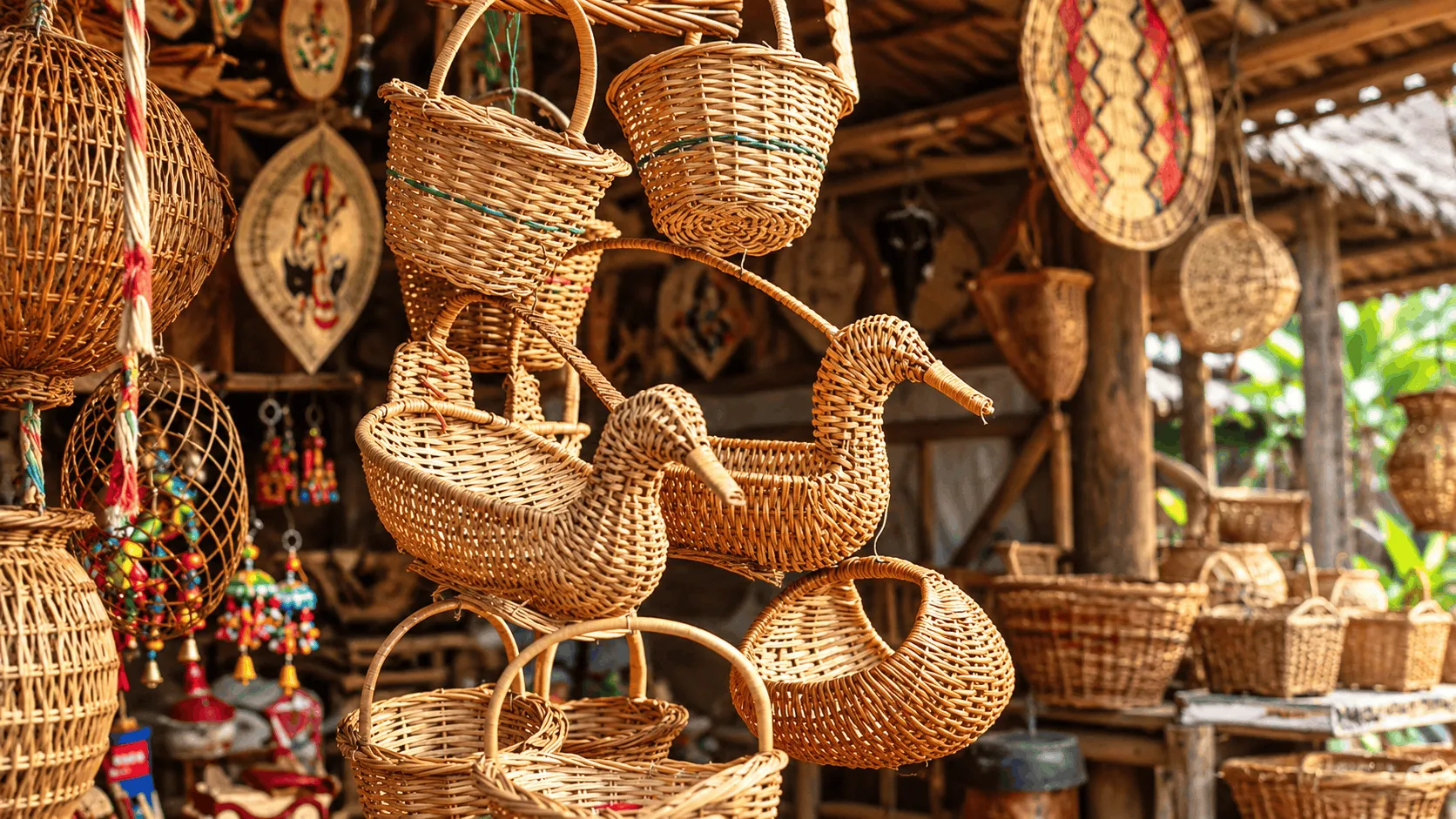
Walk through a Mizo village or an Aizawl market and bamboo is everywhere once you start looking: in the walls and floors of older houses, in the baskets carried on backs, in the poles of a dance. Cane, the strong, flexible stem used for binding and weaving, runs alongside it. Together they form the core of Mizoram handicrafts, and they are some of the most useful things a visitor can learn about and, if they choose, take home.
This guide explains the role of bamboo and cane in Mizo life, the products described in credible sources, how some are made, who makes them, where travellers might find them and how to shop with care. It leaves out Mizo textiles, which have their own guide, and it names no artisans, shops, workshops, prices or stock, because we could not verify them. Where a detail comes from an older source or only one source, it says so. For the wider state, see our Mizoram travel guide.

Bamboo and Cane in Mizoram
Bamboo grows abundantly across Mizoram's hills, and people have put it to many uses. A craft map published by Young INTACH, part of the Indian National Trust for Art and Cultural Heritage, says more than half of the state is covered with bamboo, which explains why it features so strongly in craft and daily life. Treat that figure as the source's own claim, since land-cover numbers vary.
According to the Indira Gandhi National Centre for the Arts, bamboo and cane have many uses in making commercial crafts and furniture. The Craft of India project describes bamboo being used for houses, furniture, kitchen implements, agricultural tools, weaving tools and even jewellery. Mizo houses are generally described as having bamboo walls and floors with thatched roofs.
Cane is the second material. The INTACH map notes that baskets are strengthened with cane because it is hard and durable, and the IGNCA says cane elements are smoked to a rich red-brown colour before they are used in a basket.
Mizo names matter here. The INTACH map gives mitperh for bamboo and phulrua for cane. Spellings vary between sources, so use them as a guide when you ask questions and not as fixed vocabulary.
Traditional Craft Products
The following products are named by credible sources. Availability varies, and not every item will be on sale in every place.
Baskets
Baskets are the best-documented category. The IGNCA and Craft of India describe several forms.
- Paikawng, often spelled paikwang, is an open-weave carrying basket made from split bamboo strips. It is described as typical of Mizoram, broad at the rim and tapering toward the bottom, and women generally use it for carrying firewood, bamboo water tubes and similar loads.
- Paiem is a closed-weave carrying basket used to carry grain and other field produce. One source describes it as woven with four long bamboo splints at the corners, square in the lower half and becoming circular as it opens at the top.
- Thul, or thulte, is a basket used for storing valuables at home and outside. The INTACH map says the thul has four legs that raise it above the ground.
- Other names appear in lists, including empai, emping, tlamen, dawrawn, hnam and fawng. We could not verify how each one differs in shape or use, so we are not describing them individually.
The Mizo Hat
The traditional Mizo hat is called the khumbeu in several sources, and it is described as being made of bamboo. The IGNCA calls it known for its workmanship and says a handicraft centre at Luangmual in Aizawl produces typical Mizo cane hats. A travel magazine notes that the hat is made using waterproof leaves of a plant called hnahthial, which also gives the town of Hnahthial its name. Whether the hat is made from bamboo, cane, leaves or a combination depends on the maker and the type, so ask.
Furniture and Household Objects
Sources list cane and bamboo furniture, including chairs, tables, stools and bamboo screens. The INTACH map names the traditional Mizo stool and a toy, the bamboo pop-gun. Other household and working items named in the Craft of India entry include mugs, fish baskets, rain shields and umbrella handles.
Gourd Craft
Gourds, called um in Mizo, are grown for food and craft. The INTACH map says gourds are encased with thin strips of cane, which are braided around them and then smoked above a fireplace to make containers.
Ornaments and Other Objects
Bamboo is used to make traditional ornaments, which Mizo women wear on special occasions such as weddings and festivals, according to reference sources. The back-strap loin loom used for weaving is also described as made partly of bamboo, which links this craft to the textiles in our Mizo puan and handloom guide. Bamboo poles are also central to the Cheraw dance.
Materials and Making Techniques
The sources are short on step-by-step method, and we are not going to invent any. What is documented gives a clear outline.
- Splitting bamboo into strips. The paikawng is made from split bamboo strips, according to the IGNCA. Strips are then woven into the basket form.
- Open and closed weaves. The paikawng is open weave, and the paiem is closed weave. The difference suits their jobs, since an open weave carries bulky loads and a closed weave holds grain.
- Reinforcing with cane. Cane is added for strength, and the INTACH map says baskets are strengthened with cane because of its hardness and durability.
- Smoking cane. The IGNCA says all cane elements are smoked to a rich red-brown colour before they are used in a basket, and the INTACH map describes smoking gourd casings above a fireplace. The smoking is described as part of the process, and its effects on colour and durability are for a maker to explain.
- Simple tools. Reference sources say Mizo artisans use simple tools designed for traditional products.
We could not verify measurements, tool names, seasoning of bamboo or how long particular pieces take to make. If a maker shares them, they are worth listening to, since they are part of the knowledge.
Artisans and Local Craft Knowledge
According to the IGNCA and the Craft of India project, women excel at weaving, while men are the experts at cane and bamboo work, and basket making is mostly done by men. That is a traditional division, described in sources of some age. We could not verify how it holds today, and individual makers vary, so do not assume you know who made a piece.
Many Mizo craftspeople work independently, either individually or in small groups, using weaving methods to make handmade items, according to reference sources. Government material also refers to handicraft centres. The IGNCA says all types of traditional baskets and decorative articles are produced in handicraft centres in three districts: Aizawl, Lunglei and Siaha, which it spells Chimptuipui (Saiha). That description is older, so we cannot confirm which centres are working or open to visitors today.
Crafts of this kind carry knowledge as well as skill: which bamboo to cut and when, how to split it, how to weave a load-bearing basket that lasts. When you meet a maker, ask rather than assume, and let them decide how much to share.
Where Travellers Can Find Handicrafts
We could not verify specific shops, stalls, workshops or prices, and we are not naming any. Here is what the sources and the geography support.
- Aizawl. It is the main place to start. The IGNCA says the handicraft centre at Luangmual in Aizawl produces typical Mizo cane hats, though the description is older and we could not verify current opening or sales. Aizawl district's own tourism material lists handicrafts as a category. Our Aizawl travel guide covers the city and its markets.
- Government handicraft centres. The IGNCA names centres in Aizawl, Lunglei and Siaha as sites where traditional baskets and decorative articles are produced. Ask the tourism office or the Directorate of Handicrafts and Handlooms whether any are open to visitors.
- Markets and general shops. Markets in Aizawl and other towns sell a mix of goods, and the range will vary from day to day.
- Thenzawl. The town is known mainly for handloom, and our Thenzawl travel guide covers it. We could not verify bamboo or cane workshops there, so ask locally instead of assuming.
- Village and household makers. A host may be able to introduce you to someone who makes baskets or hats. This depends on the community and the maker, so ask politely and accept a refusal.
If you cannot find a particular item, say so to a local contact, since some items are made to order or are not commonly sold.
How to Choose Locally Made Products
No single check proves a craft is locally made, and we are not going to pretend otherwise. These are general shopping suggestions, not verified tests.
Questions to ask:
- Who made this, and where? Was it made by an individual maker, a household, a cooperative or a factory?
- What is it made of? Is it bamboo, cane, another fibre or a synthetic imitation, and how was it prepared?
- How was it made? Hand woven, machine made or assembled from parts?
- What is it called, and what is it used for? A maker can usually explain the name and purpose, such as a paiem for grain.
- Does the shape and style match the traditional forms? For example, the paikawng is described as broad at the rim and tapering at the bottom.
- Is the seller the maker or an intermediary, and can they tell you about the maker?
- How long does it take to make, and how is the price set?
Things to look at:
- Weave and finish. Handmade pieces usually show small variations, though that alone does not prove authenticity.
- Material. Real cane and bamboo have a natural grain and feel. Synthetic imitations exist in many markets, so look closely and ask.
- Smoked cane. Because cane elements in baskets are smoked to a red-brown colour in the documented process, an unusually pale or painted finish is worth asking about. It may have a reason, so ask and do not assume.
- Strength. Check joints, binding and rims, particularly on carrying baskets.
Do not rely on price alone. A low price does not prove a piece is fake, and a high price does not prove it is authentic.
Responsible Shopping and Cultural Respect
- Buy from makers or outlets that can tell you about the maker, and pay the price asked for handmade work. Handmade goods take time and skill, and hard bargaining undervalues both.
- Ask before photographing people, workshops or homes, and accept a refusal. Do not pay people to pose, and do not photograph work in progress without asking.
- Treat traditional objects with respect. A khumbeu or a ceremonial ornament has cultural meaning, so do not wear or use such things as costume without understanding the context.
- Do not copy designs or ask makers to reproduce another community's styles for you. Mizoram has more than one community, and designs and names differ.
- Do not assume that every craft belongs to all Mizo people. Practice differs between groups and villages.
- Think about the source. Bamboo and cane are natural materials, so buy only what you will use, and avoid products made from protected species or wild-collected materials of unclear origin.
- Support livelihoods. Buy directly where you can, hire local drivers and guides and tell people what you valued.
Practical Buying and Packing Tips
These are general suggestions. Ask the seller for care advice specific to your piece.
- Think about size and weight before you buy. Large baskets and furniture are awkward to carry, and some sellers may be able to advise on shipping, though we could not verify any service.
- Pack carefully. Wrap baskets and hats in soft cloth, nest smaller pieces inside larger ones and pad corners. Do not crush or compress woven forms.
- Keep pieces dry. Bamboo and cane can mildew in damp conditions, so dry anything that gets wet and avoid sealed plastic bags for long periods.
- Avoid extreme heat and direct sun, which can dry and crack natural fibres.
- Dust gently with a soft cloth or brush, and avoid soaking.
- Check customs and plant-material rules if you are taking pieces abroad, since some countries have rules on natural materials. We could not verify the rules for particular countries.
- Keep a note of the maker's name, village and the item's local name, if they are happy to share. It adds to the piece and to your memory of it.
Frequently Asked Questions
What are the main traditional crafts of Mizoram?
Bamboo and cane crafts and handloom weaving are described as the core of Mizoram's handicraft identity. Gourd craft and clay craft are also mentioned.
What are paikawng and paiem?
Both are baskets. The paikawng is an open-weave carrying basket made from split bamboo strips, and the paiem is a closed-weave basket used to carry grain and field produce.
What is a khumbeu?
It is the traditional Mizo hat, described as made of bamboo and workmanship-rich. Sources say a handicraft centre at Luangmual in Aizawl produces cane hats, though that description is older.
Who traditionally makes bamboo and cane crafts in Mizoram?
The IGNCA and the Craft of India project say men are the experts at cane and bamboo work, and that women excel at weaving. This is a traditional division, and practice today may differ.
Where can I buy bamboo and cane crafts in Mizoram?
Aizawl is the usual starting point, along with handicraft centres in Aizawl, Lunglei and Siaha named in older sources. We could not verify specific shops or opening hours, so ask the tourism office or your host.
How can I tell if a craft is locally made?
Ask who made it, from what and how. Look at the weave, material and finish, and compare with documented traditional forms. No single check is conclusive.
Is it okay to photograph artisans?
Only with clear permission. Ask first, accept a refusal and do not pay people to pose or photograph work in progress without asking.
Conclusion
Bamboo and cane crafts tell you how Mizo households have worked with the landscape around them: carrying loads, storing grain, sitting, sheltering and dressing. The best way to meet them is with questions, patience and a willingness to pay fairly for work that takes real skill. Learn the names, ask who made a piece, and carry it home carefully. In return, you will own something with a story you can actually tell.