Mizo culture and traditions are often described in a few tidy phrases: close-knit villages, hospitality, bamboo dances, church music. There is truth in each, but history is more layered. Much of what visitors see in Mizoram today grew out of older village life, colonial-era change, the spread of Christianity, and decades of education, migration and urban growth.
This article offers a careful overview. It separates what is documented from what is disputed, distinguishes historical practices from present-day life, and avoids suggesting that all Mizo communities share one unchanged culture. It is an introduction, not a definitive account. For travel planning, start with our Mizoram Travel Guide 2026, which this article does not repeat.

A Brief, Sourced History of the Mizo People
Origins and migration: accounts differ
Many accounts say Mizo ancestors came into the present hills from the east, through the Chin Hills in what is now Myanmar. Travel references and academic summaries repeat this broad picture, but details, dates and routes vary, and oral traditions and written histories do not always agree. A historian writing in the Journal of People’s History and Culture (2025) points out that the Mizo did not traditionally keep written records, and that many early histories were written by British civil and military officers. That matters: much of what is written about the pre-colonial period passes through outsiders’ eyes.
We therefore do not give a single origin story or exact migration dates. If you meet a local historian, church elder or community organisation with a different account, that is part of the picture, not a mistake.
Chiefdoms and the colonial period
Before British rule, Mizo clans lived in autonomous villages under chiefs. British expeditions into what they called the Lushai Hills in 1871–72 and the Chin-Lushai Expedition of 1889–90 led to British control of the area. Colonial administration recognised chiefs in a changed role, and the area became the Lushai Hills district within Assam.
Christianity arrives
Missionary activity began in the early 1890s. The Welsh missionary William Williams visited in 1891, and two missionaries, J.H. Lorrain and F.W. Savidge, reached Aizawl on 11 January 1894, a date commemorated in Mizoram. They opened a school that year, devised a Roman-script alphabet for the Mizo language and published an early primer and a grammar and dictionary. Welsh Presbyterian and Baptist missions followed.
Historians present this with nuance. Kyle Jackson’s Cambridge University Press study argues that treating 11 January 1894 as the single birthdate of Mizo Christianity oversimplifies a longer process in which roads, animals, medicine, state rule and a cash economy all changed upland life. Other scholars have debated whether missionaries and the colonial state worked as partners or in tension, and how far Christianity displaced older spiritual practices. Sources agree that conversion became widespread in the first half of the twentieth century, but they differ on how and why.
From district to state
The Lushai Hills district became the Mizo Hills district, and in 1972 it became a Union Territory named Mizoram. It later became a state. Hereditary chieftainship was abolished by the Assam-Lushai District (Acquisition of Chief’s Rights) Act in 1954. Anyone wanting exact dates for statehood or political milestones should check an official or scholarly source.
Traditional Village Organisation
The village as a unit
Historical descriptions of Mizo villages stress the chief, the chief’s house and a hall called the zawlbuk, a dormitory where young unmarried men gathered. The Rough Guide to India describes traditional villages occupying hill crests, with the chief’s house and the zawlbuk prominent. A traditional village on a hill spur is described in ethnographic summaries as clustered and irregular, and villages were often moved or split as people searched for cultivable land and water.
Roles and hierarchy
Accounts describe a chief supported by advisers and officials, including a senior figure called the val upa who spoke for young men in the zawlbuk. Historical accounts also describe a social hierarchy that included people of lower, dependent status known as bawi. Village life was shaped by obligation and rank, and it would be wrong to portray it as simply egalitarian. Interpretations differ among scholars and communities, and we do not attempt to resolve them here.
What changed
Chieftainship ended in 1954. The zawlbuk is described in historical sources as a feature of earlier village life, and it is not something a visitor should expect to see operating today. We did not find a source summarising present-day village governance, so ask locally how a particular village or town is organised.
Community Cooperation and Social Life
Tlawmngaihna
Writers on Mizo society frequently refer to tlawmngaihna, a value often translated as selflessness or a willingness to help others and put community needs first. An academic journal article on Mizo culture links it to communal work and mutual support, and a conservation writer connects it to the group spirit expressed in the cheraw dance. Like any value, it is an ideal people refer to, not a guarantee of how every person behaves. We use it as a window into how Mizo people describe their own society, not as a stereotype.
Shared work and festivals
Village life historically involved shared labour, particularly around farming. Festivals called kut are linked to the agricultural year. Chapchar Kut, now marked in early March, is associated with the pause after clearing forest for cultivation. Its stories of origin differ between sources. Some place it in a village called Suaipui, but we do not give a precise date because accounts vary. Today the festival is celebrated with the cheraw bamboo dance, music and traditional dress, in villages and towns, and it is a public cultural event as well as a historical custom.
Dates for festivals are announced locally and can change. Do not plan travel around a date you only read online.
Church and community today
In the present day, churches are central to social life in much of Mizoram. According to the 2011 Census, roughly 87 percent of the state’s population is Christian. That figure does not describe every individual, and it sits alongside other religious communities, so it is better read as context than as a description of any person you meet.
Homes, Livelihoods and Everyday Practices
Traditional homes
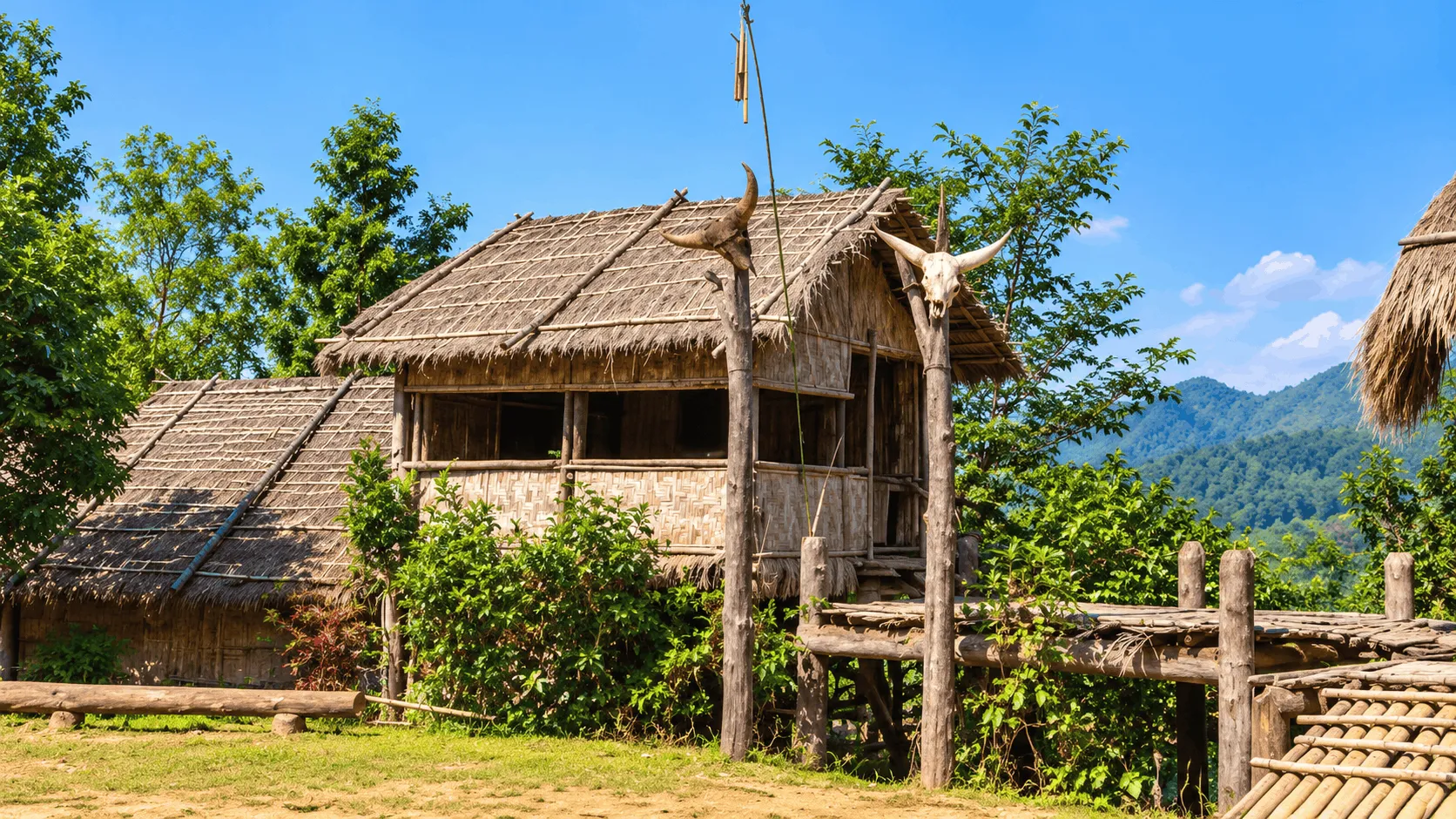
An ethnographic overview describes traditional Mizo houses as built on raised bamboo or wooden poles, with a split or plaited bamboo floor and walls and a thatched roof, and an earthen hearth inside. Wealthier households might use timber planks and corrugated iron. This describes a historical type of house in documented accounts, not the typical home in a modern Mizo town, where concrete buildings stack along the slopes of cities like Aizawl.
Jhum and livelihoods
The Indian Council of Agricultural Research describes jhum, a form of shifting cultivation, as the principal agricultural practice among the Mizo people historically, a cyclic system that involves clearing, burning, cropping and fallow. Today the picture is more varied. Conservation writers describe efforts to curtail jhum and argue instead that it should be supported because of its role in forest regeneration and culture, while others favour alternative land uses. We do not take a position. Many Mizo households today work in public service, trade, farming, education or other jobs, in Mizoram and elsewhere.
Villages after 1966
Ethnographic summaries say that in 1966, during a period of political conflict, many villages were reorganised, resulting in the linear, road-centred layout common in many villages today, with a church, school and shops. If you visit a village, you may see this modern pattern and not the older clustered form.
Clothing, Food and Craft Traditions
Clothing and textiles
Handloom weaving is a living craft. Woven wraps such as the puan carry patterns that can reflect community, occasion or style, and Mizo women wear the puanchei and other garments during festivals such as Chapchar Kut. Patterns and names differ between communities, so a design associated with one group may not belong to all. For more on weaving and how to buy respectfully, see our Mizo Puan and Handloom Guide.
Food
Traditional food is generally simple and based on rice, vegetables and boiled or smoked meat. A scientific article on traditional Mizo food processing describes how smoke and sun were used to preserve food, which reflects practical knowledge developed in a hill environment. Dishes such as bai (a stew), vawksa rep (smoked pork) and bamboo shoot preparations are widely described, and menus vary between households and communities. Our Mizo Food Guide covers dishes and etiquette.
Bamboo and cane
Bamboo and cane have long been used for houses, baskets and household items, and are still made locally. The cheraw dance, performed between clapped bamboo poles, shows how bamboo shapes culture as well as construction.
Historical Change and Contemporary Mizo Identity
Several forces at once
The twentieth century brought a package of changes. Missionary schools and a Roman-script written language changed access to literacy. Mizoram is often cited among India’s most literate states, and many people now live in towns and cities such as Aizawl, so a purely village-centred picture would be misleading. Many Mizo people have also moved for education and work, and Mizo recipes are reported to be travelling beyond the state with them.
History and identity
For many Mizo people, Christianity is part of how identity is understood today. Historical summaries describe Christianity as becoming part of a new cultural and ethnic identity, while other writers point to continuing interest in older customs, languages and crafts. Festivals such as Chapchar Kut are celebrated as markers of heritage, and weaving and music remain important. These are not opposing forces for everyone, and individuals relate to them in different ways.
Avoiding a single story
No one lives “traditionally” in a pure form. A teacher in Aizawl, a farmer in a hill village and a Mizo student in Delhi may each draw on shared history differently. Avoid assuming that anyone you meet follows, or wants to perform, a historical lifestyle.

Diversity Within Mizo Communities
“Mizo” is often used for several related communities, such as the Lusei, Ralte, Hmar and Paite. Their dialects, clan histories, dress and customs are not identical. Mizoram also has other communities with their own identities and institutions, including the Lai, Mara and Chakma, who have autonomous district councils. Our existing guides note that visitors should ask people how they describe themselves and avoid assuming everyone is the same.
There are also differences between town and village, between denominations, between generations, and between households. A statement that is true in one village may not apply in the next. Where this article says “Mizo society,” it refers to broad historical patterns documented in the sources, not to every community or person.
Learning About Mizo Culture Respectfully
- Start with context. The Mizoram State Museum in Aizawl is described in our Aizawl Travel Guide 2026 as an introduction to Mizo history and traditions. Confirm that it is open before you go.
- Listen first. Ask local people, guides and elders how they describe their own history. Expect multiple perspectives.
- Read local authors. Look for books, journals and publications by Mizo and Mizoram-based scholars and writers, as well as colonial-era works.
- Treat oral history as valuable, and as one source. Do not ask people to repeat stories for entertainment.
- Do not demand a performance. Dances, songs and ceremonies belong to the people who practise them. Ask, and accept a no.
- Ask before photographing people, homes, churches and community events. Mizoram’s student body has advised against photographing private residences and churches without permission.
- Avoid “untouched” language. Mizoram is a modern society with a long history. Describing it as timeless or primitive is inaccurate and disrespectful.
- Buy and pay fairly from makers and sellers, and ask about the maker’s community.
- Be careful with sensitive history. Colonial violence, displacement and political conflict are lived memories for some families. Do not push for stories.
Frequently Asked Questions
Where did the Mizo people come from?
Many accounts describe migration from the east through the Chin Hills in present-day Myanmar, but details and dates differ, and oral and written sources do not always agree. No single account is definitive.
What was the zawlbuk?
Historical sources describe it as a hall or dormitory in traditional villages where young unmarried men gathered. It belongs to earlier village life and is not an active institution that visitors should expect to see.
When did Christianity reach Mizoram?
Missionary contact began in the early 1890s, and two missionaries arrived in Aizawl on 11 January 1894, a date commemorated in Mizoram. Historians also note that conversion was a gradual process across the early and mid twentieth century.
What is tlawmngaihna?
It is a Mizo value commonly translated as selflessness or putting the community first. Writers use it to describe how people explain their social ideals, not as a guarantee of behaviour.
Do Mizo people still live in traditional villages?
Many live in villages, but the historical clustered, chief-led village described in older sources no longer exists in that form. Today’s villages and towns include churches, schools, shops and modern housing, and livelihoods are varied.
Are all communities in Mizoram the same?
No. Mizoram has several communities with their own languages, histories and institutions, and customs differ among and within them.
Conclusion
Mizo history is neither a single origin story nor a story of unbroken tradition. It includes migration narratives that vary, chiefdoms, British expeditions, missionary schools, the end of chieftainship, political upheaval and the growth of towns. Present-day Mizo identity draws on that past in different ways, and many people practise a mix of old and new. If you travel with that in mind, you are more likely to ask better questions and to avoid reducing living communities to a museum. For practical planning, return to our Mizoram and Aizawl guides, and keep learning from the people you meet.