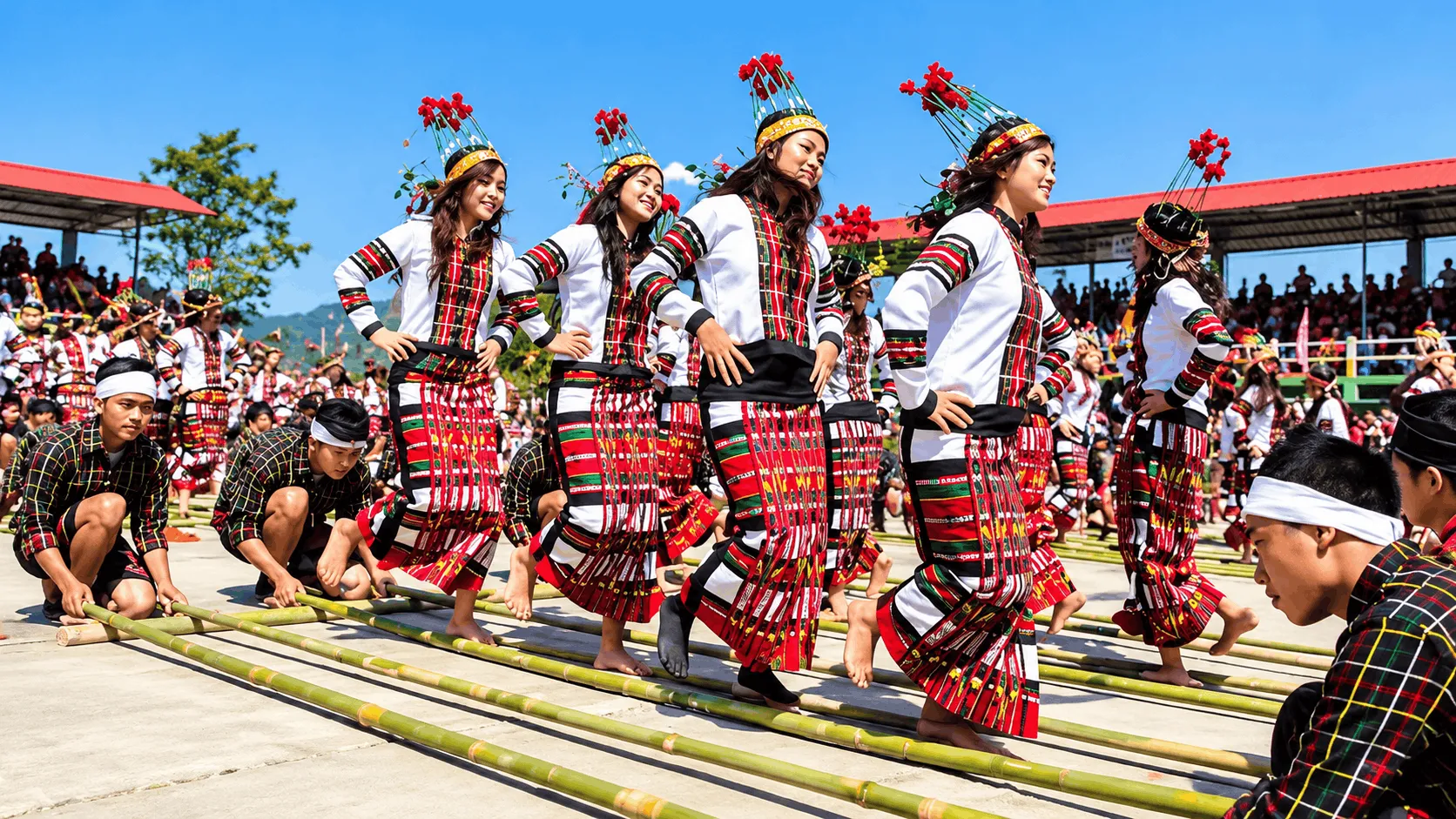
The sound comes first. Before you take in the colours of the costumes, you hear bamboo striking bamboo, a bright, hollow clack that sets the pace for everything else. Then you see the dancers stepping in and out between the poles, one mistimed move away from a trapped foot. Cheraw dance is the best-known bamboo dance of Mizoram, and watching it live is one of the most memorable ways to meet Mizo culture, as long as you understand what you are watching and when you are likely to see it.
This guide explains what Cheraw is, how it is performed, what is and is not known about its history, what the costumes and music involve, where visitors may encounter it and how to plan around events instead of expecting daily shows. It separates verified facts from interpretations, and it names no ticketed performances, venues or schedules, because we could not verify any. For the wider state, see our Mizoram travel guide.
What Is Cheraw Dance?
Cheraw, also called the bamboo dance, is a traditional dance of the Mizo people of Mizoram. According to reference sources, it is usually performed by about six to eight people, though numbers can vary, with pairs of long bamboo poles laid horizontally on the ground over other poles. The poles are struck together and tapped on the ground, producing the rhythm that the dancers follow.
Several cultural sources describe a division of roles. Men sit opposite each other and handle the poles, while women step in and out between them. A feature from People of Northeast says the challenge for the women is to move in perfect synchronisation without getting their feet caught. A cultural catalogue maintained by the University of Hong Kong adds that the dancers move alternately in and out of crossed pairs of staves.
Roles can differ, so treat this as the most commonly described arrangement and not a rule that every performance follows. Many people also describe Cheraw as one of the most recognisable dances of the state, and it appears in the official festival descriptions for Chapchar Kut.

History and Cultural Context
This is where care is needed, because the sources do not agree, and some claims are repeated more often than they are documented.
What is reasonably well supported:
- Cheraw is part of the Mizo festival repertoire. News reports on Chapchar Kut from the Assam Tribune routinely list Cheraw among the dances performed by cultural troupes.
- It is associated with Chapchar Kut, a spring festival celebrated after the clearing of fields for jhum cultivation, according to several sources, including a recent All India Radio report.
- Mizoram's tourism and cultural material describes dances such as Cheraw, Khuallam and Chheih Lam as having evolved out of community participation and not as stage creations.
What is told but not firmly documented:
- A cultural feature and a university catalogue say the dance was traditionally performed in a ritual to comfort the soul of a mother who died leaving a newborn child. The sources say "said to" and "believed", and we found no academic or archival evidence for this. Treat it as an origin story that is told.
- The same feature says the dance has existed since the first century CE. We found no reliable evidence for that date, and we are not repeating it as fact.
- Several sources call Cheraw the oldest dance of Mizoram. That is a popular claim and not an established one.
Interpretations are another matter. People of Northeast reads the dance as symbolising how people move through life's challenges with grace, awareness and agility. That is one writer's reading. It sounds fitting, but it is not evidence of what the dance meant to the people who first danced it.
One more piece of context matters. According to Outlook Traveller, Chapchar Kut and other traditional celebrations were forbidden after Christianity arrived in Mizoram in 1894, because of their links with drinking and older spiritual practices. Today, Christianity is central to Mizo social life, and festival dance is presented as cultural heritage. It helps to remember that when you see Cheraw performed as culture, not worship.
A modern milestone is often mentioned. Mizoram set a Guinness World Record for the largest Cheraw performance in Aizawl in 2010, according to cultural features. Accounts differ on the numbers, from more than 8,000 to over 10,000 dancers, so check Guinness directly if you want a figure.
How the Bamboo Dance Is Performed
The mechanics are simple to describe and difficult to do well.
- Poles are laid out. Pairs of long bamboo poles are placed horizontally on the ground, often over one or two poles set across them, depending on the arrangement described.
- The rhythm begins. People holding the poles open and close them in a steady beat, tapping them on the ground and clapping them together.
- Dancers step in and out. Dancers move between the poles on the beat, stepping into the gap as it opens and out as it closes.
- The pace builds. Many descriptions say the tempo can speed up, which raises the challenge and the energy.
Three things stand out for a viewer. First, the bamboo is the instrument as well as the stage, and the clacking creates the core rhythm, according to reference sources. Second, timing is shared. The people holding the poles and the dancers depend on each other, and a lapse by either puts a foot at risk. Third, the dance is a group effort, with a sense of coordination that matches how Mizo community life is often described.
Music, Clothing and Performance Traditions
Music
The bamboo provides the basic rhythm. Reference sources say modern versions are sometimes accompanied by traditional instruments, including the khuang, a drum, and the darbu, a gong, as well as cymbals. Other sources mention songs and gongs. We could not verify how music is arranged in particular communities, so do not assume any one pattern.
Clothing
Costumes are colourful. The University of Hong Kong catalogue lists the attire of women dancers as including the thihna, vakiria, kawrchei and puanchei. The puanchei is a woven wrap worn at the waist, and the kawrchei is a blouse. We could not verify what the thihna and vakiria look like or how they are worn, so we are not describing them. People of Northeast says men who handle the poles often wear traditional attire that is simpler than the dancers', and a cultural feature mentions a bandana and a Mizo shawl.
Our guide to Mizo puan and handloom explains the textiles in more detail, including the puanchei, and why the weave matters. Costumes vary between groups and events, so treat the details above as typical and not fixed.

Performance Traditions
Cheraw is often performed by cultural troupes at festivals and organised events. Large public performances take place in Aizawl, and smaller ones are held in communities and schools. We could not verify how the dance is taught or passed on, so we avoid claims about that.
Where to See Cheraw Dance in Mizoram
Be realistic. We found no verified, regular tourist show of Cheraw at any named venue, and no ticket arrangements. The best chances are linked to festivals and organised cultural events.
- Chapchar Kut in Aizawl. This is the clearest opportunity. All India Radio reported in March 2026 that tourists from other countries and from other parts of India attended the celebration in Aizawl. Assam Tribune reports from earlier years describe the main celebration at the Assam Rifles ground, with Cheraw among the dances. We could not verify the current venue.
- Other festivals. A cultural catalogue lists three festivals as occasions for Cheraw: Chapchar Kut, Mim Kut and Pawl Kut. Check each locally.
- Cultural programmes. State and community programmes, school and college events and cultural exhibitions may include Cheraw. Ask the Art and Culture Department or the tourism office what is on during your visit.
- Village visits. A host may arrange a performance for a group, but this depends on the community and its wishes. Do not assume it is possible, and do not ask for a show on demand.
Our Aizawl travel guide covers the capital, where most large events are held.
Festivals and Cultural Events
Chapchar Kut is the festival most strongly linked to Cheraw, and the most useful one for visitors to plan around.
According to All India Radio's report on the 2026 celebration, Chapchar Kut is a spring festival held in March in Aizawl, and the week of events included handloom, textile and handicraft exhibitions, food stalls, a flower show and a living museum showing traditional Mizo life. Other sources say the festival is usually held on the first Friday of March. Exact dates change each year, and are announced locally, so do not rely on a date from an old article. Our Chapchar Kut guide explains the festival in more detail: Chapchar Kut Festival guide.
Mim Kut and Pawl Kut are harvest-related festivals. Sources disagree on when Mim Kut falls, with some giving July to August and others November or early December, so we are not stating a month. Pawl Kut is usually placed around December. We could not verify visitor arrangements for either.
In every case, festivals are community events first and tourist attractions second. Dates, venues and programmes are set by organisers and can change.
Travel Planning and Visitor Tips
- Plan around events, not around the dance. Decide whether you want to be in Aizawl for Chapchar Kut, and then confirm the dates once they are announced.
- Book early. Festival weeks can fill accommodation and transport in Aizawl, though we could not verify the level of demand.
- Check permits. Visitors from other parts of India have generally needed an Inner Line Permit to enter Mizoram, and foreign nationals have separate arrangements. Local reporting in 2026 said new guidelines had been approved, with details not fully published at that time, so confirm before you travel.
- Ask locally. The Art and Culture Department and the tourism office are the best sources for programmes and any visitor arrangements.
- Arrive early at large events, and expect crowds. Carry cash, water and a light layer.
- Allow for weather. Spring can bring rain, and outdoor events may change at short notice.
- Remember Sundays. Mizoram is quiet on Sundays, and events are generally planned around that.
- Keep a spare day. If an event is moved, you can adjust.
Photography and Cultural Etiquette
Cheraw is a performance, and the dancers are people with families, jobs and views about how they are seen.
- Ask before photographing individual dancers up close, especially away from the main arena. In a public festival crowd, wide shots are generally expected, but a close portrait still deserves a nod or a word.
- Do not step into the performance area, touch the poles or stand where you block the audience or other photographers.
- Turn off flash. It distracts performers and can be a hazard to dancers watching their footing.
- Ask before flying a drone, and follow any rules the organisers set.
- Do not pay or ask performers to pose in the middle of a show, and do not ask for a private show.
- Do not treat the dance as a costume party. Do not dress in traditional clothing for photographs unless you are invited and know what is appropriate.
- Respect church and Sunday routines, and keep noise low near places of worship.
- Support the community by buying from local sellers and hiring local drivers or guides.
- Avoid generalising. Mizoram has more than one community, and practice differs between groups.
Frequently Asked Questions
What is Cheraw dance?
Cheraw is the bamboo dance of the Mizo people of Mizoram. Pairs of bamboo poles are struck together and tapped on the ground to set the rhythm, while dancers step between them.
How many people perform Cheraw?
Reference sources describe about six to eight dancers, though numbers can vary. Large public performances can involve many more.
Where does Cheraw dance come from?
Its exact origin is not documented. Cultural features tell a story of a ritual linked to a mother who died leaving a newborn, but we found no firm evidence, so it should be treated as an origin story.
When can I see Cheraw dance in Mizoram?
Most likely during festivals and cultural events, especially Chapchar Kut in March in Aizawl. Check dates and programmes locally, since we could not verify them.
Is there a regular Cheraw show for tourists?
We found no verified regular show or ticketed performance. Do not assume performances happen daily, and ask the tourism office or Art and Culture Department.
What do Cheraw dancers wear?
Women's costumes are described as including the puanchei and the kawrchei, along with other items. Men who handle the poles often wear simpler traditional clothing. Details vary between groups and events.
Can I photograph Cheraw performers?
Wide shots at public festivals are generally fine, but ask before taking close portraits, turn off flash and do not enter the performance area. Ask before using a drone.
Conclusion
Cheraw dance rewards visitors who come curious and unhurried. The bamboo rhythm, the shared timing and the colourful costumes make it easy to enjoy, and a little context makes it richer. Be honest about what is known and what is only told, plan around festivals such as Chapchar Kut instead of expecting regular shows, and treat performers as people sharing something that belongs to their community. If you do, you will leave with more than a photograph.