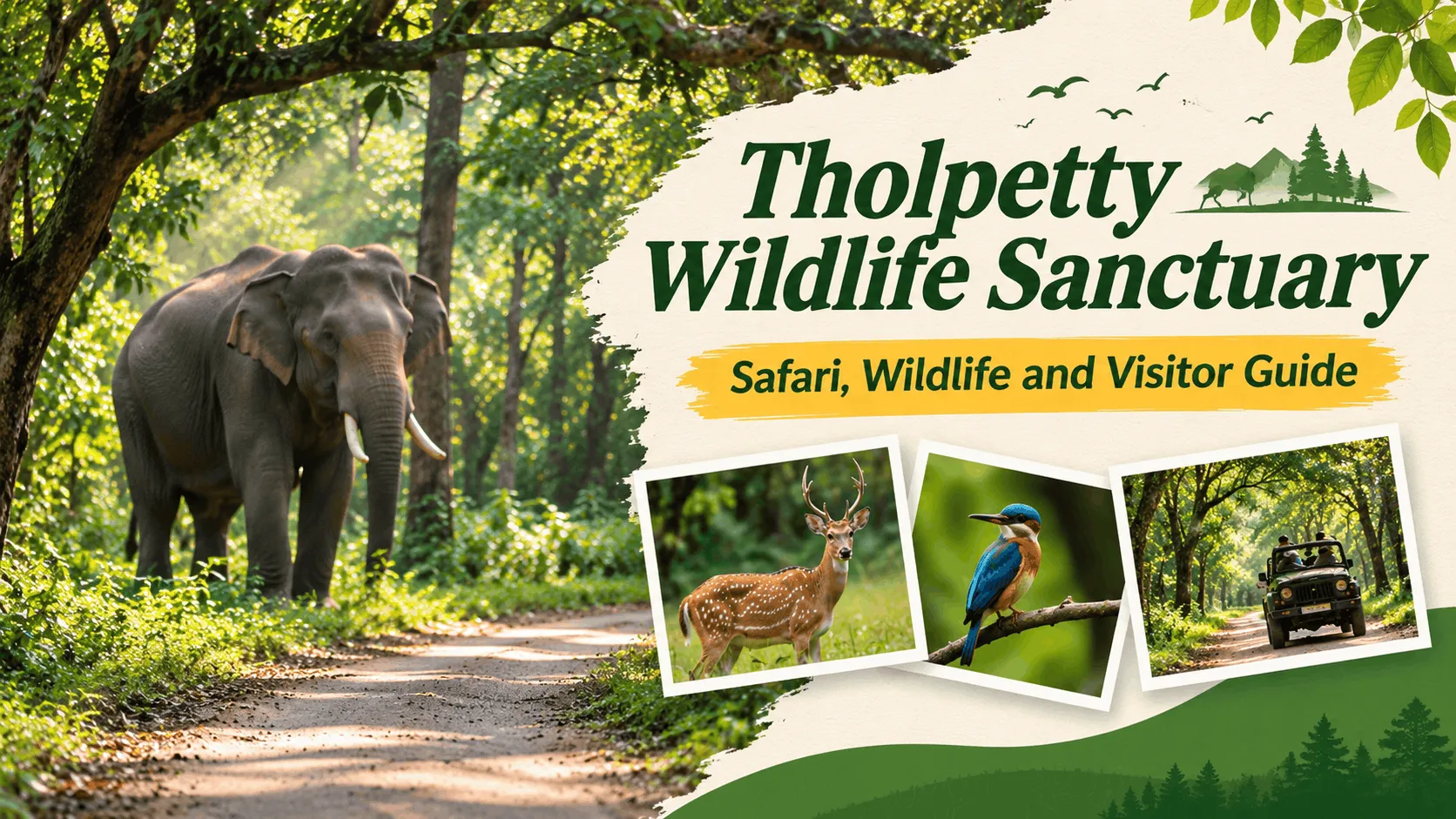
Tholpetty forest in Wayanad, Kerala, sits in the far north of the district, a short drive from the Karnataka border. It is one of the two safari ranges of the Wayanad Wildlife Sanctuary, the other being Muthanga in the south. The forest is part of a large, connected stretch of protected land, which is why elephants, deer and gaur are the animals people most often talk about. Nothing is guaranteed in a wild forest, though. This guide covers where Tholpetty is, why it matters for conservation, what you might see, how the jeep safari works, and what to confirm before you travel.
Where is Tholpetty Wildlife Sanctuary?
Tholpetty is not a separate sanctuary. It is a range of the Wayanad Wildlife Sanctuary, which Kerala Tourism describes as two discontinuous pockets: Muthanga in the south and Tholpetty in the north, next to Thirunelli. Together they cover about 344 square kilometres. Different official and tourism sources give slightly different figures, from 344.44 to 345 square kilometres, so treat the area as approximate.
Tholpetty lies beside the Nagarhole range of Karnataka. Kutta, a town across the state line, is only a few kilometres away. This is the part of Wayanad that people mean when they say "North Wayanad wildlife", and it is separate from Muthanga near Sulthan Bathery. If you are comparing the two, remember that they are run as separate visitor experiences with their own counters and slots.
Why the location matters
The sanctuary forms part of the Nilgiri Biosphere Reserve and is listed as part of Elephant Reserve No. 7 of South India. It adjoins Nagarhole and Bandipur in Karnataka and Mudumalai in Tamil Nadu. Because the forests link up, large animals can move between states, and that movement is a big reason the area is protected.

History and conservation importance
The Wayanad Wildlife Sanctuary was declared in 1973 and is the second largest in Kerala. It has four ranges: Tholpetty, Muthanga, Sulthan Bathery and Kurichiat. Only Tholpetty and Muthanga are set up for visitors.
According to a Kerala Forest Department document, the sanctuary is the only one in Kerala where four-horned antelope sightings are reported, and it holds the last remaining habitat of the state's critically endangered vulture population. The same document notes the presence of tribal groups such as the Paniya and Kattunayaka. It also lists a wide set of protection measures, among them elephant-proof trenches, solar fencing and numerous water holes and check dams.
The land around Tholpetty also has a human story, since the Mananthavady and Thirunelli area was central to the resistance led by Pazhassi Raja against colonial rule. Our history of Wayanad explains that background if you want context for the region you are driving through.
Wildlife in Tholpetty forest, Wayanad, Kerala
The Kerala Forest eco-tourism portal says visitors may see elephants, gaur, deer, monkeys, tigers, leopards, bears, vultures, reptiles, butterflies and birds in the sanctuary. "May see" is the important phrase. That list describes what lives in the forest, not what any single safari will show.
| Animal group | What sources report | How to read it |
| Asian elephant | The best-known animal here, and the sanctuary is part of Project Elephant | Sightings are possible but never promised |
| Gaur and deer | Listed on the official portal | Often seen at forest edges, but varies by day and season |
| Monkeys and giant squirrels | Reported by travel sources | Easier to spot than large mammals |
| Tiger and leopard | Listed as present | Rare. Treat any sighting as luck |
| Birds and vultures | Vultures are noted in the forest department document | Better in quieter, early hours |
Elephants, deer and birds
Elephants move through this landscape widely, including across the state border, so a herd may be on the safari route one morning and gone the next. Deer and monkeys are easier to see, and birds depend heavily on the hour and the season. Do not rely on a published probability. No source we found backed such numbers with survey data, so we have not listed any.
A few sites also say the forest is notable for its Malabar giant squirrels and hornbills. These are plausible, yet the claims come from tourism pages rather than the forest department, so treat them as a bonus rather than a promise.
Seasonal differences
In the dry months animals gather near water, and the thinner undergrowth can improve visibility. After the monsoon the forest is thick and green, and animals spread out. Heavy rain falls roughly from June to August, with the sanctuary receiving around 2,200 mm a year, so visibility can be poor and tracks wet then.
Safari experiences and activities at Tholpetty
The main activity is a guided jeep safari run by the Forest Department. Private vehicles are not generally permitted in the safari zone, so you hire a registered jeep at the entrance. A Forest Department guide travels with each group, and the official portal says a jeep carries up to seven people.

Safari routes, duration and visitor experience
Sources describe the safari as lasting about one and a half to two hours. The route follows forest tracks inside the permitted zone, and the jeeps are the only way to go further in. Exact routes can change with the season, and we found no official map of the track. Expect a bumpy ride and plenty of stops for the guide to point things out.
Reports differ on the details of the afternoon slot, so treat the figures below as a starting point.
| Detail | What is reported | Confirm before you go |
| Morning safari | 7:00 am to 10:00 am, listed on the official portal | Whether slots are still running that day |
| Afternoon safari | Between 2:00 pm and 5:00 pm, depending on the source | The exact start time |
| Duration | About 1.5 to 2 hours | Group size and conditions |
| Group size | Up to 7 per jeep | Any change in the limit |
Visitor information, booking, fees and timings
Fees are the least reliable part of any Tholpetty guide, because sources quote very different numbers and many pages are old. The Kerala Forest eco-tourism portal listed the following for its morning safari at the time of research:
- Indian adult: ₹150
- Indian child: ₹65
- Foreign visitor: ₹360
- Jeep hire: ₹900 per jeep, paid directly to the driver in addition to the entry ticket
Other sites list lower or higher prices, and some bundle the ticket and the jeep. Camera and guide charges have also been reported on some pages. We cannot verify which figures apply on the day you visit, so check the official portal or call the range office. The portal lists a booking page for the morning safari, while other guides say tickets are sold at the counter near the entrance on a first-come basis. Confirm whether online booking is open and whether slots can sell out.
Practical points reported by several sources:
- Arrive 30 to 45 minutes before the slot.
- Carry a photo ID.
- Plastic is not allowed inside.
- The Wayanad Wildlife Division at Sulthan Bathery is the permitting authority for the sanctuary.
The forest can also close for a few weeks in the dry summer fire season, generally between March and May. Check with the forest office if you plan to visit then.
Best time to visit Tholpetty
| Period | What to expect |
| October to February | Pleasant weather and, according to most guides, the most comfortable window for safaris |
| March to May | Hotter, and the forest may close for fire-season measures. Water holes can draw animals. |
| June to September | Heavy rain, dense growth and wet tracks. Safaris may be disrupted. |
Early morning is generally recommended, since animals are more active in cool hours. Even so, a quiet drive with no large animal is a normal outcome in a real forest.
How to reach Tholpetty from major Wayanad locations
Tholpetty is in the Thirunelli panchayat. Wayanad has no airport or railway station of its own, so you reach the district first and drive on. Our guide to the nearest railway station to Wayanad compares Kozhikode, Thalassery, Kannur and Mysuru as gateways.
Approximate road distances, which vary a little by source:
| From | Distance |
| Mananthavady | About 20 to 24 km |
| Kalpetta | About 49 to 59 km |
| Sulthan Bathery | About 55 km |
| Kozhikode | About 123 km |
From Mananthavady, the road goes through Kattikkulam and then on to Kutta and Tholpetty. Buses run on that road, but a taxi or a self-drive car gives you more control over safari timing. Wildlife can be on the road in this stretch, so avoid night driving and drive slowly.
Nearby attractions and wildlife destinations
The Thirunelli temple lies roughly 13 km from the sanctuary and is easy to pair with a safari. Pakshipathalam, a forest trek near Thirunelli, needs permission from the forest office. Kuruva Island on the Kabani river is another forest-edge stop, and it also follows Forest Department rules. Across the border, Nagarhole National Park is a separate destination with its own entry rules. To see how a safari fits into a longer trip, use our Wayanad Travel Guide: Itinerary, Routes and Local Experiences.
If you want a meal after an early safari, local eateries around Mananthavady and Kattikkulam serve regional food, and our Wayanad food guide explains dishes worth trying. Muthanga, the southern range of this sanctuary, is a separate trip and should not be mixed up with Tholpetty when you plan your day.
Responsible wildlife tourism and forest safety
- Stay in the jeep unless the guide says otherwise.
- Never feed, call, chase or approach an animal, including monkeys.
- Keep voices low, and switch off flash and loud camera sounds.
- Do not leave litter, and carry out any plastic you bring in.
- Follow the guide's instructions, particularly if elephants are close.
- Do not drive at night on forest roads, where elephants cross.
- Keep a respectful distance from nearby tribal settlements and ask before taking photographs of people.
- Avoid any operator who promises guaranteed sightings or offers to get you closer to animals.
Frequently asked questions about Tholpetty Wildlife Sanctuary
Where is Tholpetty Wildlife Sanctuary located?
Tholpetty is the northern range of the Wayanad Wildlife Sanctuary, in the Thirunelli area of Wayanad, near the Karnataka border. It lies roughly 20 to 24 km from Mananthavady.
What animals can visitors see at Tholpetty?
The forest department lists elephants, gaur, deer, monkeys, tigers, leopards, bears, vultures and many birds, reptiles and butterflies as living in the sanctuary. Sightings are never guaranteed, and tigers and leopards are rarely seen.
Is safari available at Tholpetty Wildlife Sanctuary?
Yes. The Forest Department runs guided jeep safaris, usually in a morning and an afternoon slot. Confirm timings and availability before you travel.
What is the best time to visit Tholpetty?
October to February is generally the most comfortable window. The monsoon brings heavy rain, and the forest may close for some weeks during the dry fire season.
How can visitors book a safari?
The official eco-tourism portal lists a booking page for the morning safari, and several guides report on-the-spot ticketing at the entrance counter. Check which method is active, arrive early and carry ID.
How far is Tholpetty from major Wayanad destinations?
Roughly 20 to 24 km from Mananthavady, 49 to 59 km from Kalpetta and about 55 km from Sulthan Bathery. Exact figures differ by route and source.
Are there restrictions for visitors entering the sanctuary?
Yes. Entry is regulated by the Forest Department, private vehicles are generally not allowed in the safari zone, plastic is prohibited, and visitors must follow the guide. Feeding or approaching animals is not allowed.
Conclusion
Tholpetty forest in Wayanad, Kerala, rewards patience more than expectation. Go in the cooler months if you can, book an early slot, confirm fees and timings with the Forest Department, and treat every sighting as a gift. A calm, respectful visit protects the animals and gives you the best chance of a memorable morning.
If you want a Wayanad trip that combines wildlife, culture and local food, Tribal Discovery Tour can help you plan one around your dates. Reach out to us and start discovering Wayanad's wildlife the responsible way.