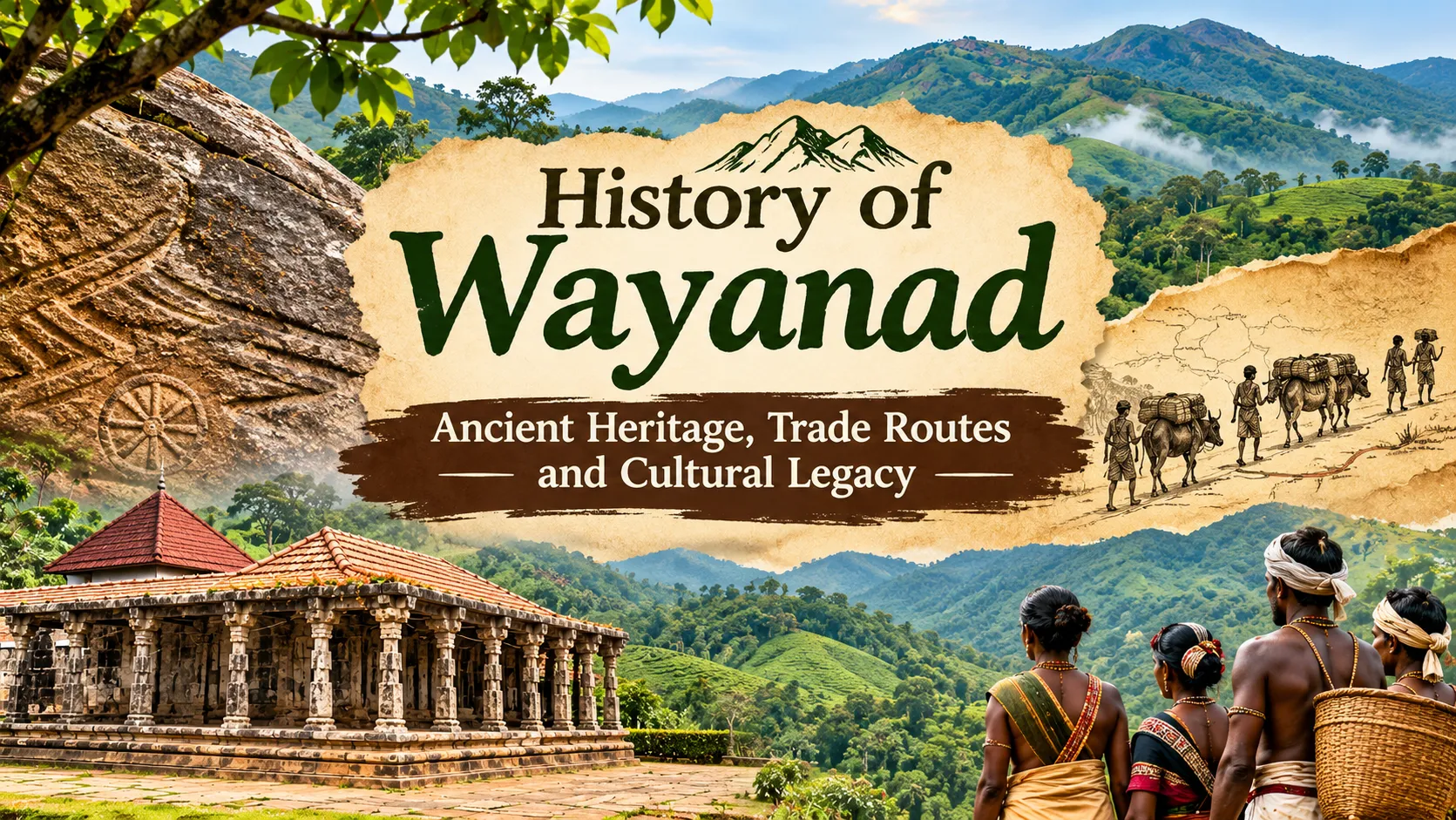
Wayanad history runs from Stone Age rock engravings to a long guerrilla campaign against the East India Company, and a good deal of it can still be seen on the ground. The district lies on a plateau in the Western Ghats of northern Kerala, at roughly 700 metres above sea level, with Karnataka and Tamil Nadu close by. That position made it a crossing point between the Mysore highlands and the Malabar coast long before modern roads arrived.
This guide keeps documented evidence apart from local tradition and says so where sources disagree. It ends with the places where you can see this history for yourself.
Wayanad history at a glance
Official district sources say written history for Wayanad is available mainly from the 18th century, so earlier periods rest on archaeology, inscriptions and tradition. Dates before the 18th century below are approximate or debated.
- Neolithic period (estimates range from about 6000 BCE to 1000 BCE): rock engravings at Edakkal Caves.
- About the 5th or 6th century CE: an inscription naming a chieftain called Vishnuvarma is recorded at Edakkal.
- From about the 10th century: inscriptions point to Jain settlements and to rulers such as the Kadambas of Bayalnad, the older name for the region.
- Later 18th century: Hyder Ali and then Tipu Sultan extend Mysore's power over Malabar, and Pazhassi Raja resists.
- 18 March 1792: the Treaty of Seringapatam transfers Malabar to the British.
- 30 November 1805: Pazhassi Raja is killed at Mavilanthode.
- April 1812: the Kurichiya and Kuruma communities rise against colonial rule.
- 1 November 1980: Wayanad becomes Kerala's 12th district.
Ancient settlements and early human presence
Evidence of Stone Age life turns up across the district rather than at a single site. Historians estimate that people have lived in these hills for at least ten centuries BCE, and excavations in the Edakkal hills have produced traces of settlement from around then. Megalithic burial sites have been recorded about seven kilometres west of the hills and at Chingeri in Ambalavayal village, which point to communities living here over a long period.
The name Wayanad is usually explained as Vayal Nadu, the land of paddy fields. Another account traces it to an older name, Mayakshetra, which became Mayanad and then Mayyanad. Neither derivation settles the question.
Edakkal Caves: prehistoric heritage and rock engravings
Edakkal Caves are two natural rock shelters on Ambukuthi Mala, near Ambalavayal in the Sulthan Bathery area. The name is often translated as "a stone in between", a reference to a boulder wedged in a cleft that forms the roof. The site is close to an ancient route linking the Mysore highlands with ports on the Malabar coast.

What the carvings show
The engravings include human figures, animals, tools, wheeled carts, stars and geometric symbols, along with signs nobody has deciphered. Researchers describe at least three groups of petroglyphs made at different times, so the shelter was used on several occasions.
How old they are, and what is still debated
Fred Fawcett, a police official in the Malabar district, brought the site to scholarly attention. Sources give 1890 as the year of discovery and 1901 for the first scholarly article.
Dates for the carvings vary. Many sources place them between about 6000 BCE and 1000 BCE, and some say the oldest may be more than 8,000 years old. Other accounts give 4000 to 1000 BCE. Engravings on rock are hard to date directly, so treat any single figure as an estimate.
In 2009 the historian M. R. Raghava Varier identified a "man with jar cup" motif that resembles a symbol from the Indus Valley, and the epigraphist Iravatham Mahadevan called the finding significant. A resemblance of this kind is an interpretation, and it does not prove direct contact between the two regions.
Later inscriptions
Edakkal also holds later inscriptions, including Tamil Brahmi writing and one naming a chieftain Vishnuvarma, usually dated to about the 5th or 6th century CE. Sources differ on its language and on his dynasty or clan.
Trade routes and commerce
Wayanad sits on the plateau side of the Western Ghats, and the routes through those hills shaped its commercial history. District sources describe the Jain temple at Sulthan Bathery, believed to date to the 13th century, as a shrine and an important centre of commercial activity before it became an ammunition store.
The best-known trade road is the Thamarassery ghat road. Kerala Tourism says it was developed in the British period to carry spices from Wayanad down to Beypore Port near Kozhikode, and other accounts mention an earlier route through Kuttiady. Some sources credit a first ghat road to Hyder Ali's rule, which the British later improved. Tradition also says a Paniya leader named Karinthandan showed the British the route and was later killed, and the Chain Tree at Lakkidi is tied to that story. Dates for the legend range from the early 1700s to the 1800s, so read it as oral tradition. For the pass as it is today, see our guide to Thamarassery Churam in Wayanad.
Wayanad under different kingdoms and rulers
The Veda tradition
District sources say that in ancient times the land was ruled by rajas of the Veda tribe. Written evidence is thin. A popular account holds that the Vedar kings were defeated by Kottayam and Kurumbranad in the late 14th or early 15th century, but this is tradition rather than a documented sequence of events.
Bayalnad and its overlords
Compilations of regional inscriptions describe Wayanad, under the name Bayalnad, as passing between several powers. In these accounts the area lay within the orbit of the Ezhimala kingdom, then came under the Gangas, the Kadambas (11th and 12th centuries), the Hoysalas (who annexed Bayalnad in 1104 CE) and Vijayanagara feudatories. In 1610 the Wodeyars of Mysore took over. These dates come from secondary compilations, so check specialist sources before quoting them.
Jain heritage
Jain centres and farming villages are said to have appeared in Wayanad around the 10th century. A Kannada inscription dated 1684 at Varadur, near Panamaram, records grants to Jain basadis in Wayanad and shows the community was still prominent in the 17th century.
Kottayam and the Pazhassi dynasty
By the end of the 17th century the rajas of Kottayam in north Malabar held North Wayanad. Earlier, inscriptions at Thirunelli from the early 11th century mention the Puraikizhar family, rulers of the older Puraikizhanad region that included Wayanad. The Pazhassi rajas were a branch of the Kottayam family and later led the resistance to British rule.
Colonial-era history and changes in administration
Pazhassi Raja and the Cotiote War
Kerala Varma Pazhassi Raja fought Hyder Ali's forces in the 1770s and later agreed to help the British against Tipu Sultan. After the Treaty of Seringapatam in 1792 the British installed another member of his family as Raja of Kottayam, and the relationship broke down. When Tipu fell in 1799 the Company moved to take Wayanad, and fighting resumed in 1800. British records called it the Cotiote War, an anglicised form of Kottayam.
Pazhassi Raja withdrew into the forests of Wayanad and fought a guerrilla war. Kurichiya and Kuruma bowmen served in his force, according to community histories, and helped him find places to shelter. He was killed on 30 November 1805 at Mavilanthode, and his tomb in Mananthavady marks the place where he was cremated.
A new administrative map
After 1792 the Company administered Malabar, and Wayanad became a taluk of Malabar district. Accounts differ on who held Wayanad in the years around 1792 and 1799. In 1877 the Gudalur and Pandalur areas, sometimes called south-east Wayanad, were transferred to the Nilgiris district. Wayanad remained a separate revenue division within Malabar until 1924.
After Independence, Wayanad became part of Kerala in 1956 despite a claim by Mysore state. The two halves of the old taluk, North and South Wayanad, were joined to form the present district on 1 November 1980, with Kalpetta as headquarters.
Roads and plantations
Under British rule, roads across the ghats to Kozhikode and Thalassery opened the plateau to tea and other cash crops, and coffee cultivation is said to have begun in this period. Settlers from other parts of Kerala followed in what is known as the Malabar migration, which ran from the early 20th century into the 1980s. Several plantation-era buildings survive, and the Wayanad Tea Museum near Pozhuthana, housed in a former tea factory, is one place to see how tea was processed.
Indigenous communities and their historical connection with the land
Adivasi communities make up about 17 percent of the district's population, according to 2011 census figures cited by researchers. The main groups are the Paniya, Adiyan, Kattunayakan, Kuruma and Kurichiya, each with its own history and customs.
The Kurichiya are the second largest adivasi community in the district. A traditional account says the name was given by the Raja of Kottayam in recognition of their skill with the bow. The Kuruma are believed by tradition to descend from the Vedars, and they were historically divided into groups by occupation, such as bamboo collectors, honey collectors and woodcutters.
Both communities supported Pazhassi Raja's campaign. In April 1812, after the Raja's death, Kurichiya and Kuruma fighters rose against the colonial government over land confiscation and taxes, and many were killed. The event is remembered as the Kurichiya revolt. Early written descriptions come largely from colonial officials such as William Logan and Edgar Thurston, so community oral traditions matter when you read this history.
Traditional agriculture, livelihoods and cultural heritage
Rice has shaped life in Wayanad for a long time. Historic accounts record that the Kurichiya and Kuruma practised shifting cultivation known as punam, and their festivals, including Thulapathu, Puthari and Uchal, mark planting and harvest. Mullu Kuruma communities built traditional wells called kenis, lined with hollowed palm trunks. Farmers such as Cheruvayal Raman, honoured by the Government of Kerala, have kept dozens of traditional paddy varieties in cultivation.
Paddy land in the district fell from about 30,000 hectares in 1985 and 1986 to about 8,000 hectares in 2015 and 2016, according to Agriculture Department figures cited by researchers, as commercial crops and settlement expanded. For how this farming heritage appears on the plate, see our guide to Wayanad famous food.
Historical monuments and heritage locations to explore
Opening hours and entry rules change, so confirm them locally before you go.
- Edakkal Caves, near Ambalavayal: the prehistoric engravings described above, reached by a climb up Ambukuthi Mala.
- Wayanad Heritage Museum, Ambalavayal: tools, weapons, pottery and carvings gathered from Wayanad, including Neolithic axes and 13th to 14th century hero stones.
- Jain temple, Sulthan Bathery: a stone temple believed to date to the 13th century. Tipu Sultan's use of it as a battery gave the town its present name; it was earlier called Ganapathivattam.
- Pazhassi Raja's tomb, Mananthavady: a memorial at the place where he was cremated. A Pazhassi Raja Museum is also listed in the same area.
- Thirunelli Temple: an ancient riverside temple in the forested hills near the Brahmagiri range, described by district sources as a fine example of classical Kerala temple architecture.
- Lakkidi and the Chain Tree: the top of the Thamarassery ghat road and the site of the Karinthandan legend.

How Wayanad's history shapes its identity and tourism today
The caves, the Jain temple, the plantation roads and the memorials to Pazhassi Raja each belong to a different layer of the past, and seeing them in order gives a trip a clear thread. If you are planning that kind of route, our Wayanad travel guide with itineraries and routes shows how to fit these sites around the district's roads.
Visiting communities needs care. Kerala Tourism's community trail guidance asks visitors to follow the guide's instructions and to get consent before photographing people. Ask before entering any hamlet or place of worship, and treat festivals and rituals as living practice rather than a show.
Frequently asked questions about Wayanad history
What is the history of Wayanad?
Wayanad has Stone Age rock engravings at Edakkal, a medieval period shaped by Jain settlements and regional dynasties, and an 18th century struggle among Mysore, the Kottayam rajas and the British.
What is the earliest evidence of human settlement in Wayanad?
The Edakkal petroglyphs are the best-known evidence, with estimates for the carvings ranging from about 6000 BCE to 1000 BCE depending on the source. Megalithic burial sites and excavations in the Edakkal hills add to the picture.
Which historical sites can visitors explore in Wayanad?
Edakkal Caves, the Wayanad Heritage Museum at Ambalavayal, the Jain temple at Sulthan Bathery, Pazhassi Raja's tomb at Mananthavady and Thirunelli Temple. Check access and timings locally.
What is the historical importance of Edakkal Caves?
They hold some of the few known Stone Age carvings in South India and show repeated human use over thousands of years. Interpretations of the later inscriptions and the Indus-style motif are still debated.
Which rulers governed Wayanad in the past?
Tradition names the Vedar kings. Inscription-based accounts mention the Kadambas, Hoysalas, Vijayanagara feudatories and the Wodeyars of Mysore. Later the Kottayam rajas, Hyder Ali, Tipu Sultan and the British all held it at different times.
How did trade influence Wayanad's history?
Routes between the Mysore plateau and the Malabar ports passed near the district, and spices later moved down the ghats to Beypore. Roads built for that trade also opened the plateau to plantations.
What is the cultural significance of Wayanad's indigenous communities?
They are among the district's oldest living cultures, with distinct festivals, farming practices and knowledge systems. Kurichiya and Kuruma fighters played a major part in the resistance to colonial rule.
Conclusion
Wayanad history is easiest to understand on the move: a carved rock shelter in the morning, a Jain temple in the afternoon, a hill road to the ghats by evening. Each stop adds a layer, from prehistoric engravings to Pazhassi Raja's rebellion and the plantation roads that followed.
If you would like to see these places with someone who knows the district and its communities, Tribal Discovery Tour can help you plan a heritage journey through Wayanad at a pace that suits you.