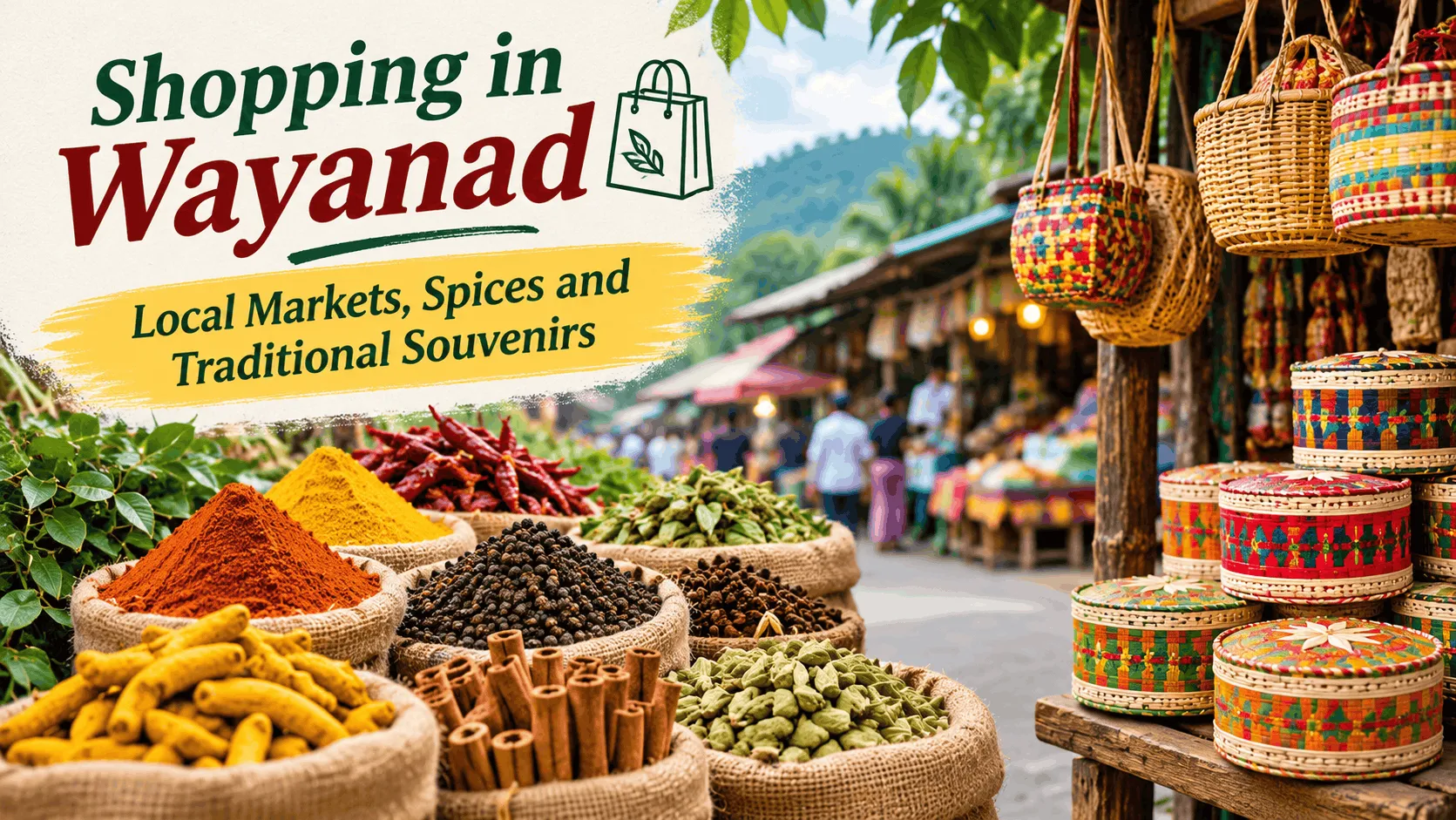
Shopping in Wayanad is less about malls and more about what the hills produce: coffee grown under shade trees, spices from home gardens, scented rice, honey and bamboo goods. The district has three municipal towns, Kalpetta, Sulthan Bathery and Mananthavady, and each has the market streets where everyday buying happens. A few community enterprises and farmer-run shops add products you will not find in a city souvenir store. This guide explains where to look, what is genuinely local, and how to buy with care.
What makes shopping in Wayanad different
Many Kerala destinations are known for one headline craft, such as boat-shaped models or coir mats. Wayanad is different because its best purchases are agricultural. The district is the centre of Kerala's coffee growing, and its slopes also carry pepper vines, tea, spices and two aromatic rice varieties. The handicraft side is smaller and tied to bamboo and community-run workshops.
That mix has a practical effect. Prices and quality depend on the season and the maker far more than on a single "market rate". It also means you can often meet the person who grew or made what you are buying, which is hard to do in a larger city.
Wayanad has no tradition of a single central bazaar. Buying happens across several towns and roadside outlets, so a little planning saves time. Our Wayanad Travel Guide: Itinerary, Routes and Local Experiences helps you place shopping stops along your route.
Popular local markets and shopping areas
| Place | What it is known for | Notes |
| Kalpetta | District headquarters with a town market street and shops selling spices, clothing and household goods | A practical stop for supplies and packaged local products |
| Sulthan Bathery | One of the busiest commercial towns in the district, with markets and shopping complexes | Reported for spices, coffee, textiles and small crafts |
| Mananthavady | A third municipal town, with shops stocking cooperative and tribal-linked products according to one source | Worth a look if you are heading to Tholpetty or Thirunelli |
| Plantation roadsides | Shops along routes such as Kalpetta to Meppadi | Sell packed spices, tea and coffee; quality varies |
We have not listed market days or opening hours. Sources disagree on timings, and we could not verify them, so ask your hotel or check on arrival. Shop and complex names also change, so use a map app to confirm a specific address before you travel.
Spices in Wayanad
Spices are the most common souvenir, and the district's farms grow a mix of black pepper, coffee and other crops together. Fresh pepper, cinnamon, clove and turmeric are widely sold in town markets and estate shops. Cardamom is sold here as well, though it is worth knowing that much of Kerala's cardamom comes from the neighbouring hills of Idukki, so a Wayanad label is not automatic proof of where it was grown. Ask the seller where the batch came from.

A few ways to buy well:
- Look at whole spices rather than powders. Whole pepper, cinnamon sticks and cloves keep their aroma longer and are harder to adulterate.
- Smell before you buy. A strong, clean scent is a better guide than a bright colour.
- Buy small packs first and compare before you commit to a large quantity.
- Ask for a packing date or a batch label on sealed packs.
One source describes a farmer-run spice outlet in Sulthan Bathery. We could not confirm its details independently, so treat it as a lead to check rather than a fixed recommendation.
Coffee, tea and locally produced food
Wayanad Robusta Coffee carries a Geographical Indication (GI) tag, and the district accounts for roughly 70 per cent of Kerala's coffee output according to published figures. Sources give different years for the registration, with the official GI register listing it in 2018 to 2019, so we have not quoted a single date. Coffee reached these hills through British plantation companies in the early nineteenth century, a story we touch on in our history of Wayanad.
For buyers, the practical points are these:
- Robusta has a fuller, stronger profile than Arabica, and it is often used in blends and filter coffee.
- Buying whole beans from a roaster or estate shop gives you more control than a pre-ground pack.
- A GI claim on a label should name Wayanad Robusta. A vague "Wayanad blend" may include coffee from elsewhere.
Tea is also sold, but we cover tea estates in a separate article, so here it is enough to say that packed tea is available from estate shops and town stores.
Two scented rice varieties, Wayanad Jeerakasala and Wayanad Gandhakasala, were both registered as GI products in 2010 to 2011. Jeerakasala is described as resembling cumin seed in shape and aroma, while Gandhakasala is described as having a sandalwood-like fragrance. Rice is heavy, but a small bag works as a souvenir. For dishes to cook with it and what to eat while you are in the district, see our Wayanad food guide. Honey is another common item. Ask where it was collected and whether it is raw, since quality differs widely.
Handicrafts, bamboo products and handmade souvenirs
The handicraft options in Wayanad are narrower than in a craft-heavy state capital, and bamboo leads. Uravu, at Thrikkaipetta near Kalpetta, is the most frequently named place. Sources describe it as a community-based organisation that began as an indigenous science and technology study centre in 1996 and promotes bamboo livelihoods for rural people. Its range is reported to include baskets, trays, lampshades, kitchen accessories and decorative items, and it has a bamboo grove with guided walks. Visitors should confirm opening hours and whether workshops are running, since sources quote different times.
Other items you may see include coconut shell crafts, handloom textiles and wooden articles. Quality varies, and a mass-produced item can be sold next to a handmade one. Look for tool marks, uneven weaving and the maker's name or a cooperative label. Machine-perfect finish across a whole shelf suggests factory production.

Indigenous crafts and cultural context
Wayanad has a large population of Adivasi communities, among them the Paniya, Kurichiya, Kuruma, Adiyan and Kattunayakar. Their traditional skills include bamboo and cane work, forest gathering and farming, and some community-run enterprises sell products made by members of these groups. Sources suggest basketry, honey and herbal products are typical.
Be careful with labels, though. Shops sometimes market ordinary goods as "tribal" without any link to a community. A reliable sign is a named cooperative, a community-run centre or a maker who can tell you where the product comes from. At En Ooru in Vythiri, a tribal heritage village run with community participation, visitors can learn about local traditions before deciding what to buy. Our guide to En Ooru explains what the village offers.
Some practical respect points:
- Ask before photographing artisans or their work.
- Pay the price asked at community-run centres, since those margins fund the group.
- Do not assume a design or pattern belongs to a particular community unless the seller says so.
- Treat any claim that an item is "authentic tribal art" as something to ask about, not something to accept.
What to buy in Wayanad
| Item | Why it suits Wayanad | What to check |
| Robusta coffee beans | Wayanad's best-known product, with GI protection | Whole beans, roast date, a clear Wayanad origin on the label |
| Whole spices | Pepper, cinnamon, clove and turmeric are widely sold | Aroma, freshness, where the batch was grown |
| Scented rice | Jeerakasala and Gandhakasala are GI-registered | A sealed pack with the full GI name |
| Honey | Commonly sold as a local product | Source and whether it is raw |
| Bamboo goods | Sold by community enterprises such as Uravu | Maker information, finish, size for travel |
| Packed tea | Available from estate shops | Whether it is estate-packed or generic |
| Handloom textiles | Found in town shops | Fibre content, weaver or cooperative label |
Best places and times for shopping
Town markets work best on a day when you are already passing through. Kalpetta and Sulthan Bathery sit on main routes, so they fit the start or end of a trip. Community enterprises such as Uravu suit a planned half-day, and they are worth calling ahead to check hours.
Markets are generally busiest in the late morning and again in the early evening. Mornings are calmer and give you more time to compare. Festival weeks and school holidays bring larger crowds, and prices at tourist-facing shops may rise then. Rain can slow travel between towns from June to September, so keep a buffer if you need to catch a flight.
Price negotiation, quality and practical tips
Fixed-price shops, cooperatives and community enterprises generally do not bargain. In open markets and small roadside stalls, a polite, light negotiation is common, but we found no reliable guide to typical prices, and any figure would date quickly.
- Compare two or three sellers before buying.
- Ask for the price per kilogram and weigh the bag yourself if the seller allows it.
- Buy sealed packs for gifts and for anything going on a flight.
- Keep bills, which help if you need to return an item or declare a purchase.
- Check airline and customs rules if you carry large amounts of spices or food abroad.
- Carry cash for smaller stalls, since card machines are not available everywhere.
Responsible shopping and supporting local producers
Spend where the money stays close to the maker. Farmer-run outlets, cooperatives and community enterprises usually return more to producers than a general souvenir shop. Avoid products made from wild-collected forest materials unless the seller can show they are legal and sustainable, and never buy items made from animal parts. Choose less plastic packaging, and take reusable bags.
If you want to meet producers and see how the goods are made, the experiences in our local guides are a better way to spend a morning than moving between shops.
Frequently asked questions about shopping in Wayanad
What is Wayanad famous for shopping?
Wayanad is best known for Robusta coffee, spices, scented rice, honey and bamboo products. Most of these are agricultural goods rather than traditional crafts.
What are the best things to buy in Wayanad?
Coffee beans, whole spices, Jeerakasala or Gandhakasala rice, honey and bamboo items suit most visitors. Check the origin label and buy sealed packs for gifts.
Where can visitors buy spices in Wayanad?
Town markets in Kalpetta and Sulthan Bathery, estate shops and farmer-run outlets sell spices. Ask where each batch was grown, since not every spice labelled Wayanad is grown in the district.
Can tourists buy locally produced coffee and tea?
Yes. Wayanad Robusta coffee and packed tea are sold in town shops and at estate outlets. Look for the full Wayanad Robusta name if you want the GI-protected product.
Are traditional handicrafts available in Wayanad?
Some are. Bamboo goods from community enterprises such as Uravu are the most commonly named, along with some handloom and wooden items. Ask about the maker to avoid mass-produced items sold as local crafts.
What are the best places for shopping in Wayanad?
Kalpetta, Sulthan Bathery and Mananthavady for everyday and market buying, and Uravu at Thrikkaipetta for bamboo goods. Confirm hours before you travel.
Is bargaining common in Wayanad markets?
Light bargaining is common at open stalls, but not at fixed-price shops, cooperatives or community-run centres. Be polite and avoid pushing prices below what a maker can accept.
Conclusion
Shopping in Wayanad rewards curiosity more than a long list. Buy coffee, spices and rice from sellers who can say where they came from, choose bamboo and handmade goods from named community enterprises, and be honest with yourself about what is local and what is only sold locally. The result is a bag of souvenirs that actually tastes and feels like the district.
If you would like help building a Wayanad trip that includes markets, farm visits and cultural experiences, Tribal Discovery Tour can plan a route around your dates and interests. Get in touch and explore Wayanad's local markets with us.