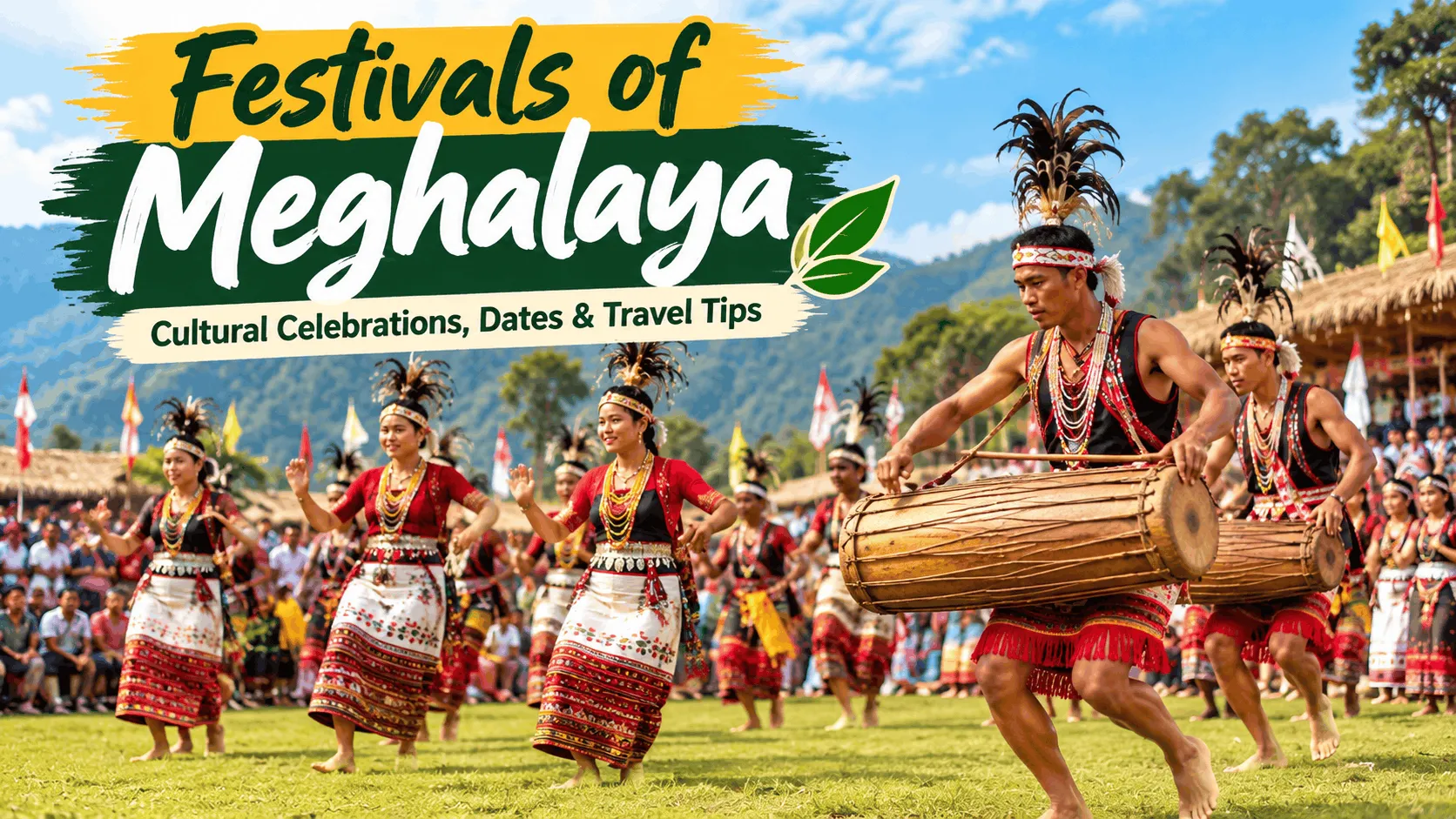
The festivals of Meghalaya are deeply tied to the agricultural year and to the traditional beliefs of the state's communities. Among the best known are Shad Suk Mynsiem, a Khasi thanksgiving dance held in Shillong, usually in April; the Nongkrem Dance at Smit, a Khasi religious festival generally held in autumn; Behdienkhlam, the Pnar (Jaintia) festival at Jowai, usually in July; and Wangala, the Garo post-harvest festival, held between September and December. Dates change every year and are set by community and religious authorities, so always check current announcements before you plan a trip.
Festivals can be a rare chance to see music, dance and ritual, but many are religious occasions first. This guide explains what each festival is, where and roughly when it takes place, and how to attend respectfully.

Understanding Meghalaya's festivals
Meghalaya's main communities, the Khasi, Jaintia (Pnar) and Garo, each have their own festivals, rituals and religious institutions. Many traditional festivals are connected with sowing, harvest and thanksgiving, and are associated with indigenous faiths such as the Khasi Seng Khasi tradition and the Pnar Niamtre religion. At the same time, a large share of Meghalaya's population is Christian, and Christmas is widely celebrated across the state.
Festivals differ in purpose, form and setting from one community to another, and sometimes from one village to another. For broader context on the region's communities, see our guide to the tribes of Northeast India.
Festival comparison table
| Festival | Community | Main location | Usual timing | Purpose (in brief) |
| Shad Suk Mynsiem | Khasi | Weiking Ground, Shillong | April | Thanksgiving dance ("Dance of Peaceful Hearts") |
| Nongkrem Dance | Khasi | Smit, near Shillong | Generally November (autumn) | Religious festival for a good harvest and prosperity |
| Behdienkhlam | Jaintia (Pnar) | Jowai and Tuber Kmai, Jaintia Hills | July, after sowing | Driving away disease and evil spirits; good harvest |
| Wangala | Garo | Garo Hills villages; 100 Drums event at Asanang near Tura | September to December | Post-harvest thanksgiving to Misi Saljong, the sun god |
Usual timing only. Confirm exact dates for the year you plan to travel.
Khasi festivals
Shad Suk Mynsiem
- Community: Khasi.
- Meaning and purpose: often translated as "the Dance of Peaceful Hearts", it is a thanksgiving dance in which participants give thanks for past blessings and ask for blessings in the year ahead, according to EastMojo's reporting on the festival.
- Organiser: Seng Khasi, a Khasi cultural and religious organisation.
- Location: Weiking Ground in Shillong, where it has been held since 1911; earlier editions were held at nearby Mawkhar.
- Usual timing: April; recent editions have run for three days.
- What to expect: large numbers of Khasi men and women dancing in traditional attire to drums and pipes. The 2023 edition was reported as the 112th, with more than 1,400 dancers on the final day.
Nongkrem Dance
- Community: Khasi.
- Purpose: a religious festival held to appease the goddess Ka Blei Synshar and seek a good harvest and prosperity, according to the Government of Meghalaya.
- Location: Smit, described by the state government as the cultural centre of the Khasi Hills, about 11 km from Shillong.
- Usual timing: generally November, in autumn. The state government describes it as a five-day festival.
- Traditional practices: the Syiem (traditional chief) of Khyrim, with the high priest, performs the Pomblang ceremony, which includes animal sacrifice and offerings, including to Lei Shyllong, the deity of Shillong Peak, and to the ancestors of the ruling clan. Religious rites are followed by dances in which unmarried women in traditional attire and men with swords and whisks dance to drums and pipes.
- Visitor note: the rites are sacred. Follow organisers' instructions, especially around ceremonial areas.
Jaintia (Pnar) festivals
Behdienkhlam
- Community: Pnar (Jaintia), particularly followers of the Niamtre religion; it is described as the largest festival of Niamtre practitioners.
- Meaning and purpose: the name combines Pnar words meaning "drive away" and "disease". The festival is an invocation to ward off evil spirits and illness and to bring a good harvest.
- Location: the largest celebrations take place in Jowai (West Jaintia Hills) and Tuber Kmai.
- Usual timing: July, after the sowing season.
- Traditional practices (as documented):
- Men beat the roofs of houses with bamboo poles to drive away evil spirits.
- Religious leaders (Daloi) perform rites and offerings to ancestors and clans.
- A football-like game (Dad-lawakor) is played with a wooden ball.
- On the last day, polished wooden logs and bamboo are carried through neighbourhoods and plunged into Aitnar, a central mud pool, with dancing to drums around it.
- Women offer food to the spirits of ancestors.
- Visitor note: crowds can be large around the pool and processions. Stay back from moving logs and follow local instructions.

Garo festivals
Wangala
- Community: Garo.
- Purpose: a post-harvest festival in which the Garo give thanks to Misi Saljong, the sun god, for a good harvest.
- Usual timing: between September and December. Each village sets its own dates, and neighbouring villages often celebrate together.
- Duration: traditionally two to three days, sometimes longer; it may be shortened to one day in towns.
- Traditional practices (as documented):
- The priest (Kamal) performs rituals in the house of the chief (Nokma), including offerings of rice beer and incense.
- On the last day, people perform the drum dance associated with Wangala, dancing to long, oval drums in colourful attire and feathered headgear.
- Other dances are also performed.
The 100 Drums Wangala Festival
A larger, state-supported celebration of Wangala, the 100 Drums Festival, is held at Asanang in West Garo Hills, near Tura. It was first held in December 1976 and now runs for several days, with troupes, competitions and cultural events. It is more accessible to visitors than village celebrations, but its dates also change each year.
Other celebrations in Meghalaya
- Christmas: widely celebrated across the state, with church services, carols and decorated streets in Shillong and elsewhere. Many shops and services may close around Christmas.
- Contemporary festivals: Meghalaya Tourism promotes events such as the Cherry Blossom Festival and the Me·Gong Festival. These are modern events rather than traditional community festivals. Check Meghalaya Tourism's Festivals & Events listings for current dates.
Typical timing vs confirmed dates
The timings above are usual seasons, not fixed calendar dates.
- Traditional festivals are often set by religious leaders, traditional institutions or village councils, sometimes based on agricultural or lunar calendars.
- Dates can shift from year to year, and some events may be scaled down, postponed or cancelled.
- Village-level celebrations, such as many Wangala festivals, are set locally and may not be widely announced.
How to check current dates
- Meghalaya Tourism: its Festivals & Events section and helpline (1800 599 2026).
- District administrations: East Khasi Hills, West Jaintia Hills and West Garo Hills district websites and announcements.
- Organising bodies: for example, Seng Khasi for Shad Suk Mynsiem.
- Local news: regional outlets often report announced dates.
- Your accommodation or tour operator: they can often confirm local arrangements.
For planning around Meghalaya's seasons as well as festivals, see our guide to the best time to visit Meghalaya.
Planning a festival trip
- Book accommodation early: large festivals can fill hotels in Shillong, Jowai and Tura.
- Allow flexibility: dates may be confirmed only shortly before the event.
- Plan transport: roads around festival venues can be busy; arrange transport in advance.
- Expect crowds: especially at Shad Suk Mynsiem, Behdienkhlam and the 100 Drums Festival.
- Weather: Behdienkhlam falls in the monsoon, so pack rain gear.
For broader trip planning, see our Meghalaya travel guide. If you would like help planning around a festival, our Meghalaya Explorer tour (Shillong, Dawki and Cherrapunjee) can be a starting point; ask about timing it with a festival.
Etiquette and respectful participation
- Remember that many festivals are religious. Treat rituals and ceremonies with the same respect you would show in a place of worship.
- Follow organisers' and community instructions, including restrictions on where visitors may stand or go.
- Do not enter ceremonial areas unless invited.
- Dress modestly.
- Do not interrupt rituals, dances or processions.
- Join in only when invited, and accept if you are not.
- Avoid alcohol-related behaviour that could disrupt events, and respect local rules.
- Keep the venue clean and carry out your rubbish.
Responsible photography
- Ask before photographing individuals, especially dancers, priests, elders and children.
- Respect "no photography" requests or signs, including at sacred rites.
- Do not use flash during rituals or performances.
- Do not block dancers, processions or other spectators.
- Drones: do not fly without permission from organisers and in line with current regulations.
- Think before posting: avoid sharing images that show sacred rites or people in ways they might not want shared.
Frequently asked questions
What are the main festivals of Meghalaya? Major traditional festivals include Shad Suk Mynsiem and the Nongkrem Dance (Khasi), Behdienkhlam (Pnar/Jaintia) and Wangala (Garo). Christmas is also widely celebrated.
When is Shad Suk Mynsiem held? Usually in April, at Weiking Ground in Shillong. Exact dates change each year; check current announcements.
Where is Behdienkhlam celebrated? The largest celebrations are in Jowai and Tuber Kmai in the Jaintia Hills, usually in July after the sowing season.
What is the Wangala festival? A Garo post-harvest festival giving thanks to Misi Saljong, the sun god, held between September and December. The 100 Drums Festival at Asanang near Tura is its best-known public celebration.
Can tourists attend Meghalaya festivals? Many public celebrations welcome respectful visitors, but some rituals are restricted. Follow organisers' instructions and community wishes.
How can I find this year's festival dates? Check Meghalaya Tourism's Festivals & Events listings, district administration announcements, organising bodies and local news, and confirm with your accommodation or operator.
Conclusion
The festivals of Meghalaya offer a window into the beliefs, music and seasonal rhythms of the Khasi, Jaintia and Garo communities. Plan around usual seasons, confirm dates close to your trip, book early, and above all, attend as a respectful guest who follows the wishes of the community hosting the celebration.