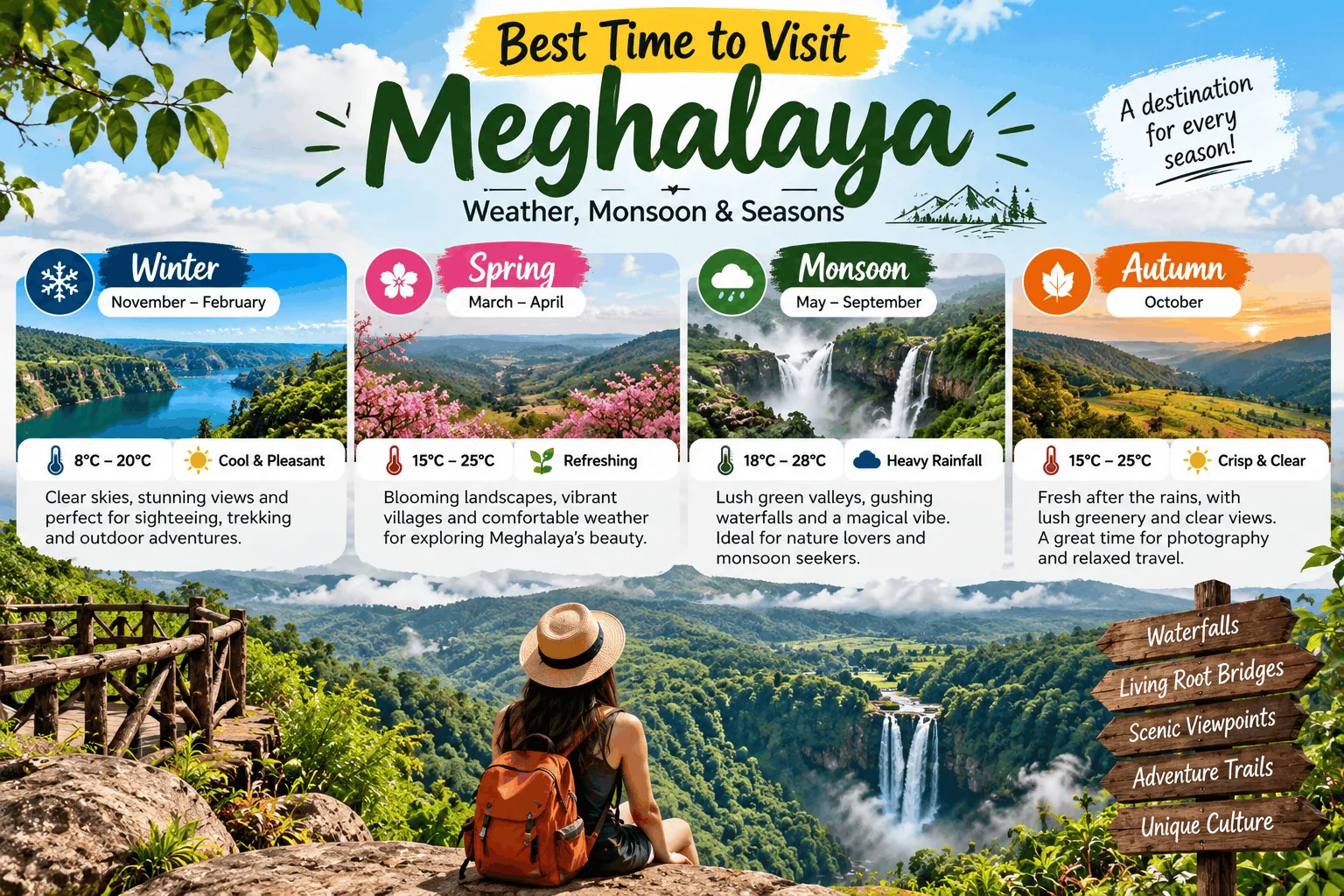
There is no single best month for everyone. For clearer views, easier trekking and fewer weather disruptions, the drier months, roughly November to February, usually work best, with October and March as good shoulder months. For full waterfalls and the greenest landscapes, the monsoon, roughly June to September, is the most dramatic, but it brings heavy rain, mist, slippery paths and possible road disruption. Long-term climate data shows clear patterns, but every year and every week differs, so check forecasts shortly before you travel.
Meghalaya means "abode of clouds", and its weather is the single biggest factor in how a trip unfolds. The same viewpoint can be crystal clear one morning and completely white the next. This guide explains the seasonal patterns, what they mean for different kinds of travellers, and how to plan around rain.
Understanding Meghalaya's climate
Two things to know first:
- Rainfall varies enormously by place. Long-term averages from the India Meteorological Department (IMD) for 1991 to 2020 show:
- Shillong: about 2,100 mm a year.
- Sohra (Cherrapunji): about 11,176 mm a year, more than five times as much. Sohra and Mawsynram, on the southern edge of the plateau, are among the wettest places on Earth, while Shillong is far drier.
- Averages are not forecasts. They describe typical patterns over three decades. Any given month can be wetter, drier, colder or warmer than average.
Monthly rainfall averages (IMD, 1991–2020)
| Month | Shillong (mm) | Sohra (mm) |
| January | 12.6 | 15.5 |
| February | 15.4 | 53.7 |
| March | 42.7 | 364.1 |
| April | 131.4 | 792.4 |
| May | 244.5 | 1,297.1 |
| June | 423.7 | 2,608.1 |
| July | 402.0 | 2,665.4 |
| August | 328.4 | 1,768.7 |
| September | 270.1 | 1,089.7 |
| October | 197.2 | 461.4 |
| November | 24.7 | 49.3 |
| December | 7.2 | 10.2 |
| Year | about 2,100 | about 11,176 |
Source: IMD climate normals as reported on Wikipedia's Shillong and Cherrapunji pages. Long-term averages only, not a forecast.
Temperatures in Shillong (IMD, 1991–2020)
| Month | Average daily high (°C) | Average daily low (°C) |
| January | 15.2 | 5.7 |
| April | 23.4 | 14.1 |
| July | 24.2 | 17.9 |
| October | 21.9 | 14.2 |
| December | 16.4 | 7.2 |
Winter nights can be much colder than the average low; record lows below freezing have been noted in the long-term data. Lower-lying areas such as Dawki are generally warmer than the plateau.
Season by season
Winter and dry season: roughly November to February
What to expect: the driest months in the long-term data, with cool to cold weather on the plateau, especially at night.
Good for:
- Clear views from viewpoints
- Trekking, including root bridge trails, as steps are less slippery
- Caving
- Clearer water at Dawki, where our Dawki travel guide suggests November to February is usually best
- Road trips with fewer rain-related delays
Trade-offs:
- Waterfalls carry far less water; some may be reduced to a trickle.
- Cold mornings and evenings.
- Busier travel period; Meghalaya Tourism advises booking accommodation early in winter.
- Short days, so less daylight for sightseeing and driving.
Spring and pre-monsoon: roughly March to May
What to expect: temperatures rise and rainfall increases steadily, especially in Sohra, where April and May are already very wet in the long-term averages.
Good for:
- Mild weather in Shillong
- Greening landscapes
- Travellers wanting fewer crowds than in winter
Trade-offs:
- Storms and heavy showers become more frequent as the season progresses.
- Visibility becomes less predictable, particularly in Sohra.
- March is often the most comfortable of these months for sightseeing; by May, plan as you would for the monsoon in the south.
Monsoon: roughly June to September
What to expect: the wettest period. In Sohra, June and July average more than 2,600 mm each; Shillong's wettest months are June and July at around 400 mm.
Good for:
- Waterfalls at their fullest
- Lush, green landscapes and dramatic mist
- Moody photography, if you are patient
- Quieter travel at some sites
Trade-offs:
- Viewpoints can be hidden in cloud for hours or days.
- Paths, steps and cave floors are slippery; trekking becomes harder and riskier.
- Dawki's water is usually murky and boating may be suspended.
- Heavy rain can cause landslides and road disruption.
- Some activities may be paused for safety.

Post-monsoon: roughly October
What to expect: rainfall drops but is still significant, especially in early October. Landscapes stay green and waterfalls often still flow well.
Good for:
- A balance of greenery, flowing waterfalls and improving visibility
- Photography
- Travellers who want some of the monsoon's beauty with fewer disruptions
Trade-offs:
- Showers are still common in many years.
- Trails can remain wet.
Meghalaya Tourism suggests October to December as a good window for Nohkalikai Falls in Sohra.
Which season suits your priorities?
| Priority | Season to consider | Why |
| Clear views and sightseeing | Roughly November to February | Driest months in long-term data |
| Full waterfalls | Roughly June to September, or October | Highest rainfall; October often balances flow and visibility |
| Green landscapes | Monsoon and post-monsoon | Vegetation at its lushest |
| Trekking and root bridges | Roughly October to March | Drier steps and trails |
| Clear water at Dawki | Roughly November to February | Less rain and run-off |
| Photography | October, or patient monsoon visits | Mist and drama vs clearer light |
| Fewest weather disruptions | Roughly November to February | Lowest rainfall |
| Fewer crowds | Shoulder months and monsoon | Outside the main winter season |
Activity-by-season notes
- Waterfalls: heavily seasonal. The same waterfall can be spectacular in the monsoon and minimal in winter. Our Cherrapunji travel guide explains how Sohra's falls change through the year.
- Caves: possible year-round in principle, but wet-season access can be limited and floors slippery; always follow local guides.
- Root bridge treks: easiest in drier months. In heavy rain, steps are slippery and streams can rise quickly.
- Road trips: generally smoother in the dry season. In the monsoon, allow extra time and keep plans flexible.

Planning around heavy rain
- Build in buffer days, especially in the monsoon.
- Check forecasts each evening using IMD or other reliable sources, and ask your driver or host about roads.
- Plan viewpoints for mornings, when visibility can be better, and keep a backup indoor plan (museums, markets, cafés in Shillong).
- Avoid trekking in heavy rain, and do not swim in pools or streams that may rise suddenly.
- Start drives early so you are not on hill roads after dark.
- Be ready to swap days if weather changes.
- Choose bases wisely: Shillong is far drier than Sohra, so it can be a better base in the wettest months.
What to pack by season
All year
- Rain jacket or poncho
- Shoes with good grip
- Dry bags for phone and camera
- Small torch
- Water bottle
Winter (roughly November to February)
- Warm layers, a fleece or down jacket, hat and gloves for cold evenings
- Lip balm and moisturiser for dry air
Monsoon (roughly June to September)
- Waterproof shoes or sandals with grip
- Quick-dry clothes and extra socks
- Umbrella
- Leech socks for forest trails
- Waterproof cover for your backpack
Shoulder months
- Layers you can add or remove
- A light rain layer
Combining Meghalaya with other states
If you are combining Meghalaya with Assam or other Northeast states, seasons differ across the region. Our Northeast India travel guide has wider planning advice.
Booking and seasonal demand
- Winter and holidays: busier; book accommodation early.
- Monsoon: quieter at some sites, but plan for flexibility.
- Tours: if you prefer someone else to handle seasonal adjustments, our Meghalaya Explorer tour (Shillong, Dawki and Cherrapunjee) covers several highlights; ask about the best dates for your interests.
Conclusion
The best time to visit Meghalaya depends on what you want from the trip. Drier months generally bring clearer views and easier trekking; the monsoon brings full waterfalls, deep greens and more uncertainty; October often sits usefully in between. Whatever you choose, treat long-term averages as a guide, not a promise, check forecasts close to departure, and leave room in your plans for the clouds the state is named after.
Internal links (exactly 4)
| # | Anchor text | URL | Status |
| 1 | Dawki travel guide | https://www.tribaldiscoverytour.com/blog/dawki-travel-guide | ✅ Live (used in place of the unpublished pillar) |
| 2 | Cherrapunji travel guide | https://www.tribaldiscoverytour.com/blog/cherrapunji-travel-guide | ✅ Live |
| 3 | Northeast India travel guide | https://www.tribaldiscoverytour.com/blog/northeast-india-travel-guide | ✅ Live |
| 4 | Meghalaya Explorer tour (Shillong, Dawki and Cherrapunjee) | https://www.tribaldiscoverytour.com/tours/meghalaya-shillong-cherrapunjee-dawki-tour | ✅ Live |
Future internal-link opportunities (not live)
- Meghalaya Travel Guide pillar: /blog/meghalaya-travel-guide
- Best Places to Visit in Meghalaya: /blog/best-places-to-visit-in-meghalaya (drafted)
- Meghalaya Itinerary: /blog/meghalaya-itinerary (drafted). Link from "Planning around heavy rain" once live.
Image markers (exactly 2)
- [IMAGE 1: Lush green Khasi Hills plateau near Sohra during the monsoon, with low clouds and mist over the valleys | ALT: Monsoon clouds and mist over green hills near Sohra in Meghalaya]
- [IMAGE 2: Nohkalikai Falls near Sohra in full flow after monsoon rains, partly framed by mist | ALT: Nohkalikai Falls in full flow after monsoon rain near Sohra Cherrapunji]
Use photos genuinely taken in the stated season and place.
FAQs
What is the best month to visit Meghalaya? It depends on your priorities. Roughly November to February is usually best for clear views and trekking; June to September is best for full waterfalls but brings heavy rain.
Is it good to visit Meghalaya in the monsoon? Yes, if you want lush landscapes and full waterfalls and can keep plans flexible. Expect mist, slippery paths and possible road disruptions.
When is the best time to see Dawki's clear water? Usually in the drier months, roughly November to February. In the monsoon, the water is often murky and boating may be suspended.
How cold does Shillong get in winter? Long-term IMD averages (1991–2020) show January lows around 6°C, and nights can be colder. Pack warm layers.
Is Cherrapunji worth visiting in winter? Yes for clear views, caves and trekking, but many waterfalls carry much less water than in the monsoon.