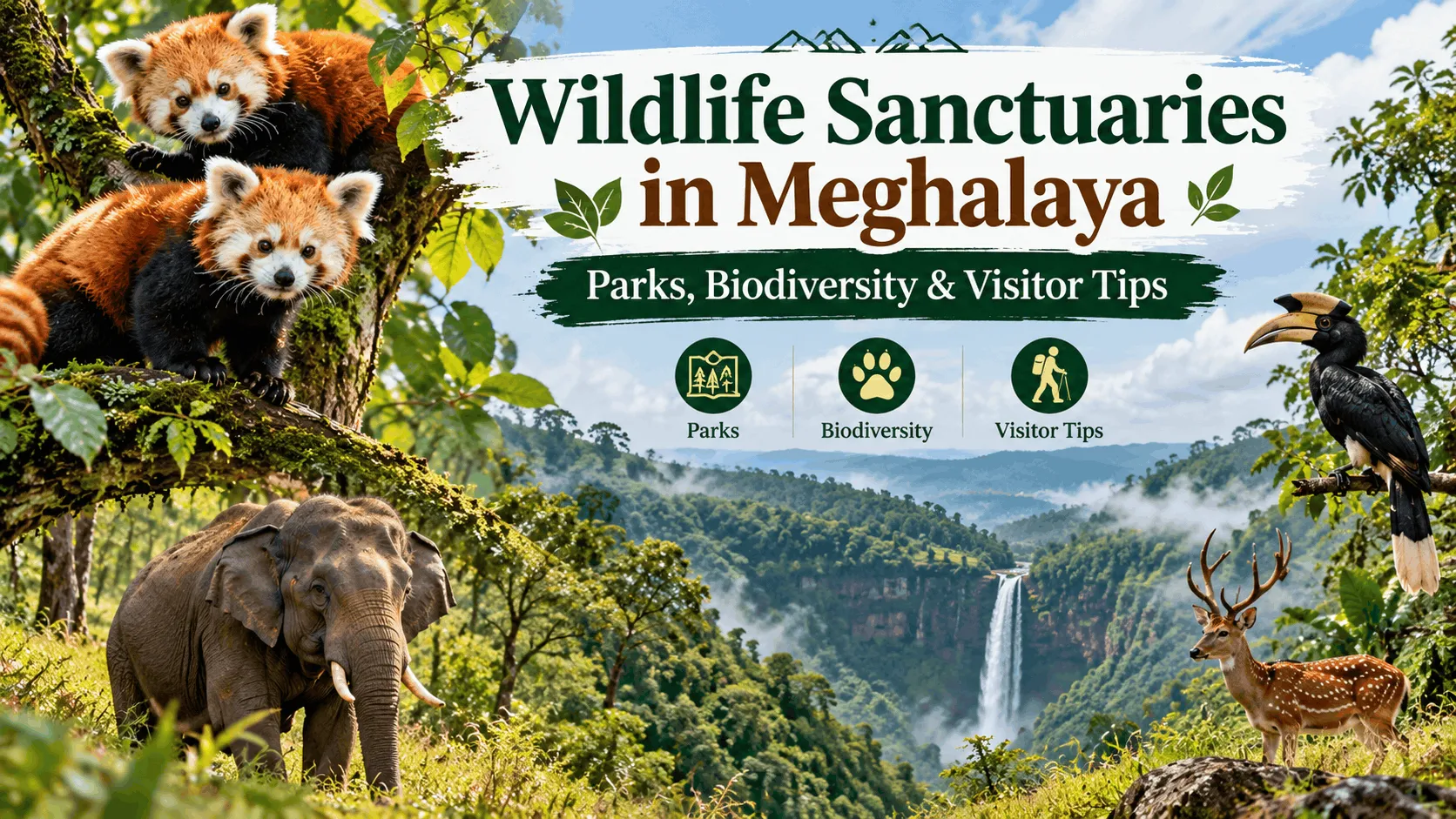
Wildlife sanctuaries in Meghalaya protect some of the most biodiverse hill forest in Northeast India. Meghalaya Tourism describes a landscape of high elevations and deep valleys, heavy rainfall and dense vegetation, with many forests still hard to reach. Others are protected by local customs, such as sacred groves.
This guide explains how the state's protected areas are classified, which ones to know, what the official sources say about their wildlife, and how to visit responsibly. Sightings depend on season, habitat and luck, and none of the places below can promise you an animal. For wider trip planning, see our Meghalaya travel guide.

Understanding Sanctuaries, National Parks and Protected Areas
These terms are not interchangeable.
- Protected area: the umbrella term. Meghalaya's network includes national parks, wildlife sanctuaries and a biosphere reserve.
- National park: generally more strictly protected than a sanctuary under India's Wildlife (Protection) Act, 1972.
- Wildlife sanctuary: a protected area for wildlife, usually with fewer restrictions than a national park.
- Biosphere reserve: a UNESCO designation with a core area and surrounding buffer and transition zones.
- Reserve forest: a forest-law category that is not automatically a wildlife protected area.
- Sacred grove: a community-protected forest patch. Mawphlang is one example, but it is not listed in the state's protected-area table.
- Important Bird Area (IBA): a BirdLife International programme site, not a legal designation.
Websites sometimes mix these labels. Meghalaya Tourism pages call Siju a "Bird Sanctuary" and Balpakram a "National Reserve" in places. The Meghalaya Biodiversity Board lists Siju as a Wildlife Sanctuary and Balpakram as a National Park.
Wildlife Sanctuaries in Meghalaya and Other Protected Areas to Know
According to the Meghalaya Biodiversity Board, the protected-area network covers 1,133.9 sq km, about 5.06% of the state's area, and includes two national parks, four wildlife sanctuaries and one biosphere reserve.
| Protected area | Category | Area (sq km) | District | Established |
| Siju | Wildlife Sanctuary | 5.81 | South Garo Hills | 1979 |
| Nongkhyllem | Wildlife Sanctuary | 29 | Ri-Bhoi | 1981 |
| Baghmara Pitcher Plant | Wildlife Sanctuary | 0.02 | South Garo Hills | 1984 |
| Narpuh | Wildlife Sanctuary | 59.90 | East Jaintia Hills | 2014 |
| Balpakram | National Park | 220 | South Garo Hills | 1985 |
| Nokrek Ridge | National Park | about 48 | Garo Hills | 1986 |
| Nokrek | Biosphere Reserve | 820 | East, West and South Garo Hills | 1988 |
Three sanctuaries are most often visited:
- Siju Wildlife Sanctuary sits beside the Siju cave system, across the Simsang River. Meghalaya Tourism describes moist evergreen forest and lists elephants, flying squirrels, macaques, porcupines and barking deer among its fauna.
- Nongkhyllem Wildlife Sanctuary is in Ri-Bhoi district, roughly 60 km from Shillong according to Meghalaya Tourism. It describes subtropical and moist deciduous forest and reports over 400 bird species recorded in and around it.
- Narpuh Wildlife Sanctuary is the newest, notified in 2014. Narpuh Reserve Forests are listed separately as an Important Bird Area.
National Parks in Meghalaya
Balpakram National Park, in South Garo Hills, has plateaus, gorges, limestone caves and forest. Meghalaya Tourism notes that the Garo community reveres it as the resting place of departed souls, so approach it respectfully. Key Biodiversity Area records describe Balpakram and Siju as contiguous.
Nokrek Ridge National Park is the core of the Nokrek Biosphere Reserve, on the Tura Mountain Range. Nokrek Peak, at 1,418 m, is the highest in the range. The reserve's buffer zone holds a gene sanctuary for the rare citrus Citrus indica, known locally as Memang Narang. Meghalaya Tourism describes Nokrek as the state's only UNESCO-listed biosphere reserve, with Daribokgre as a base for treks.
The Biodiversity Board also records the Garo Hills Elephant Reserve, covering 3,500 sq km, of which only 402 sq km is protected area. That gap is a useful reminder that wildlife habitat does not stop at park boundaries.
Birds, Mammals, Reptiles and Other Biodiversity
What the sources can and cannot tell us about the wildlife of Meghalaya is worth separating.
Described by the Meghalaya Biodiversity Board for the protected-area network:
- Viable populations of the Endangered Western Hoolock Gibbon. The Bengal Slow Loris is patchily distributed.
- Several macaques and two langurs.
- The leopard is still widely distributed. The Bengal tiger and clouded leopard have become extremely rare.
- Sun bear, Asiatic black bear and sloth bear are listed.
- Smaller cats, including marbled cat and leopard cat, are still found.
Listed on tourism pages, which are possibilities rather than expectations:
- Elephants, red panda, Asian golden cat and wild water buffalo at Balpakram.
- Elephants, tigers, gaur and clouded leopards at Nongkhyllem.
- King cobra, Indian rock python, monitor lizards and Asian leaf turtle at Nongkhyllem.
The clouded leopard is Meghalaya's state animal, but that does not make it easy to see.

Birds are the more realistic draw. The Meghalaya Biodiversity Board identifies nine Important Bird Areas: the Balpakram complex, Mawphlang Sacred Grove, Nokrek National Park, Nongkhyllem Wildlife Sanctuary, Narpuh Reserve Forests, Riat Khwan Umiam, Saipung, Upper Shillong, and the Cherrapunjee cliffs, gorges and sacred groves. It highlights two Globally Vulnerable birds: the Tawny-breasted Wren-babbler, found in Khasi Hills forest at 1,000 to 2,000 m, and the Khasi Hills Swift, known to breed only in the Khasi Hills and in Mizoram. Meghalaya Tourism names White-cheeked Hill Partridge and Rufous-necked Hornbill at Nongkhyllem.
Plants matter too. The pitcher plant Nepenthes khasiana is endemic to Meghalaya, and Meghalaya Tourism says the state has over 300 orchid species.
Forests, Hills, Caves and Other Habitats
Meghalaya sits on the Shillong Plateau, divided into the Khasi, Jaintia and Garo Hills. Meghalaya Tourism says about 76% of the state is forested, with 105 to 125 sacred groves. Habitats range from evergreen forest and bamboo groves to table-top plateaus at Balpakram and Siju's limestone cave system. Caves are fragile and can be dangerous. Visit them only with a local guide.
Where Responsible Wildlife Viewing May Be Possible
The official pages we reviewed describe walks and treks, not vehicle safaris. These are the activities they mention:
- Nongkhyllem: guided forest walks with naturalists, birdwatching and soft trekking trails.
- Siju: guided treks and birdwatching, with a short trek through forest to the sanctuary entrance.
- Nokrek: trekking to Nokrek Peak and birdwatching.
- Balpakram: plateau treks and birdwatching, with caves visited only through local guides.
Meghalaya Tourism says patience "often rewards" visitors at Nongkhyllem. Take that as encouragement to slow down, not as a promise.
Best Time to Visit for Nature and Wildlife
Meghalaya Tourism's site-by-site guidance is broadly consistent:
- Nokrek: October to May.
- Nongkhyllem: October to April.
- Balpakram: October to March, with November to February singled out for birds and orchids.
- Siju: November to March.
The monsoon (June to September) brings heavy rain, and Meghalaya Tourism advises checking forecasts for landslide warnings. Nokrek trails may be slippery. Winter is a busy tourist season, so book accommodation ahead. Summer (March to May) is described as mild.
Season also shapes what you may see. Meghalaya Tourism mentions resident and migratory birds at Balpakram in winter, and winter visitors from higher biomes at Nongkhyllem. Even so, a good season only improves the odds slightly.
How to Plan a Wildlife-Focused Meghalaya Trip
Distances are long in the Garo Hills. Meghalaya Tourism reports Balpakram is about 9 to 10 hours from Shillong, and Siju about 10 to 11 hours from Shillong or 6 to 7 hours from Guwahati. Baghmara is the nearest town for both, and there is no direct public transport to Balpakram. Nongkhyllem is far easier, at roughly 1.5 to 2 hours from Shillong.
- Treat the Garo Hills as a separate trip of several days.
- Fit Nongkhyllem into a Shillong or Guwahati itinerary as a day trip.
- Travel in the cooler, drier months.
- Use local guides and lodging.
Our Northeast India travel guide shows how Meghalaya fits into a longer regional trip. If you would like local guidance, you can browse Tribal Discovery Tour's tours and ask whether a wildlife-focused option suits you.
Permits, Guides, Access and Safety
Entry into protected areas is regulated by Meghalaya's Forest and Environment Department. Meghalaya Tourism says Nongkhyllem entry may require permits or local guide assistance, and public descriptions of Nokrek say permits are issued on payment. We have not verified current fees, offices or opening arrangements, so confirm them with the relevant forest division before you travel.
- Guides: Meghalaya Tourism recommends a local guide at Balpakram, Nokrek and Siju.
- Connectivity: expect no mobile signal at Siju and limited network at Nokrek.
- Roads: an SUV is recommended for Balpakram's rough roads.
- Terrain: Meghalaya Tourism describes slippery, steep or moderately challenging trails at Siju and Nokrek, and advises sturdy walking or trekking shoes. At Nongkhyllem it also suggests insect repellent.
- Supplies: carry water and snacks. There are no shops inside Nongkhyllem.
- Boundaries: do not enter restricted or core areas, and follow forest staff.
Wildlife Photography and Responsible Visitor Behaviour
Meghalaya Tourism asks travellers not to disturb wildlife or pluck plants, to keep noise to a minimum, and to stay on marked paths.
- Keep your distance. If an animal changes its behaviour because of you, you are too close.
- Never feed wildlife.
- Avoid loud talking, music and sudden movements.
- Skip flash and baiting. Do not use playback calls to lure birds.
- Do not share precise locations of nests or rare species.
- Carry out all waste.
- Ask before photographing villagers or guides.
Conservation Challenges and Community Stewardship
Meghalaya Tourism acknowledges a steady decline in forest cover, driven in part by felling for firewood and timber. It also says over half of the state's 55,000 recorded springs have dried up or lost flow. Because protected areas cover about 5% of the state, conservation outside them, including community-managed forests and sacred groves, matters too.
Communities are central. The Meghalaya Community-Led Landscape Management Project works with 400 villages, and Payment for Ecosystem Services incentives extend to sacred groves, living root bridges and elephant corridors. The Biodiversity Board's work includes Biodiversity Management Committees and Biodiversity Heritage Sites, such as Mawtneng in Ri-Bhoi. For context on the Khasi, Jaintia and Garo communities, read our guide to the tribes of Northeast India.
Frequently Asked Questions
How many wildlife sanctuaries are there in Meghalaya? The Meghalaya Biodiversity Board lists four: Siju, Nongkhyllem, Baghmara Pitcher Plant and Narpuh. Check for updates before publishing or travelling.
What national parks are in Meghalaya? Two: Balpakram National Park and Nokrek Ridge National Park.
Will I see tigers or clouded leopards? Almost certainly not. The Biodiversity Board describes both as extremely rare, and sightings are never guaranteed.
Which sanctuary is best for birdwatching? Nongkhyllem is notable, with over 400 species recorded in and around it according to Meghalaya Tourism. The state has nine Important Bird Areas.
What is the easiest protected area to reach? Nongkhyllem, roughly 60 km from Shillong according to Meghalaya Tourism.
What is the best time to visit? October to March or April is the common window across several sites. Monsoon trips carry landslide and slippery-trail risks.
Do I need a guide or a permit? Local guides are recommended at several sites, and entry is regulated. Confirm current requirements with the forest department.
Is Mawphlang a wildlife sanctuary? No. It is a sacred grove and an Important Bird Area, and it is not in the state's protected-area table.
Can I go on a jeep safari? The official pages we reviewed describe walks and treks rather than safaris. Ask the forest department about current options.
Closing Thoughts
Wildlife sanctuaries in Meghalaya reward patience and humility. Learn the difference between a sanctuary and a national park, travel in the right season, hire local guides, and treat every sighting as a bonus rather than a right.