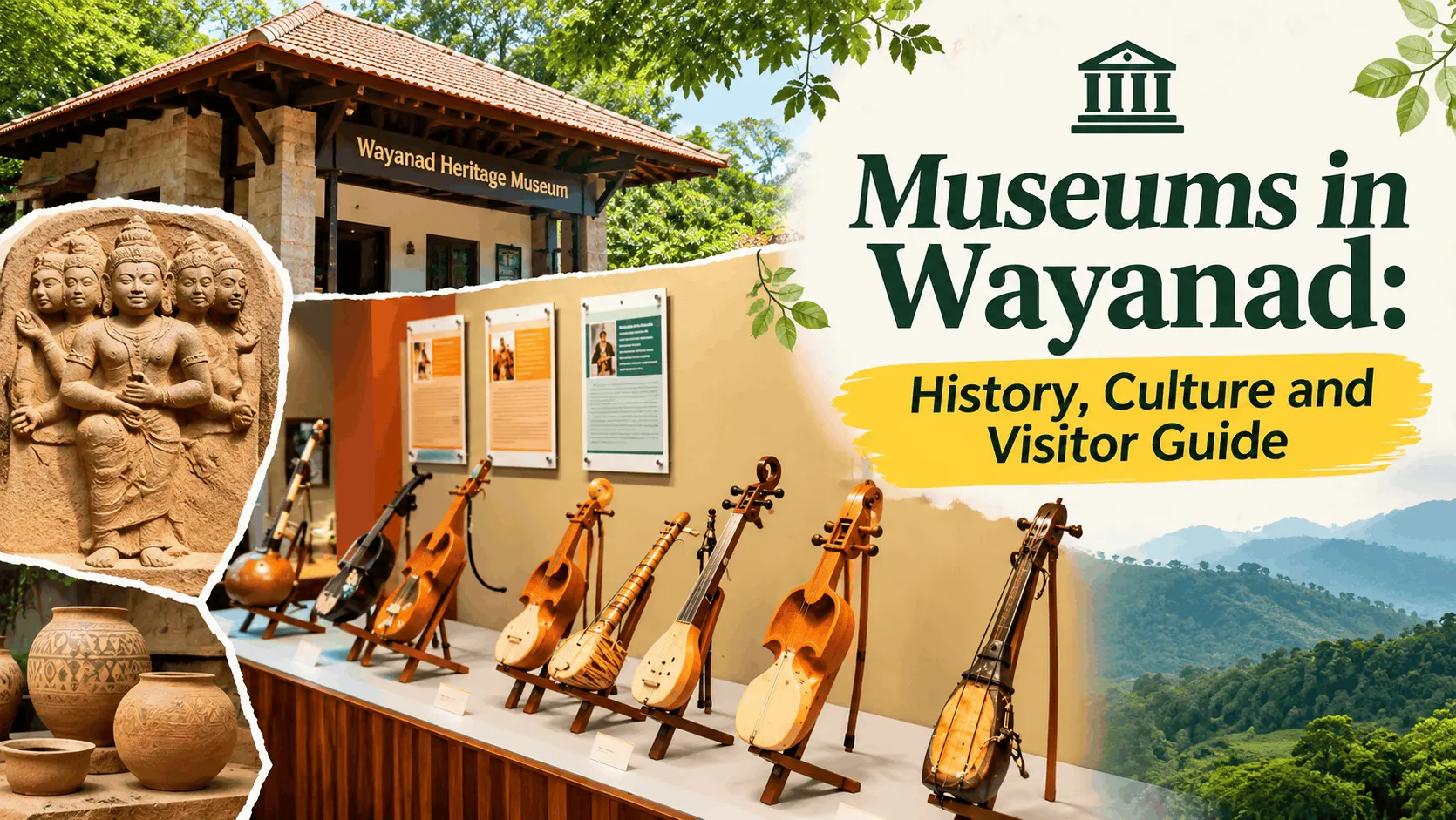
Wayanad is known for its hills and forests, but its past is just as striking. Stone Age rock engravings, Jain settlements, a long guerrilla campaign against the East India Company and the traditions of several Adivasi communities all leave traces here. A Wayanad museum is where many of those traces are gathered under one roof, with labels and context that a roadside viewpoint cannot give.
This guide stays on museums and heritage collections. Wayanad has a short list of verified museums: the Wayanad Heritage Museum at Ambalavayal, the Pazhassi Tomb and Museum at Mananthavady, and the Wayanad Tea Museum near Pozhuthana. We cover each, say what we could and could not confirm, and flag nearby sites that are often mistaken for museums. For the wider district, our guide to Wayanad tourist places covers the main attractions. Information was last checked on 28 November 2026.
Why Explore Museums in Wayanad?
Much of Wayanad's early history rests on archaeology and oral tradition rather than written records. Official district sources say that written history is available mainly from the 18th century, so objects carry more weight here than in many regions. Hero stones, megalithic pottery, tools and weapons help fill the gap.
Museums also keep local knowledge from disappearing. Farming implements, musical instruments, hunting gear and ornaments from Adivasi households were collected from the district itself, and the Heritage Museum's own history describes local people contributing artefacts. Seeing these objects first makes later visits to villages and plantations easier to read.
Popular Museums in Wayanad
Only places with a clear museum identity are included below. Opening hours and entry fees differ between websites, so we have not quoted them. Confirm them locally before you go.
Wayanad Heritage Museum, Ambalavayal
The Wayanad Heritage Museum, also called the Ambalavayal Heritage Museum, is in Ambalavayal village, about 12 km from Sulthan Bathery according to Kerala Tourism. Wikipedia lists the District Tourism Promotion Council as its curator, and Kerala Tourism describes it as one of the largest archaeological museums in the state.
Its origin is tied to research around Edakkal Caves in the 1980s. Anthropologists collected artefacts from Ambalavayal, Sulthan Bathery and the forests of Wayanad, and relics were later unearthed at Muthanga, Nalluvayal and Edathara, among other places. With the state Archaeology Department's help, a museum was set up to keep them.
The collection is arranged in four blocks:
- Veerasmruthi holds hero stones, carved memorials to warriors, including men who died fighting wild animals.
- Gothrasmruthi and Jeevanasmruthi cover tribal life, with headgear, jewellery, hunting and fishing weapons, cowbells, farming implements and musical instruments.
- Devasmruthi covers objects from the Neolithic to the 17th century, including stone idols dating to the 12th century and terracotta figurines from Malabar.
Kerala Tourism also lists stone weapons, megalithic pottery and sculptures from the 14th to 16th centuries, and a multimedia theatre is located near the museum. Visitors come away with a sense of how long people have lived in these hills.

Pazhassi Tomb and Museum, Mananthavady
The Pazhassi Tomb stands on the bank of the Kabani river in Mananthavady, in northern Wayanad. It was built where Kerala Varma Pazhassi Raja was cremated after his death in 1805, and Kerala Tourism says the tomb was converted into a museum in March 1996. It is managed by the Kerala State Archaeology Department.
The museum has four galleries: Pazhassi, Tribal, Heritage and Numismatic. According to Kerala Tourism, the collection includes British orders and letters relating to the Pazhassi revolt, ancient weapons, stone statues, utensils, furniture, tools used by tribal groups, and rare coins. An art gallery inside the memorial displays works by the painter Raja Ravi Varma. A garden beside the memorial is open to visitors.
This is the best Wayanad museum for understanding the resistance to colonial rule. It is also a memorial, so visit quietly. Kerala Tourism lists Kannur International Airport at about 65 km as the nearest airport.
Do not confuse it with the Pazhassi Raja Archaeological Museum, which is in Kozhikode and not in Wayanad.
Wayanad Tea Museum, Pozhuthana
The Wayanad Tea Museum is at Achoor near Pozhuthana, on the Banasura Sagar Dam road. It was opened by Harrisons Malayalam Ltd inside an old tea factory, and Kerala Tourism-linked sources date the building to 1911. A 2018 Onmanorama report describes exhibits on the history of tea in India and in Wayanad, old processing machinery and photographs of past gardens and factories.
We keep this entry short because tea heritage deserves its own guide. As a museum, it adds a colonial and industrial layer that the other two do not cover.
Historical Collections and Cultural Exhibits in Wayanad
Several well-known heritage sites are not museums, and the difference matters when you plan your day.
Edakkal Caves, near Ambalavayal, are an archaeological site. The engravings of human figures, animals, wheeled carts and symbols remain on the rock. They are not displayed in a gallery, and we found no reliable official source saying that the carvings themselves are held in the Heritage Museum. What the museum holds are artefacts from research and excavation in the area. Dates for the carvings vary, with many sources giving about 6000 BCE to 1000 BCE, so treat any single figure as an estimate. Our guide to the history of Wayanad explains the sequence from Edakkal to Pazhassi Raja.
The Jain temple at Sulthan Bathery is a historic monument, and Thirunelli is a working temple. Neither is a museum.
The strongest collections are the hero stones and Neolithic to 17th century objects at Ambalavayal, and the British letters, weapons and coins at Mananthavady. Together they cover prehistory, medieval sculpture and colonial resistance.
Understanding Wayanad's Tribal and Cultural Heritage
Wayanad has several Adivasi communities, including the Paniya, Kurichiya, Kuruma, Adiyan and Kattunayakan, and each has its own history and customs. Museum labels often group them together, so remember that a display of headgear or a bow represents particular communities and not a single tribal culture.
Early written accounts of these communities come largely from colonial officials, so museum narratives can reflect an outside view. Community oral histories add what the records leave out, such as the role of Kurichiya and Kuruma fighters in Pazhassi Raja's campaign and the 1812 revolt.
Objects in a case are only part of the picture, since these are living cultures. En Ooru, a tribal heritage village at Pookode, is a heritage village rather than a museum. Our guide to En Ooru in Wayanad explains how to visit respectfully. Ask before photographing people, and buy crafts directly from community sellers where possible.
Best Time to Visit Museums in Wayanad
November to February is the most comfortable period for the road journeys between sites, and the busiest stretch is Christmas to early January.
The monsoon, from June to September, is when indoor stops earn their keep. The Heritage Museum is a sensible fallback when rain closes waterfalls or viewpoints, though roads can slow and landslide alerts can lead to closures. We have not verified current schedules for any of the three museums, so check before travelling. Our guide to Wayanad in July explains how to build a rain-friendly plan.

How to Reach Museums in Wayanad
Wayanad has no airport or railway station of its own, so all travel ends on the road. Kozhikode is the usual gateway, and the main route climbs the Thamarassery ghat to Lakkidi and then Kalpetta.
The Heritage Museum is in the south-east, about 12 km from Sulthan Bathery. Kerala Tourism lists it as commonly combined with Edakkal Caves, and one travel directory puts it about 5 km from the caves and roughly 22 km from Kalpetta. The Tea Museum is on the Banasura Sagar Dam road at Achoor, around 12 km from Kalpetta and 9 km from Vythiri by one directory. The Pazhassi Tomb and Museum is in Mananthavady town, in the north.
Because the three are in different parts of the district, plan them on separate days or as part of a wider route. Taxis and hired cars with drivers are the practical choice, and buses link the main towns.
Tips for Visiting Museums in Wayanad
Check opening days and timings before travelling, since websites disagree and some sites close on a weekly day. A phone call to the museum or the District Tourism Promotion Council is the safest check.
Ask about photography at the entrance. We found no official published rules for these museums, so follow staff instructions and any signs. Do not touch exhibits, and keep to marked paths in galleries.
Allow time, since a rushed visit misses the labels. Pair the Heritage Museum with Edakkal in the same area, and keep the Pazhassi Museum for a northern day.
Frequently Asked Questions
Are there museums in Wayanad?
Yes. The verified ones are the Wayanad Heritage Museum at Ambalavayal, the Pazhassi Tomb and Museum at Mananthavady and the Wayanad Tea Museum near Pozhuthana.
Which museum can visitors explore in Wayanad?
All three are open to visitors. The Heritage Museum is the largest for archaeology and tribal artefacts, and the Pazhassi Museum is best for colonial-era history.
What can visitors learn about Wayanad's history?
Visitors can learn about megalithic and Neolithic objects, hero stones, medieval sculpture, the Pazhassi revolt against the East India Company and the history of tea.
Are there museums showcasing tribal heritage?
Yes. The Heritage Museum has blocks on tribal life, and the Pazhassi Museum has a Tribal Gallery. For living culture, En Ooru is a heritage village rather than a museum.
What is the best time to visit museums in Wayanad?
Any time works, and they suit the monsoon well, though road conditions need checking. November to February is the most comfortable period.
Should visitors check museum timings in advance?
Yes. Published hours and fees differ between sources, so confirm them locally before you set out.
Are museums in Wayanad suitable for families?
Generally yes, as they involve indoor walking and little strenuous activity. Check access if you travel with very young children or older relatives, since the Tea Museum is reported to have stairs.
Conclusion
Wayanad has a short but worthwhile list of museums. The Heritage Museum at Ambalavayal gathers the district's archaeology and tribal artefacts, the Pazhassi Tomb and Museum at Mananthavady tells the story of resistance to colonial rule, and the Tea Museum adds the plantation era. Together they turn a scenic trip into an informed one. Visit with an open mind, treat tribal heritage and memorials with respect, confirm timings before you go, and let every Wayanad museum you see send you back to the landscape with a better sense of its past.