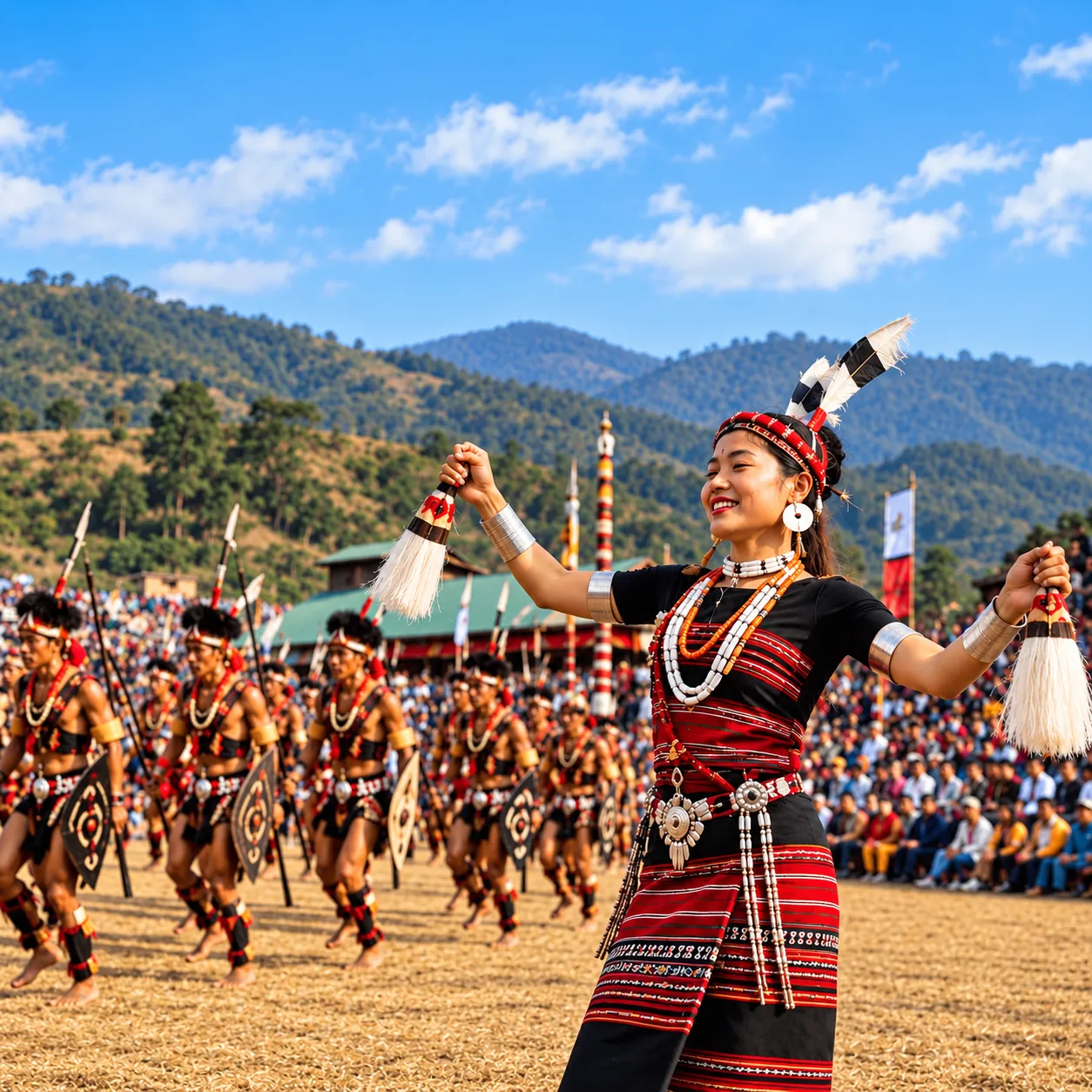
Festivals are one of the clearest windows into the cultural life of Northeast India. Across the region's hills and valleys, communities mark the farming year, honour ancestors and deities, welcome new seasons and bring families together through ceremony, music, dance and shared meals. Each festival belongs to a particular community, and none of them speaks for the region as a whole.
This guide introduces some of the better-known tribal festivals state by state, explains what they usually involve and offers advice on attending respectfully. It is an outside overview. The most reliable sources on any festival are the communities who celebrate it. Dates, venues and arrangements change from year to year, so please verify everything with official tourism offices or community organisers before you plan a trip.
Why Tribal Festivals Matter in Northeast India
Festivals are not simply events on a calendar. For many communities, they are the moments when belief, memory and social life meet. Many follow the agricultural year, with ceremonies connected to sowing, harvest, thanksgiving or the end of a season. Others mark a new year, honour ancestors or involve rituals for the well-being of the village.
They also keep language, song, dress and oral history alive. Elders pass knowledge to younger people, families reunite and communities that have been separated by work or migration come home. In a region where smaller communities face pressure from larger languages and changing economies, festivals can be a way of affirming identity.
It helps to remember the diversity involved. The festivals of one community differ in meaning, ritual and tone from those of its neighbours, even when they fall in the same month. For the wider picture, see our Tribes of Northeast India.
Major Tribal Festivals of Arunachal Pradesh
Arunachal Pradesh is home to many communities, and most have festivals tied to farming, belief or the turning of the year. The festivals below are among those most often mentioned.
Losar and Torgya (Monpa). Losar marks the new year in the Tibetan Buddhist calendar and is observed by Monpa communities, while Torgya is a monastic festival associated with Tawang Monastery, known for ritual masked dances. Their timing follows a lunar calendar and changes each year.
Myoko and Dree (Apatani). The Apatani of Ziro Valley celebrate Myoko and Dree, the latter widely described as an agricultural festival connected with prayers for a good harvest. Dree is generally associated with the middle of the year.
Reh (Idu Mishmi). Reh is a major Idu Mishmi celebration linked with ritual, thanksgiving and family gatherings, traditionally held early in the year.
Nyokum Yullo and Boori Boot Yullo (Nyishi). These Nyishi festivals are connected with prayers for prosperity and the agricultural year, and are widely reported as taking place in the early part of the year. See our [INTERNAL LINK: Nyishi Tribe Guide].
Solung and Aran (Adi). Solung is an Adi agricultural festival, usually associated with the later part of the year.
Mopin (Galo). Mopin is a Galo festival connected with the agricultural cycle, usually associated with spring.
Sangken (Khamti). The Khamti community's new year festival, often described as a water festival, is traditionally held in spring. It is tied to Theravada Buddhist culture.
Tamladu (Digaru Mishmi). A Digaru Mishmi festival, traditionally associated with early spring.
Tribal Festivals of Nagaland
Nagaland is home to a number of Naga tribes, and many have their own festivals through the year. In recent years, the state has also hosted a large cultural festival that brings communities together in one place.
Hornbill Festival. Organised by the state, this festival is held at Kisama near Kohima, usually in early December. It brings together Naga tribes to present dress, music, dance and food, and it is the state's best-known festival event. It is a staged showcase, not a village ceremony, which is worth remembering when you compare it with community festivals.
Sekrenyi (Angami). A purification festival of the Angami Nagas, traditionally held in late winter.
Moatsu (Ao). An Ao festival associated with the period after sowing, traditionally held in early May.
Aoleang Monyu (Konyak). A Konyak festival associated with the start of the agricultural year, traditionally held in spring.
Tuluni (Sumi). A Sumi festival marked in mid-year, associated with food, feasting and community gathering.
Tribal Festivals of Meghalaya
The Khasi, Jaintia and Garo communities each celebrate their own festivals.
Wangala (Garo). A post-harvest festival honouring the deity associated with the harvest, known for large drum ensembles and dance. It is usually held in the later part of the year.
Nongkrem (Khasi). A major Khasi festival involving dance and ritual, usually held in late autumn near Shillong.
Shad Suk Mynsiem (Khasi). A thanksgiving dance festival, usually held in spring in Shillong.
Behdienkhlam (Jaintia). A Jaintia festival often described as driving away disease and ill luck, usually held in mid-year around Jowai.
Tribal Festivals of Assam
Assam's festivals combine traditions from many communities. The best known, Bihu, is celebrated widely across the state, including by many groups who are not tribal, so it should not be treated as belonging to a single community.
Bwisagu (Bodo). A Bodo spring festival marking the new year and agricultural season.
Ali-Aye-Ligang (Mising). A Mising spring festival connected with the start of sowing.
Bushu Dima (Dimasa). A Dimasa harvest festival, traditionally held in winter.
Karbi festivals. Karbi communities in the hills of Karbi Anglong have their own celebrations and cultural events through the year.
Tribal Festivals of Manipur, Mizoram and Tripura
I have included only festivals I could name with reasonable confidence, and each should be checked.
Manipur. Lui-Ngai-Ni is a seed-sowing festival celebrated by several Naga communities, traditionally in early spring. Gaan-Ngai is a Zeliangrong festival held in the cooler months. The state has faced serious ethnic tensions in recent years, so check current travel advisories and local conditions before any trip.
Mizoram. Chapchar Kut is a spring festival associated with the end of jhum clearing work, and Mim Kut and Pawl Kut are linked to later harvest periods. The bamboo dance, Cheraw, is widely associated with Mizo culture.
Tripura. Garia is a festival of the Tripuri community, usually held in spring, and Boisu, the Tripuri new year festival, is also mentioned. Reang communities are known for the Hojagiri dance.

Traditional Music and Dance
Music and dance sit at the centre of most festivals. Songs may tell stories, mark seasons or accompany ritual, and dances often involve groups moving together in patterns that reflect community and cooperation.
Instruments vary. Drums, bamboo instruments, flutes, stringed instruments and gongs appear in different places. In Garo festivals, drum ensembles are a defining sound. In Mizoram, the bamboo dance involves performers moving between clapped bamboo poles. In Monpa monastic festivals, masked dances are performed by monks. Khasi thanksgiving dances involve carefully dressed participants moving in formation.
Some dances are open to visitors and some are ritual acts. Watch quietly, follow instructions about where to stand and do not step into performance spaces. If you are invited to join a social dance, do so with humility.
Traditional Clothing and Festival Dress
Festival dress is often the finest clothing a family owns. Textiles are handwoven in many communities, and patterns, colours and ornaments can show clan, region or occasion. Naga shawls, Mizo puan, Khasi women's garments and Garo costumes are examples, each with its own designs. Meanings are best learned from the people who wear them, not guessed.
Headgear, beads, necklaces and ornaments may be heirlooms. Some items are worn only by people with a particular role or status. Ask before photographing clothing and ornaments, and do not ask to try on or buy ceremonial items.
Food and Community Celebrations
Feasts are central to festivals. Households and villages prepare large meals, and sharing food is a sign of welcome and belonging. Menus vary widely, but rice, bamboo shoots, fermented preparations, fish, smoked and boiled meats and local vegetables appear in many places.
Rice-based drinks are part of hospitality in many communities. If you do not drink, or do not eat certain foods, decline politely and explain. Tell hosts about allergies in advance. Food at a ceremony may have ritual meaning, so ask before taking any.
Tribal Festivals and Tourism
Festival tourism can help communities when it is done well. It can bring income, attention and pride, and it can encourage younger people to learn customs. It can also do harm when it turns a living ceremony into a spectacle.
Respectful cultural tourism starts with the question of who is being served. A community festival is held for the community. Visitors are guests, and they attend at the community's invitation or with its clear welcome. A staged cultural festival, such as a state-run showcase, is designed for audiences and is a different kind of event.
Entertainment tourism treats people as scenery. It pushes to the front, shoots photographs without asking, demands performances and expects access to sacred moments. If you find yourself wanting a better angle, stop and think about whose event it is.

Best Time to Experience Tribal Festivals
There is no single best time, and I have not given a fixed calendar. Festivals are spread through the year, though many cluster after harvest and in spring, when farm work eases and the weather allows travel. Late autumn and winter are busy for several festivals in Nagaland, Meghalaya and Arunachal Pradesh, and spring brings many new year and sowing observances.
The trade-offs matter. Popular festivals draw crowds and put pressure on rooms and roads. Monsoon festivals may be harder to reach because of rain and landslides. Quieter village festivals may welcome fewer outsiders. Decide what you want, whether the scale of a large event or the intimacy of a small one, and plan around that.
Dates follow lunar calendars, community decisions or local conditions, so they move.
How to Attend a Tribal Festival Respectfully
Photography permission. Ask before photographing people, ceremonies and clothing. Never photograph rituals or sacred objects without clear permission, and accept a refusal. Avoid drones near ceremonies, and avoid posting images in ways that identify people without their agreement.
Dress. Wear modest, comfortable clothing, and follow local advice. Avoid anything that could be disrespectful in a religious setting.
Behaviour. Arrive early, stay behind lines, keep voices low and follow instructions from organisers and elders. Do not interrupt ceremonies or block views.
Religious spaces. Treat prayer sites, shrines and monasteries with care. Remove shoes where asked, stay out of restricted areas and never touch ritual items.
Local customs. Accept hospitality with thanks and learn a few greetings. If you are unsure, ask your host.
Environmental responsibility. Carry out your waste, avoid single-use plastic and respect natural areas around festival grounds.
Supporting local businesses. Use local guides, homestays and food stalls, buy crafts directly from makers and pay fair prices.
How to Plan a Festival Trip
Festival confirmation. Contact the relevant tourism office, community organisation or a trusted local host to confirm dates, venues, visitor access and any rules. Confirm again close to your trip, since plans change.
Transportation. Roads in the hills are slow and affected by rain. Book vehicles early for busy festivals and allow spare days.
Accommodation. Rooms fill quickly during major festivals. Book early, and consider homestays, which keep income local.
Local guides. A good guide can explain customs and arrange respectful access. Ask how they work with communities.
Weather and road conditions. Conditions vary by state and season. Check forecasts and ask locally about roads.
Permits. Some states and areas require permits for certain visitors, and rules change. Verify current requirements with the official authority before you travel.
Frequently Asked Questions
What are the main tribal festivals of Northeast India?
Examples include Reh, Nyokum Yullo and Solung in Arunachal Pradesh, Sekrenyi and Moatsu in Nagaland, Wangala and Nongkrem in Meghalaya, and Chapchar Kut in Mizoram.
When are tribal festivals held in Northeast India?
They are spread through the year, with many after harvest and in spring. Dates vary and should be verified each year.
Can tourists attend tribal festivals?
Often yes, but access depends on the festival. Some are open, some are community-only, and some rituals are private. Ask organisers first.
What is the Hornbill Festival?
It is a state-organised cultural festival at Kisama near Kohima, Nagaland, usually held in early December, showcasing Naga tribes. Verify current details.
Is it okay to take photographs at tribal festivals?
Ask first, every time. Do not photograph rituals or sacred objects without clear permission.
What should I wear to a tribal festival?
Wear modest, comfortable clothing suited to the weather, and follow local advice.
Do I need a permit to attend a festival?
Some states and areas require permits for certain visitors, and rules change. Verify current requirements with the authorities.
Are tribal festivals tourist performances?
No. Most are community ceremonies. Some state-run festivals are staged showcases, which are a different kind of event.
How can I support the community when attending a festival?
Use local guides and homestays, buy crafts directly from makers, eat at local stalls and follow community instructions.
How far in advance should I plan a festival trip?
As early as you can for major festivals, since rooms and vehicles fill up. Confirm dates again close to travel.