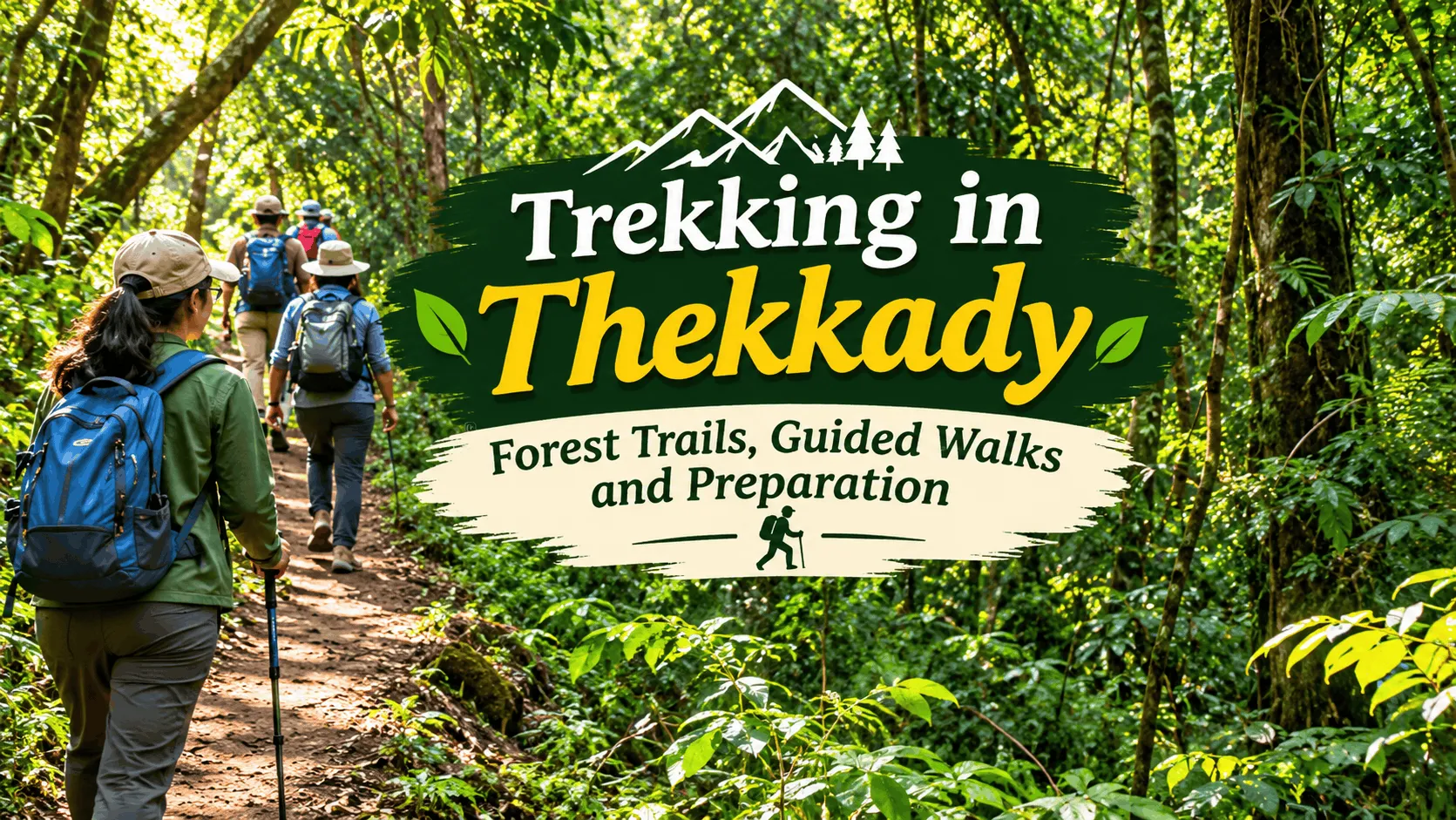
Most visitors meet Periyar from the water, on a boat that drifts past the lake's edge. Walk into the forest itself and the experience changes. The air under the canopy is cooler, the sounds are closer, and you start to notice the small things: a line of ants on a root, a butterfly resting on a leaf, fresh elephant dung on a path. That is what trekking in Thekkady offers, and it is the reason many travellers come back for a second visit.
This guide covers the guided forest walks and treks organised around the Periyar Tiger Reserve. It explains how the main programmes differ, how hard they are, when to go, what to wear and how to book. One point matters more than any other. Treks inside the reserve run only as official, guided programmes with forest department permission, so this is a planning guide for those activities and not a list of trails to try alone.
Why Thekkady is interesting for nature and trekking enthusiasts
Thekkady sits in the Cardamom Hills of Idukki district in the southern Western Ghats. The name is usually traced to thekku, the Malayalam word for teak. The Periyar Tiger Reserve begins at the edge of the village and is the main reason people visit. Its terrain climbs from low, warm forest to high ground that reaches around 2,000 metres, where grasslands are interspersed with patches of shola forest. The reserve is also the watershed for two important Kerala rivers, the Periyar and the Pamba.
For a trekker, that variety matters. A short morning walk and a day-long hike can feel like two different places, even though both start from the same small town. Kumily, about 4 km from the reserve entrance, has the guesthouses, restaurants and spice shops you will need before and after a walk. If you are still deciding what else to fit around your trek, our Thekkady travel guide covers the wider destination, while this article stays with the forest trails.
Another reason Thekkady stands out is how its programmes are run. Periyar is known for community based eco-tourism, and many guided activities involve local people, including members of tribal communities and former poachers who now work as guides. Joining a walk supports that model directly.
Popular trekking and guided forest-walk experiences
The Periyar Tiger Reserve and Kerala Tourism list several eco-tourism programmes. Names, timings and availability change, so treat the descriptions below as an orientation and confirm the current list with the reserve before you plan around any one of them.
Nature Walk and Green Walk
The Nature Walk is the usual first choice for visitors who want hiking in Thekkady without committing a whole day. Kerala Tourism describes it as a guided trek of roughly 4 to 5 km that takes about two and a half to three hours, with several departure slots across the morning and afternoon. The route passes through a mosaic of habitats and is aimed at spotting birds, butterflies and, with luck, larger animals. Groups are led by trained guides, and a forest guard goes along.
Cloud's Walk
Cloud's Walk is a longer guided trek of about three to four hours. Kerala Tourism notes that groups are small, with a maximum of five people accompanied by a trained guide. It suits visitors who want views of the valleys and are comfortable on uphill sections.
Border Hiking
Border Hiking is a day-long hike inside the reserve. It is the more demanding option for anyone searching for trekking trails in Thekkady that go beyond a short walk, and some operators describe it as moderate to challenging. Age and fitness conditions are stricter than for the short walks, so check them when you book.
Jungle Scout and other night programmes
Jungle Scout is a guided night trek in the periphery of the reserve's eco-development zone. Kerala Tourism also lists programmes such as Jungle Patrol, in which visitors join the forest staff's night patrolling. Night activities depend on conditions and permissions, and they are often the first to be adjusted, so ask before building an itinerary around one.
Periyar Tiger Trail and bamboo rafting
The Periyar Tiger Trail is a multi-day trekking and camping programme led by guides from the local community. It has age and medical fitness requirements and needs advance planning. Bamboo rafting combines a river journey with a trek in a day-long programme. These are the commitments to make if you want more than a morning on the trail.

Periyar forest trekking: what visitors should know
Periyar forest trekking is regulated. The reserve has a single entry point at Thekkady, and its eco-tourism programmes run with prior permission from the Kerala Forest Department and in coordination with trained guides and forest guards. Groups stay on designated trails with their guide throughout. Wandering into the forest on your own, or following a track that looks inviting from the road, is not a legitimate alternative and puts both you and the wildlife at risk.
It helps to separate three kinds of walking around Thekkady:
- Official reserve programmes, such as the Nature Walk, Cloud's Walk and Border Hiking, which require booking and a guide.
- Walks on private spice and cardamom plantations around Kumily, which follow the landowner's rules and are separate from the reserve.
- Public roads and village lanes, which are open to everyone but are not forest trails.
Only the first group counts as trekking inside Periyar. If an operator offers you "forest access" outside that framework, ask which permission covers it. The reserve is also a plastic-free zone, and visitors are expected to follow that rule on every walk.
Trail difficulty, duration and physical preparation
Difficulty depends on the programme you choose, so match the trek to your fitness honestly.
The short guided walks are generally rated as easy to moderate. They cover 4 to 5 km on forest paths, with some slopes and uneven ground, and the heat and humidity add effort. If you walk regularly, you will manage them comfortably. Cloud's Walk adds length and climbing. Border Hiking and the Tiger Trail are the demanding end, and the Tiger Trail has stated age and medical requirements.
Age limits vary by programme and sometimes by source. Most short walks set a minimum age of around 12, and longer programmes have both a lower and an upper limit, so confirm the rule for the specific activity before you pay. Some programmes also ask about health or weight.
A few weeks of preparation is enough for the shorter treks:
- Walk 5 to 6 km most days, ideally with some hills or stairs.
- Wear your trekking shoes on those walks so they are broken in before the trip.
- Build leg strength with squats or step-ups if you plan a day-long hike.
- Practise carrying a small daypack with water.
If you have a heart, joint or breathing condition, speak to your doctor before booking anything beyond the Nature Walk.
What to expect during a guided forest walk
A typical walk begins at the reserve's reporting point, where guides check bookings and brief the group. The briefing is worth hearing. Guides explain the route, how to move, what to do if wildlife appears and what you may not carry. Expect to walk in single file at an unhurried pace. Guides stop often to point out a bird call, a tree, a track in the mud or a sign that an elephant passed earlier.
The walk is slower than most people expect, and that is the point. You are there to observe. Silence helps, so keep conversation low and phones on silent. Photography is allowed during the nature walk, with rules, so ask your guide when and where you can use a camera. Always keep the distance your guide sets from any animal and never move toward one for a better shot.
Do not treat a sighting as a promise. Tigers live in the reserve but are rarely seen, and even elephants are never guaranteed on foot. Many guests say the best moments were the quiet ones: mist on a ridge, a hornbill in the canopy, the smell of wet leaves.

Wildlife, vegetation and natural surroundings
Periyar is best known for Asian elephants, and the reserve is considered to have one of the highest elephant densities in India. Gaur and sambar are also seen, and the forest shelters many smaller mammals, reptiles and insects. On foot you are more likely to notice butterflies, birds, tracks and droppings than a large animal in the open, so go with the expectation of reading the forest rather than collecting sightings.
The vegetation changes with elevation. Lower areas hold dense moist forest with tall trees and a thick understorey, while higher ground opens into grassland with shola pockets. Walks along the reserve's edges pass through this transition, which is why the same programme can look different from one season to the next.
Birds reward patient walkers, particularly in the early slots when activity is highest. If birds are your main interest, read our guide to birdwatching in Thekkady before you choose a time slot, because it explains what to look for and when.
Best time for trekking in Thekkady
Thekkady can be visited through the year, and Periyar does not close during the monsoon. Activities may still be restricted in heavy rain, and the trails are wetter and leeches are common from roughly June to September. Many guides and travel writers suggest September to March for green forest and comfortable walking, with summer often better for spotting animals as they gather near water.
Within a day, the early slots are cooler and quieter, and they tend to give better chances for birds. Afternoon slots can feel warmer and more humid. Cool, clear weather between November and February suits longer treks, and the seasonal notes in our piece on Thekkady in winter will help you weigh the trade offs. Whatever month you choose, ask about current trail conditions at booking, since weather can change the programme list at short notice.
Clothing, footwear and essential equipment
Dress for protection and quiet. The reserve's guidance asks for clothing that covers the skin in neutral, non-bright colours, and shorts are generally not permitted.
- Clothing: lightweight, quick-drying long trousers and a long-sleeved shirt in green, brown or grey. Cotton is comfortable, but it dries slowly after rain.
- Footwear: closed walking shoes or trekking shoes with good grip. Sandals are a poor choice on slippery ground.
- Leech protection: leech socks are often provided when needed, but bring your own in the monsoon months.
- Rain layer: a light poncho or rain jacket, particularly from June to September.
- Water: a refillable steel or other non-plastic bottle, since plastic is banned in the reserve.
- Small daypack: for water, a snack, your ID and booking confirmation.
- Optional extras: binoculars, a hat, sunscreen and insect repellent. Check what is allowed before you apply or carry anything strongly scented.
Leave strong perfume, bright clothing and loud gear at your stay.
Safety guidelines and responsible trekking practices
Safety in the forest starts with the guide. Follow instructions immediately, stay in the group and keep to marked trails. If you meet an elephant or other large animal, stay still, keep quiet and wait for the guide to decide the next move. Do not run or take photos at close range.
Practical habits also protect you:
- Eat before you start and drink water regularly.
- Tell your guide about any medical condition, allergy or injury.
- Do not feed, call out to or approach wildlife.
- Carry out everything you bring in, and never leave food waste on the trail.
- Do not pick plants, collect souvenirs or leave the path to look at something.
Responsible trekking goes beyond rules. Book official programmes so that fees reach conservation work and local communities, and choose small groups over crowded ones. Our guide to responsible tourism in Thekkady explains how visitors can reduce their impact before, during and after a trip.
Booking official guided activities and checking availability
Guided treks inside Periyar are booked through the Periyar Tiger Reserve, either on the reserve's official online booking system or in person at the Eco-Tourism Centre, which sources place near the boat jetty and in Kumily. Popular programmes can fill well in advance, especially at weekends, holidays and in the main season, so plan ahead.
Before you pay, confirm these points directly with the reserve or its official channels:
- The programme is currently running and has places on your date.
- The current fee and what it includes, since entry fees are often charged separately.
- Reporting time and meeting point.
- Age, health and weight conditions.
- Cancellation and weather policies.
Prices and timings on third-party sites are often out of date, so rely on the official source. Tribal Discovery Tour can help you shape the rest of your Thekkady plan around the booking you secure, but the reserve controls availability for its own activities.
Suggested preparation checklist
Use this list in the week before your walk.
- Booking confirmed through an official channel, with a printed or saved copy.
- Valid photo ID packed for each trekker.
- Age and health conditions checked for your chosen programme.
- Walking shoes worn in, with spare socks.
- Long, neutral-coloured clothing and a rain layer.
- Leech socks if travelling between June and September.
- Refillable non-plastic water bottle, filled.
- Small snack and any personal medication.
- Insect repellent, sunscreen and a hat.
- Charged phone with the ringer off, and a camera if permitted.
- Binoculars for birds, if you own a pair.
- Plan to arrive at the reporting point early.
Frequently asked questions
Can I trek in Periyar without a guide?
No. Treks inside the reserve are organised programmes that run with permission from the Kerala Forest Department and trained guides and forest guards. Entering restricted forest areas independently is not allowed.
Which is the best option for first-time trekkers?
The guided Nature Walk is the usual starting point. It is shorter than the day-long programmes, covers roughly 4 to 5 km and suits most people with basic fitness.
How long do the guided walks last?
It depends on the programme. The Nature Walk takes about two and a half to three hours, and Cloud's Walk takes about three to four hours. Border Hiking is a day-long hike, and the Tiger Trail runs over several days.
Is there a minimum age for trekking in Thekkady?
Yes, and it varies by programme. Many short walks set a minimum age of around 12, while longer treks have stricter lower and upper limits. Check the current rule for your activity when you book.
Will I see a tiger on a forest walk?
Unlikely. Tigers live in the reserve, but sightings on foot are rare. You are more likely to see birds, butterflies, tracks and perhaps elephants or other herbivores at a distance.
Is trekking near Kumily possible in the monsoon?
Periyar stays open in the rainy season, but some activities may be restricted in bad weather. Trails are slippery and leeches are common, so you need leech socks, a rain layer and flexibility about your plans.
What should I bring on a guided forest walk?
Bring long neutral-coloured clothing, closed walking shoes, a non-plastic water bottle, your ID and booking confirmation, and a rain layer in the monsoon. Binoculars are useful if you enjoy birds.
Are night treks available?
Night programmes such as Jungle Scout have been listed by Kerala Tourism, but availability can change. Confirm with the reserve before building your itinerary around one.
Conclusion
Trekking in Thekkady rewards visitors who arrive prepared and move slowly. The official guided programmes give safe access to forest that would otherwise stay out of reach, and they send fees back to conservation and local communities. Choose the programme that matches your fitness, travel in the season that suits your goals, and book early through the reserve's official channels. Pack for rain and leeches, respect your guide and keep your distance from every animal you meet.
If you want help planning the days around your trek, Tribal Discovery Tour can help you build a trip that fits the forest's rhythm.