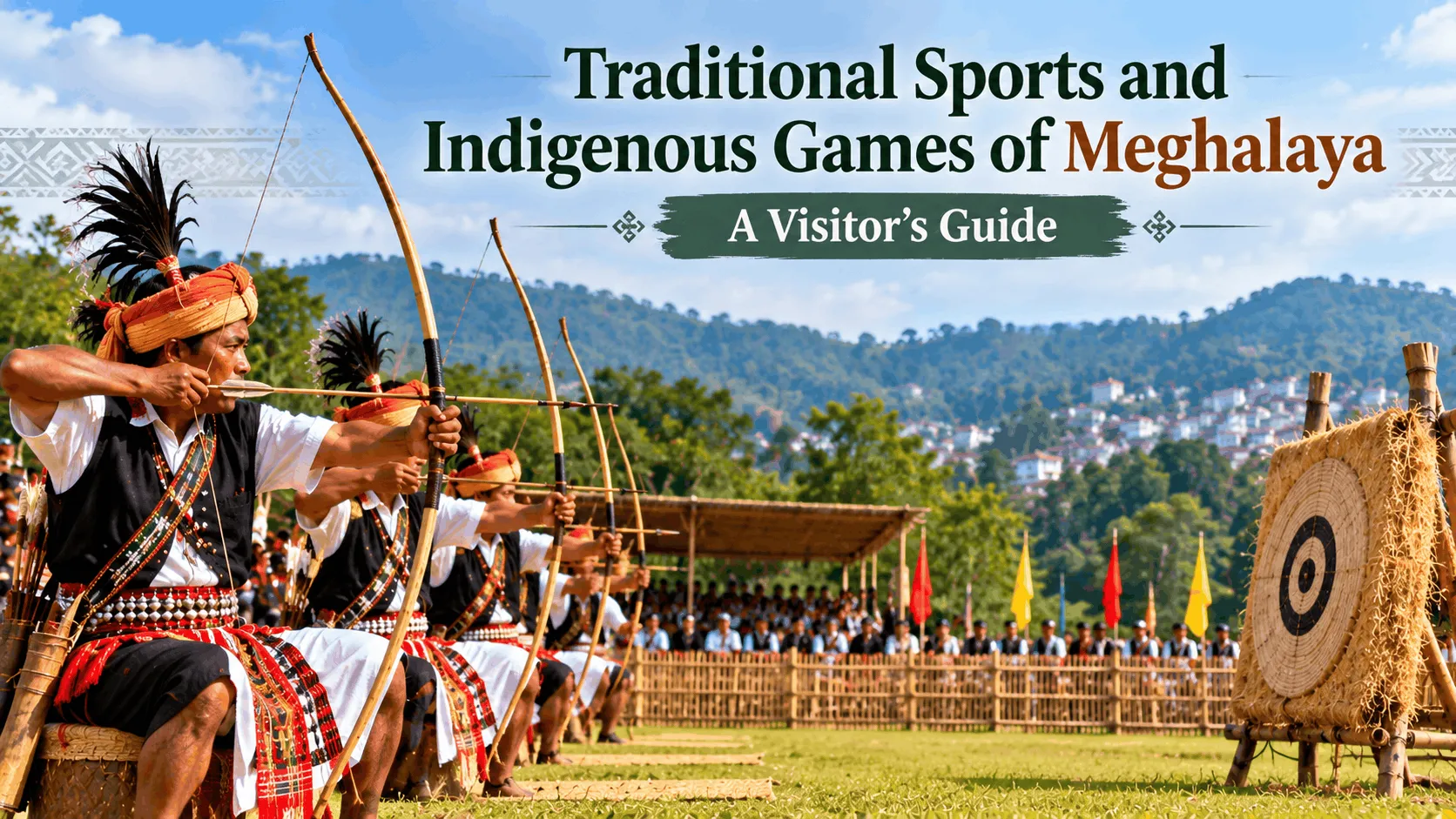
Meghalaya's hills hold more than waterfalls and living root bridges. They also hold games: archery contests in Shillong, a ball game in the mud of Jowai, bamboo-pole pushing at a Garo harvest festival, and spinning tops that children still battle over in village lanes. Some of these traditions are ritual, some are competitive, and some are simply play.
This guide is for culturally curious travelers, families, students and heritage enthusiasts. It describes the games and sports that credible sources document among the Khasi, Jaintia (Pnar) and Garo communities, how they are played, and whether a visitor can realistically see them. It also says plainly where the evidence runs out. Names, spellings and rules differ between sources and between villages, so treat the details here as a starting point and confirm locally. For background on the communities themselves, our guide to the tribes of Northeast India is a good companion read.
The role of games in Meghalaya's cultural heritage
Meghalaya is home to three main indigenous groups, the Khasi, Jaintia (also called Pnar) and Garo. Each has its own language, festivals and customs, so there is no single "Meghalayan game." A game that matters deeply in one community may be unknown in another.
Many of the games documented today need little equipment, using stones, bamboo, wood and household scraps. Reports also record a decline. A survey of Khasi Hills games notes that many urban children have forgotten the rules of games their grandparents played, and that these games survive mostly among rural children. At the same time, festivals, community organizations and government events have given some traditions a new public stage.
It helps to separate three kinds of activity:
- Historical and ritual practices, such as archery's role in life ceremonies.
- Contemporary competitions and festival events, such as the daily archery contest in Shillong or the games held at Wangala.
- Recreational and children's games, which are played informally and are rarely staged for visitors.
Traditional games and sports of Khasi communities
Archery
Archery is the best documented Khasi sporting tradition, and it gets its own section below. Beyond archery, several children's games are recorded in Khasi Hills sources.
Mawpoin
A survey of indigenous games in the Khasi Hills describes mawpoin as a stone-stacking game. The name combines maw (stone) and poin (stones arranged one on top of another, with the largest at the bottom). Teams take turns throwing a ball at the stack, and the game is described as one that many adults remember fondly from childhood.
Spinning-top games
The same survey describes a top-spinning game (the words pynshad and latom refer to spinning and the top). The top is a piece of wood with a nail through the middle, spun by pulling a wound thread. Players try to topple or stop each other's tops inside a drawn circle. A writer describing a revival event calls these top fights a common sight in neighborhoods.
Khalai Sbai
India's Ministry of Education's Bharatiya Khel program lists khalai sbai (also called lehkai sbai, and kawang kot in a card-based variation) as a children's aiming game played in Meghalaya, especially among Khasi and Jaintia communities. Players stand behind a line and throw a smooth stone to knock small targets, such as pottery fragments or flat stones, out of a circle drawn on the ground.
Revived games
In 2015 an event called INDIGIGAMES in Pahambir tried to relive and reimagine old Khasi-Jaintia pastimes. An account of it describes an obstacle course that included a puzzle called kyrwoh, a climb up a greased bamboo pole, and a shot at a straw target with a bamboo crossbow. It was a one-off revival event, not an ongoing tradition, so do not expect to find it on a calendar.
Documented games and sporting traditions of Jaintia/Pnar communities
The most clearly documented Pnar sporting tradition belongs to a festival.
Datlawakor at Behdienkhlam
Behdienkhlam is the largest festival of the Pnar community, centered on Jowai in West Jaintia Hills, with another major celebration at Tuberkmai in East Jaintia Hills. The name means "to drive away the plague" in Pnar. The state government and Meghalaya Tourism both describe Datlawakor (spelled Dat-lawakor, Dad-lawakor and similar ways) as a football-like game played with a wooden ball.
Sources agree on the broad picture and differ on details. The Meghalaya government site describes teams from the northern and southern sides, and says that the side putting the ball on the other side signals a bumper harvest in its region. A 2026 account says the teams represented the upper and lower valleys of the Myntdu River. One cultural account describes the game as an act of propitiation, played under the supervision of the Dalloi, the traditional head. Several descriptions place the match at the festival's climax, near the sacred Aitnar pool in Jowai.
The important point for visitors is that Datlawakor is a ritual game within a religious festival, played by community teams, and not a show. The festival is organized by Seiñraij Jowai, and the schedule is announced locally, so dates change from year to year.
Reports also describe a tussle between groups over a large wooden log carried to the Aitnar pool, though this is part of the festival's ritual procession and not a separate sport. Beyond Datlawakor, we did not find reliable sources documenting other distinct Pnar sports, so this guide does not list any.
Games and sports associated with Garo communities
Garo indigenous games are documented mainly in connection with Wangala, the post-harvest festival of the Garo people, honoring Saljong, the Sun God. The best-known public version is the Hundred Drums Wangala Festival, held near Tura. Reports of recent editions place it at Asanang, with the Garo Heritage Village described as its permanent site, and in November.
Official and news accounts list these indigenous games at Wangala:
| Game (spelling varies) | Description as reported |
| Wa·pong Sika | A contest of strength in which two people at opposite ends of a bamboo pole push each other |
| An·ding O'ka | Described by the Wildlife Trust of India as similar to tug of war and played with bamboo |
| Jak·pong Pe·a | Traditional arm wrestling |
| Gando Makal (also written Makal pala) | Traditional wrestling |
| Budu Sala | Tug of war |
| Ro'ong dea | Stone lifting |
Spellings differ between the Indian government's cultural portal and news reports, and the Garo orthography uses special marks, so confirm names with Garo sources before publishing them widely. The sources describe these as competitions organized as part of a festival. They do not tell us how widely each game is played in everyday village life, so we do not claim that.
Wangala also includes dance contests, food and craft exhibitions, and in recent years a showcase of folk songs and storytelling. The games are one strand of a much larger celebration.
Traditional archery and other documented sporting practices

Archery in Khasi life
Several sources describe archery as central to Khasi culture, not only as sport. Accounts report that a bow and three arrows are placed before a newborn boy during a naming ritual, and that arrows are shot at a death ceremony to accompany the spirit. Origin stories differ. One account says the divine bow and arrows passed from the goddess Ka Shinam to her sons, while another names Ka Mei Hukum as the divine mother who governs archery and whose blessing is sought before games. These are community narratives, and different tellers emphasize different figures.
Archery also carries historical memory. Khasi archers are linked in accounts to resistance against the British, and a competition commemorating the 1829 attack led by U Tirot Sing Syiem at Nongkhlaw has been reported.
Teer: archery and betting
Today the best-known archery event in Shillong is Teer. Organized by the Khasi Hills Archery Sports Institute (also written Association in some reports), it combines a traditional archery contest with legal betting on the results. World Archery describes it as the only legalized form of gambling in the state, and AP reporting says the institute sets the rules and holds the event daily except Sundays and public holidays.
Reports differ on the details. The Khasi bow, called ka ryntieh, is described as bamboo, roughly five feet long, with a split-bamboo string and bamboo arrows. Accounts give the target distance as 50 yards in some reports and about 60 feet in another. Numbers of archers and arrows per round also differ between reports. This probably reflects changes over time and different reporters, so check on site if exact figures matter to you.
Teer is both a living sport and a business. Many people, including archers' families, depend on it, and it has helped keep archery visible to younger people. It is also a betting activity, and you should not feel obliged to bet to watch.
Equipment, rules and how games are played
| Game | Community association | Equipment | Basic idea |
| Archery and Teer | Khasi | Bamboo bow (ka ryntieh), bamboo arrows, straw or bamboo target | Archers shoot at a target in timed rounds, with officials counting arrows |
| Mawpoin | Khasi (Khasi Hills survey) | Stones, a ball | Teams throw a ball at a stacked pile of stones |
| Top spinning | Khasi (Khasi Hills survey) | Wooden top with nail, thread | Players try to topple each other's tops in a circle |
| Khalai sbai | Khasi and Jaintia | Pottery pieces or flat stones, a throwing stone | Knock targets out of a drawn circle |
| Datlawakor | Pnar | Wooden ball | Two teams contest the ball at a festival climax |
| Wa·pong Sika, An·ding O'ka, Jak·pong Pe·a, Gando Makal, Budu Sala, Ro'ong dea | Garo | Bamboo, ropes, stones, depending on game | Strength contests held at Wangala |
Rules vary between villages and sources. A Khasi Hills survey notes that the name of a game may be the same in two places while the way of playing differs. If you watch a game and the rules seem different from what is written here, that is normal, and it is worth asking a local person to explain.
Community competitions and public events
A few events regularly bring these traditions into public view.
Daily archery in Shillong. The Teer contest runs most days. Check current times locally, since reports have given different schedules.
Behdienkhlam in Jowai. The Pnar festival takes place in the monsoon, with reports placing it in July. Datlawakor is part of the closing day. The organizer, Seiñraij Jowai, announces the schedule locally, so look for local news close to the time. One 2026 account says it could find no official visitor rules or photography guidance, so we cannot give any either.
Wangala in the Garo Hills. The Hundred Drums Wangala has been reported for November, with indigenous games on the program. Dates and sites are set each year by the organizing committee.
Can visitors watch or participate?
Watching is often possible, and participating is a different matter.
Watching. The daily archery contest in Shillong is a public event. Behdienkhlam attracts visitors, according to news reports, and Wangala includes public showcases of games and culture. In each case, arrive early, stay at the edge, and follow the lead of organizers.
Participating. We found no reliable source confirming that visitors may join Teer rounds, Datlawakor matches, ritual ceremonies or festival competitions. These are played by community members, often with ritual meaning. Unless an organizer or host explicitly invites you, assume you are an observer. If an event does offer a public activity, such as a demonstration or a craft stall, accept it as an invitation and not an entitlement.
Children's games. Games such as khalai sbai are informal. If you are visiting a village through a host or guide, they may be able to arrange a casual demonstration, though this depends entirely on the community.
Planning. Use our Meghalaya travel guide for general trip planning. If you want help building a cultural trip, you can browse the tours catalogue. We do not list a dedicated traditional-games tour, so ask any operator what a given itinerary includes before booking, and confirm festival dates with local organizers.
Cultural etiquette and photography
- Ask before photographing people. This includes archers, players and spectators. If someone declines, accept it.
- Treat rituals as rituals. Behdienkhlam and Wangala are religious and community occasions. Do not photograph sacred objects or ceremonies without clear permission.
- Stay out of the way. Keep clear of the playing area, targets, the ball's path and procession routes. Archery involves real arrows.
- Do not interrupt or stage. Never ask players to repeat a move for your camera, and do not step into a game.
- Follow organizers and local hosts. If there are rules about positions, flash or drones, follow them.
- Be thoughtful with betting. Teer betting is regulated, and you can watch without taking part.
- Use local guides and support local vendors where possible.
- Share accurately. Credit the community and the game's proper name when you post.
For wider guidance on traveling respectfully across the region, see our Northeast India travel guide.

Frequently asked questions
What are the traditional games of Meghalaya?
Documented examples include Khasi archery, children's games such as mawpoin, top spinning and khalai sbai, the Pnar ritual ball game Datlawakor, and Garo festival contests such as Wa·pong Sika and Jak·pong Pe·a. Many other games likely exist but are not well documented.
What is Teer in Shillong?
Teer is a daily archery contest organized by the Khasi Hills Archery Sports Institute, combined with legal betting. It grew out of the Khasi archery tradition, and reports describe it as helping keep the sport alive.
What is Datlawakor?
It is a football-like ball game played with a wooden ball during Behdienkhlam in Jowai. It is described as a ritual contest, and tradition links the winning side with a good harvest.
What games are played at the Wangala festival?
Reports list Wa·pong Sika (bamboo pole pushing), Jak·pong Pe·a (arm wrestling), An·ding O'ka, Gando Makal (wrestling), tug of war and stone lifting, among others. Programs vary each year.
Can tourists join these games?
We found no reliable evidence that visitors can join Teer rounds, Datlawakor or festival competitions, so assume you are an observer unless organizers invite you.
When are these events held?
Dates change. Behdienkhlam is reported in the monsoon, and Wangala has been reported in November, but organizers announce schedules each year. Teer runs most days. Check locally before you plan.
Conclusion
Meghalaya's traditional games reflect three distinct communities and many local variations. Khasi archery links sport, ritual and memory. Pnar Datlawakor binds a ball game to a monsoon festival. Garo harvest contests turn strength and teamwork into public celebration. Alongside them sit quieter children's games that survive in village lanes.
The best way to experience them is to treat yourself as a guest. Check dates locally, ask before you photograph, stay clear of the action and let the community set the terms. Where the evidence for a game or a visitor opportunity is thin, say so, and let local hosts fill in the rest.