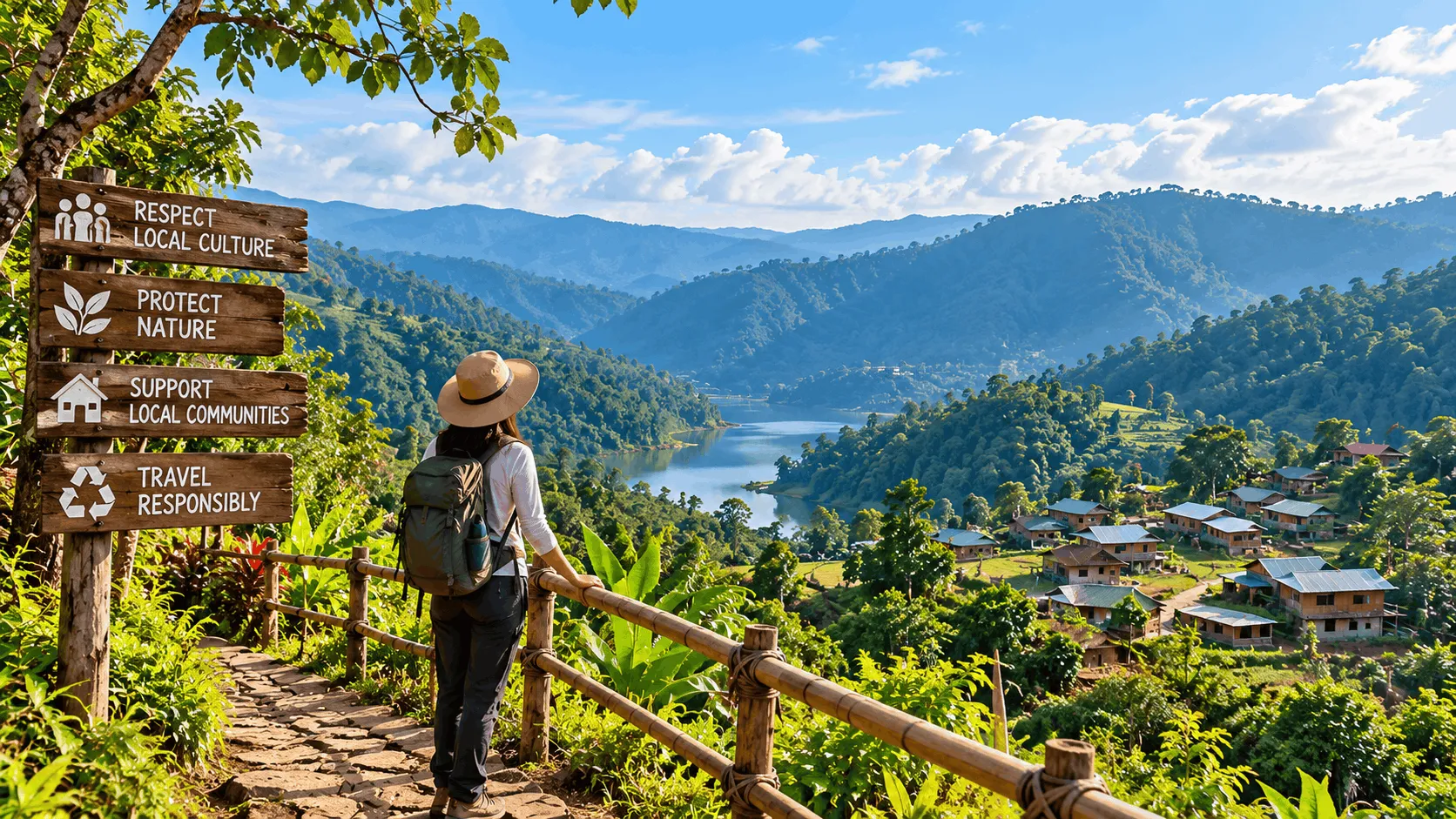
Meghalaya is one of the greenest states in India, and much of its forest, water and culture is looked after by the communities who live there. Meghalaya Tourism says about 76 per cent of the state is forested, with somewhere between 105 and 125 sacred groves. The same page also notes a steady decline in forest cover, driven mainly by tree felling for household firewood and timber, and says over half of the state's recorded springs have dried up or lost flow.
Visitors are a small part of that picture. Responsible tourism in Meghalaya is not about tourists fixing large problems. It is about not adding to them, following the rules communities have set, and spending in ways that keep benefits local. Rules and customs also vary from village to village, so a general guide can only point you in the right direction.
This guide separates what the law or local authorities require from what is simply good practice. For wider trip planning, see our Meghalaya travel guide.

Respecting local customs and community rules
Meghalaya has three main indigenous communities, the Khasi, Jaintia and Garo, along with smaller groups. Our guide to the tribes of Northeast India explains how much customs differ even between neighbouring villages.
Good practice that applies almost everywhere:
- Ask before entering a compound, church, sacred site or ceremony.
- Dress modestly in villages and religious places.
- Ask before photographing people, homes or ceremonies, and accept a refusal.
- Follow your host's or guide's lead.
- Remember that Sunday is a church day in many communities. Meghalaya Tourism's own trekking publication notes that nearly all commercial establishments in Shillong close on Sundays.
The state's trekking publication puts the principle simply: what looks like a stone platform to you could be a memorial, and a patch of green could be a sacred forest. Ask first.
Visiting villages and community spaces
Villages are homes, and only some welcome visitors. Where the community has set rules, those rules come first.
Examples documented by official or reliable sources:
- Mawlynnong has not allowed day visitors on Sundays since January 2026, a decision by the village council. Overnight homestay guests are exempt.
- In Kongthong, visitors may not roam around the village after 10 PM.
- At Mawphlang's sacred grove, visitors enter a small section with guides from the managing clans, and nothing may be taken out, not even a leaf.
- Suktia is a designated no-tobacco zone, according to Meghalaya Tourism's trekking publication.
Plan around the community. Contact hosts in advance, avoid arriving unannounced, and do not ask residents to perform customs for you. Daily practices such as Kongthong's melodic names are part of ordinary life. For the full picture on respectful visits, read our village tourism guide once it is published, or ask your host what suits their community.

Protecting forests, waterfalls, rivers and trails
Meghalaya Tourism's own advice is to walk gently on trails, especially in sacred groves, forests and areas with living root bridges, and to stay on marked paths to protect fragile ecosystems. It also says not to pluck plants or disturb wildlife, and to keep noise down.
Good practice:
- Stay on authorised paths, even when a shortcut looks easy. Steep, wet ground erodes fast.
- Follow access rules and any closures at waterfalls, caves and bridges.
- Do not climb on, cut or damage living root bridges. They are cared for by the communities who use them.
- Pay small community entry fees where they are charged. Amounts vary, so carry small change.
- Leave stones, plants and soil where they are, particularly in sacred places.
Water safety matters as much as protection. Meghalaya Tourism notes that swimming and other water activities are not permitted in most river areas for safety reasons during the monsoon, and our Travel Guide advises following local rules on swimming and boating. If water is high, murky or fast, stay out. Never enter wild caves without an experienced local guide.
Waste reduction and plastic responsibility
Rules:
- The Meghalaya High Court has directed strict enforcement of a ban on single-use plastic. In East Khasi Hills, a district order in effect from 1 June 2025 prohibits plastic carry bags under 120 microns and a list of single-use plastic items.
- A district order under Section 163 of the BNSS prohibits littering along the Shillong to Sohra road and at other popular tourist spots in the district.
- The state pollution control board has reported seizures of banned plastic in 2025.
- A Green Deposit scheme was reported in May 2025, under which visitors carrying plastic into designated eco-tourism zones would pay a refundable deposit. Check whether it applies where you are going.
Good practice:
- Carry a reusable bottle and bag. Meghalaya Tourism asks visitors to bring reusable items and avoid disposable ones.
- Pack out what you pack in, including wrappers and food scraps.
- Use bamboo bins and other facilities where they exist, and follow village waste practices. Mawlynnong, for example, segregates waste.
- For treks, carry non-perishable food only, since food spoils quickly in humid conditions.
Your own waste is only one part of the issue. Local waste systems and infrastructure matter more, and communities are already working on them. Following their lead is the most useful thing you can do.
Responsible photography and drone considerations
Photography:
- Ask permission before photographing people, homes, textiles and ceremonies.
- Do not photograph sacred objects or rituals without clear permission.
- Check the rules at sacred sites with your guide.
- Take care with geotags and captions. Avoid pinning private homes or sensitive locations.
Drones:
- Legal requirement: drones in India fall under the Drone Rules 2021, which divide airspace into green, yellow and red zones on the Digital Sky platform. Green zones need no flight permission, yellow zones need permission from air traffic control, and red zones are restricted.
- Good practice: do not fly over villages, ceremonies or sacred groves without permission from the community, and keep drones away from wildlife and nesting birds.
- Rules for foreign visitors and for protected areas can differ, so confirm with the relevant authority before flying.
Hiring local guides and choosing local businesses
Meghalaya Tourism urges visitors to stay local and buy local: choose homestays or locally run guesthouses, and buy handmade crafts, weaves and produce from village markets. Its accommodation listing includes a homestay category.
Local guides do more than navigate. At Mawphlang, guides from the managing clans explain the rules before you enter. Our Travel Guide recommends local guides for caves, treks and forests.
When hiring, ask:
- Is the guide from the area, or authorised by the community?
- What are the group size and route limits?
- What is included, and is the fee clear in advance?
- Where will our money go?
Meghalaya Tourism also announced Tourist Buddies at Shillong, Sohra, Dawki and Mawlynnong to help travellers and offer work to local youth, according to Outlook Traveller. Check current availability.
Wildlife and habitat protection
The Wildlife (Protection) Act, 1972 prohibits hunting of listed species and restricts damage to habitat inside sanctuaries without a permit. It also restricts trade in animal articles, so do not buy products made from wild animals.
Meghalaya's wildlife includes hoolock gibbons in Nokrek, clouded leopards and hill mynas. The state's trekking publication notes that the Garo community regards the hoolock gibbon as sacred and protects it. In Umpung village, the Dorbar Shnong banned the capture and sale of hill mynas from 2018, a local rule that shows how communities lead conservation.
Good practice:
- Watch from a distance and keep quiet. Never feed, chase or touch animals.
- Do not buy caged birds or wildlife products.
- Do not pick orchids or other plants. Meghalaya Tourism lists over 300 orchid species.
- Stay on paths and out of closed areas.
- For national parks and sanctuaries, check entry arrangements with the forest department. Nokrek and Balpakram are described as having regulated entry, and plastic is discouraged. Confirm current rules before travelling.
Responsible trekking and outdoor activities
Meghalaya's official trekking publication, Echoes of the Hills, gives practical advice that doubles as responsible practice:
- Check current weather and trail conditions. Trails are slipperiest in the monsoon, and rain can disrupt roads.
- Leave a contact number with your organiser or a local, since mobile signal is limited on many trails.
- Carry cash, since ATMs are limited, and prepay for accommodation and transport where possible.
- Book a vehicle for the whole trip. Local transport schedules can change suddenly.
- Pack light and carry only non-perishable food.
- Do not leave litter. Carry out everything you carry in.
Safety essentials:
- Stay on marked trails and use a local guide on unfamiliar routes.
- Respect closures, village rules and checkpoint advice.
- Do not cross swollen streams or enter fast water.
- Carry a first-aid kit and enough water.
- Start early so you finish before dark.
Our Meghalaya trekking guide covers routes in more detail. Check which trails need guides or permission before you go.
Choosing tours and accommodation thoughtfully
No label guarantees a responsible choice, and this guide does not rate any operator or property as sustainable. The state itself notes that the recognition villages receive reflects effort, not a blanket guarantee. Instead, ask questions and compare answers.
Questions for operators:
- Do you use local guides, drivers and homestays? Who are they?
- How do you handle waste on trips?
- What are your group-size limits, and how do you respect village rules?
- Do you visit villages only with the host's agreement?
- What is included in the price, and what is not?
Questions for accommodation:
- Who owns and runs the property?
- How are waste and water handled?
- Does it use local staff and buy local food?
- Are the claims on the website something you can check?
Be cautious about "eco" labels without detail. Ask for specifics, and read reviews. If you would like to compare trip formats, browse our tours catalogue and read each itinerary to see what it includes.
A responsible Meghalaya travel checklist
Before you go
- Check weather, road and trail conditions close to your dates
- Confirm that any village, sacred site or park you plan to visit accepts visitors
- Ask about fees, dress and photography rules
- Book local guides and homestays where possible
- Pack a reusable bottle and bag, rain gear and sturdy shoes
- Share your plans and a contact number
On the ground
- Stay on authorised paths and respect closures
- Ask before photographing people, homes and ceremonies
- Carry out all waste
- Take nothing from sacred places, including plants and stones
- Keep wildlife at a distance and quiet around it
- Stay out of dangerous water
- Spend locally, and pay fair prices
Before you share
- Check captions and geotags
- Describe communities by their own names and avoid generalisations
Frequently asked questions
Is single-use plastic banned in Meghalaya?
The High Court has directed enforcement of a ban, and East Khasi Hills has a district order in effect since 1 June 2025 covering thin plastic bags and listed single-use items. Carry reusable items and check local rules.
Do I need permission to visit villages?
Not always, but you should ask. Some communities have set rules, such as Mawlynnong's Sunday restriction for day visitors. Contact your host or guide in advance.
Can I fly a drone in Meghalaya?
Drones are covered by India's Drone Rules 2021 and the zones on the Digital Sky platform. Ask permission from the community before flying near villages or sacred sites, and check rules for protected areas.
Is it safe to swim in rivers and pools?
Not always. Meghalaya Tourism notes that swimming and water activities are not permitted in most river areas for safety reasons in the monsoon. Follow local instructions and stay out of high or fast water.
Which tours or hotels are sustainable?
No operator or property is rated here. Ask about local ownership, waste handling, group size and village agreements, and look for specifics.
What should I do with my rubbish on a trek?
Carry it out. Many trails have no bins, and the official trekking guide asks visitors not to leave litter.
Does responsible travel really make a difference?
Individual choices matter at the margin. Larger problems such as forest loss depend on policy and local economies. What you can do is avoid adding harm and spend where it supports local livelihoods.