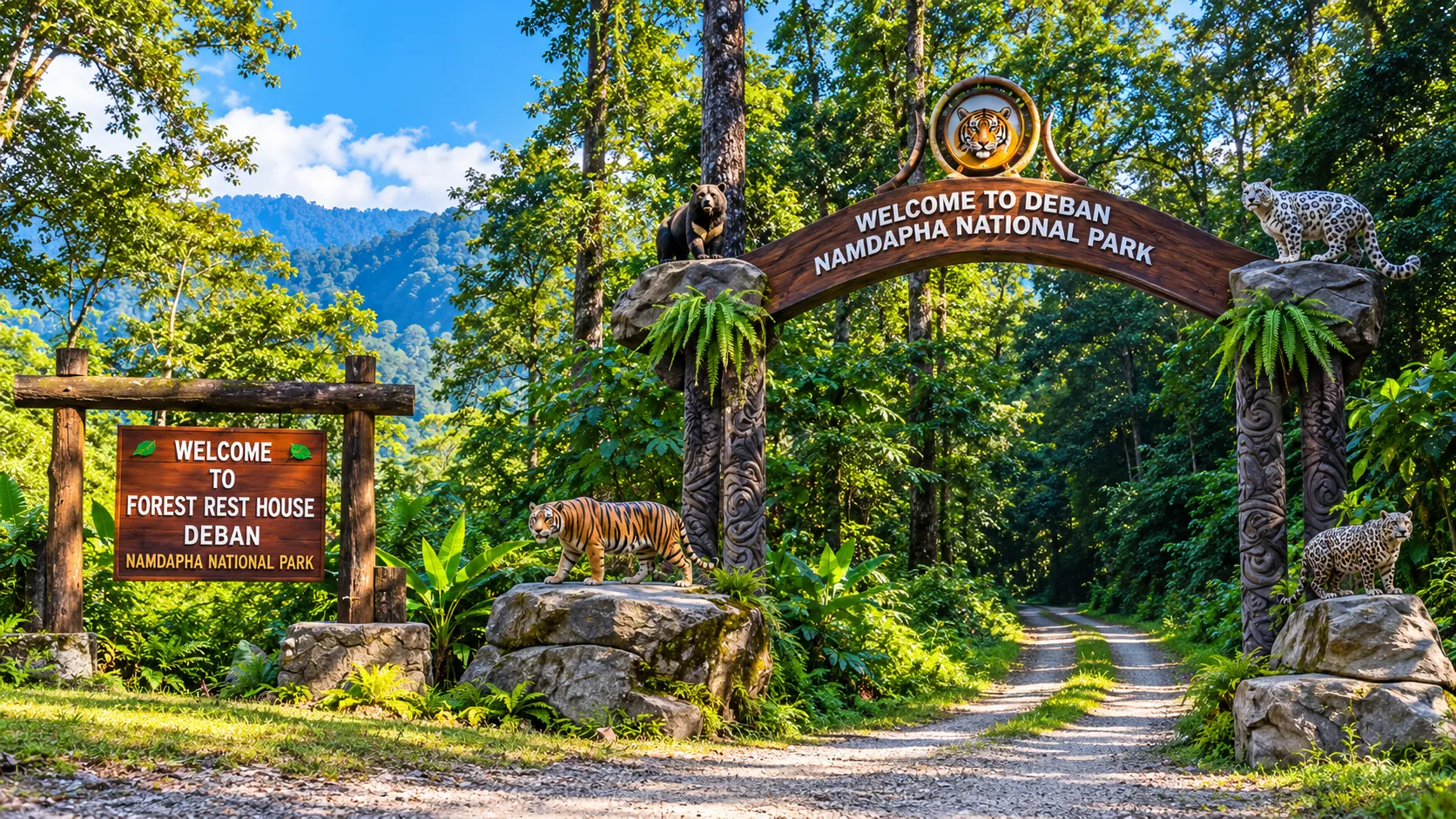
Namdapha National Park sits in the far southeastern corner of Arunachal Pradesh, in Changlang district, running right up to the border with Myanmar. It's one of India's largest protected areas, spread across roughly 1,985 square kilometres, and one of its least visited. Most of that acreage has no road at all — the park is reached on foot as much as by vehicle, and long stretches remain genuinely unsurveyed.
What sets Namdapha apart is its elevation range: from near 200 metres above sea level along the Noa-Dihing River to over 4,500 metres at the Dapha Bum ridge, all inside one reserve. That gradient produces tropical rainforest, temperate broadleaf forest, and alpine terrain within the same boundary, which is part of why Namdapha carries real weight among people planning a wildlife, trekking, or nature trip through Arunachal Pradesh — few Indian parks offer this range of habitat in a single visit.
Where is Namdapha National Park?
Namdapha National Park is located in Changlang district, in the far southeast of Arunachal Pradesh, along the international border with Myanmar. The gateway town is Miao, a small settlement that handles permits, transport, and supplies for anyone heading into the park — nearly every trip here begins with arranging logistics in Miao.
From Miao, a forest department road runs roughly 26 kilometres to Deban, on the banks of the Noa-Dihing River. Deban is the last point reachable by vehicle. Beyond it, the park is explored on foot, with trekking routes continuing toward remote outposts like Haldibari, Hornbill Camp, and Firmbase, and eventually toward the isolated settlement of Vijoynagar deep inside the reserve. Miao itself connects to the larger towns of eastern Assam and Arunachal — Margherita, Tinsukia, and Dibrugarh are the usual staging points before the final stretch in.
Why visit Namdapha National Park?
Namdapha is built for travellers who want wilderness on its own terms rather than a packaged safari circuit. Its dense, largely untouched forests are the main draw — hollong and mekai trees towering over canebrake, orchids, and undergrowth that thins out only as the terrain climbs toward alpine elevation. The park sits within a globally recognised biodiversity hotspot, and its documented wildlife, discussed below, makes it a serious destination for wildlife-focused travel even though sightings are far from guaranteed.
Birdwatchers rate Namdapha among the strongest sites in Northeast India, and trekking routes from Deban toward Hornbill Camp and Firmbase give visitors a genuine forest experience rather than a drive-through one. Nature photographers tend to come for the landscape and birdlife as much as for predator encounters. And because so much of Namdapha remains unexplored — botanists still haven't finished cataloguing its plant life — a visit here carries a different weight than most Indian national parks: this is one of the last large forests in the country that hasn't been fully mapped.
Wildlife in Namdapha
Namdapha's fauna list runs long, and the park is known for hosting all four of Asia's big cats — tiger, leopard, clouded leopard, and snow leopard — a result of its unusually wide elevation range. This is a genuinely rare distinction, but it's worth being direct about what it means in practice: these animals are documented through camera traps and field surveys far more often than through visitor sightings, and wildlife sightings in Namdapha are never guaranteed. The forest is dense, the terrain steep, and many mammals here are naturally elusive or nocturnal.
Beyond the big cats, close to 96 mammal species have been recorded in the park, including red panda, Asiatic black bear, dhole, gaur, and takin. The hoolock gibbon, India's only ape, may be seen or heard in the forest canopy around Deban, along with capped langur, Assamese macaque, and slow loris. The critically endangered Namdapha flying squirrel is known from a single specimen collected in 1981 and hasn't been confirmed since — a reminder of how much of this ecosystem remains not fully understood.
Treat a Namdapha visit as a chance to experience an intact forest ecosystem, not as a wildlife-sighting guarantee. Visitors who go in with that expectation tend to get more out of the trip than those chasing a specific animal.
Birdwatching in Namdapha
Namdapha is regarded as one of the more significant birdwatching destinations in Northeast India, and several hundred species have been recorded within the park, including six species of hornbill. Species that draw dedicated birders to the region include the white-bellied heron, one of the world's rarest waterbirds, along with rufous-necked hornbill and great hornbill.
As with the park's mammals, treat any specific species count you see online as approximate — comprehensive surveys of Namdapha's birdlife are still incomplete, and what gets recorded depends heavily on season, effort, and location within the park. Early morning walks near Deban and along the Noa-Dihing tend to be the most productive time and place for birdwatching, though this too varies by season and weather.
Trekking and nature experiences
Namdapha isn't a jeep-safari park. Its terrain and forest cover make vehicle-based wildlife viewing impractical beyond the road to Deban, so the park is explored mostly on foot, with forest guides required for anything beyond the immediate Deban area.
Short forest walks and riverside excursions near Deban suit most fitness levels and don't need advance planning beyond arranging a guide locally. Longer treks toward Hornbill Camp, Firmbase, and further into the reserve are multi-day undertakings that require porters, camping gear, and permits arranged well ahead of time — these routes demand a reasonable level of fitness and comfort with basic camping conditions, and not every route or camp operates year-round.
Weather in Namdapha shifts quickly given the range of elevations involved, so trekkers should be prepared for cool, wet conditions even outside the official monsoon season, particularly at higher altitudes. Given the remoteness of the terrain — no mobile network, limited emergency access, and long walking distances between points — arranging treks through an established local operator with experienced guides is the sensible approach rather than assuming independent access.
Best time to visit Namdapha
Dry season / winter (November–February): Generally considered the most reliable period for both road and trail access, with cooler, drier weather. Most operators and the forest department point to this window as the most comfortable time for trekking and wildlife or bird observation, though nights can get cold, especially at higher elevations.
Spring (March–April): Warmer days, active birdlife, and forest flowering, with trails still mostly accessible. A reasonable alternative to peak winter for travellers who prefer milder temperatures.
Monsoon (June–September): Not recommended. Heavy rain makes forest roads and trekking trails difficult or impassable, and river levels in the Noa-Dihing can rise quickly and unpredictably.
Pre-monsoon summer (May) and post-monsoon (October): Transitional periods. May brings rising heat and humidity at lower elevations along with early pre-monsoon showers; October sees conditions gradually improving after the rains, though some trails may still be recovering from monsoon damage.
Because access and trail conditions genuinely change year to year, confirm current conditions with the Namdapha Tiger Reserve forest office or a local operator shortly before travelling, especially for any trek beyond Deban.

How to reach Namdapha National Park
Via Miao: Every route into Namdapha passes through Miao, the park's gateway town, where permits, guides, and local transport are arranged. From Miao, a forest road covers the roughly 26 kilometres to Deban, the last motorable point inside the park.
From Assam: The standard approach route runs through Tinsukia, Digboi, and Margherita before reaching Miao via Ledo. Dibrugarh, in Assam, is the nearest airport (Mohanbari), with road distances to Miao reported in the range of 135 to 170 kilometres depending on the source — confirm current driving time when booking transport. Tinsukia is the nearest major railway junction with wide connectivity, while Margherita has a smaller station somewhat closer to Miao.
Local transport: Buses generally run as far as Miao from towns like Tinsukia; onward travel to Deban and into the park is typically arranged through taxis, forest department vehicles, or a local operator. Current bus schedules, fares, and vehicle availability are not something to rely on from general travel content — confirm these directly with a local operator or the forest office before your trip.
Permits and travel preparation
Two separate permits apply to a Namdapha trip. Indian citizens who aren't residents of Arunachal Pradesh need an Inner Line Permit (ILP) to enter the state at all, obtainable online through the state's e-ILP portal, at certain airports and railway stations on arrival, or through Deputy Commissioner offices in Arunachal's districts. Foreign nationals need a Protected Area Permit (PAP) instead, generally arranged through a registered tour operator or the Resident Commissioner's office.
Beyond state-level entry, Namdapha requires its own park entry permit, issued by the Field Director's office at the Namdapha Tiger Reserve in Miao, covering entry into the park and any camping or rest house bookings inside it.
Fees, validity periods, and application procedures for both the ILP and the park permit change from time to time. Treat any specific fee amounts you find online as unverified until confirmed directly with the Arunachal Pradesh government's ILP portal or the Namdapha Tiger Reserve forest office, and build in a buffer day for permit processing if you're arranging things in Miao rather than in advance.
Where to stay
Accommodation in and around Namdapha is limited by design, which is part of what keeps the park uncrowded. The Deban Forest Rest House, run by the forest department, is the primary lodging option inside the park, at the farthest motorable point from Miao. Camping at designated sites further into the reserve is possible for trekking parties, but requires forest department permission and typically a guide.
In Miao itself, basic guesthouses and a handful of homestays serve as a staging point before or after the park. Availability at Deban in particular is limited, so book ahead through the Field Director's office or a local operator, and confirm current rates and facilities directly rather than relying on published prices, which change.
What to pack
Namdapha's elevation range means packing well matters more here than at most Indian parks. Waterproof clothing is worth carrying regardless of season, since showers can appear with little warning in this climate, and sturdy, broken-in trekking footwear with good grip is essential on muddy, uneven trails. Insect protection is important year-round given the dense, humid forest, and quick-dry clothing helps manage the combination of humidity, sweat, and sudden rain.
A good pair of binoculars does more for the wildlife and birdwatching experience here than almost any other item, since much of Namdapha's fauna is heard or briefly glimpsed rather than seen up close. Protect camera gear from humidity and rain with dry bags or covers. Round out your kit with a basic first-aid kit, a refillable water supply or purification method, and a portable power bank, since charging points are scarce once you're past Miao and mobile network coverage is minimal to nonexistent inside the park.
Responsible wildlife tourism
Namdapha's remoteness makes it ecologically valuable and also genuinely fragile. Never feed wildlife, including primates — it alters their natural behaviour and can make them dependent on or aggressive toward people. Maintain distance from any animal you encounter and never approach for a closer look or photograph.
Avoid loud noise on forest walks and treks; sound carries in dense forest, and quiet movement improves everyone's chances of a genuine wildlife encounter. Do not disturb animals or their habitat for the sake of a photograph, and carry all waste back out with you, since the park has limited waste infrastructure this deep in the forest.
Follow forest department regulations on permitted routes, camping sites, and group sizes, and work with registered guides who know current rules. Throughout the region, respect the customs and land of the Lisu, Chakma, Tangsa, Singpho, and other communities whose homeland this is — ask before photographing people, and choose guides with a genuine connection to the area.
Suggested Namdapha itinerary
Two days: Enough time for the journey from Miao to Deban, an afternoon of walks and birdwatching near the river, and a return the following day. This covers the accessible core of the park without a trek beyond Deban.
Three days: Adds a full day at Deban for a longer forest walk, more birdwatching time, or a short day-trek toward a nearer viewpoint, depending on trail conditions and guide availability, without the rushed feel of a two-day turnaround.
Longer trips (four days or more): Opens up the possibility of a multi-day trek beyond Deban toward Hornbill Camp or similar points, with time built in for weather delays, which are common in this terrain. Treks further toward Firmbase or Vijoynagar require considerably more time, porters, and advance planning, and aren't realistic on a short visit.
Whatever length you choose, build in slack for road conditions, permit processing, and weather — Namdapha isn't a park where tight schedules work well.
Frequently asked questions
Where is Namdapha National Park located? In Changlang district, in the far southeast of Arunachal Pradesh, along the border with Myanmar. The gateway town is Miao.
What is Namdapha National Park known for? Its wide elevation range, spanning roughly 200 to over 4,500 metres within one reserve, and its documented presence of all four Asian big cat species, alongside the hoolock gibbon and hundreds of recorded bird species.
Will I definitely see wildlife at Namdapha? No. Wildlife sightings in Namdapha are never guaranteed — the forest is dense and many species are naturally elusive. The park's big cats in particular are documented mainly through camera traps rather than visitor sightings.
Is Namdapha good for a wildlife safari? Not in the conventional jeep-safari sense. Dense forest and difficult terrain mean wildlife and bird observation happen mostly on foot, through guided walks and treks.
What is the best time to visit Namdapha? Roughly November through April, with winter (November–February) generally offering the most reliable access and comfortable conditions. Monsoon months, June to September, are best avoided.
How do I reach Namdapha National Park? Via Miao, reached by road from Assam through Tinsukia, Digboi, and Margherita. Dibrugarh is the nearest airport and Tinsukia the nearest major railhead, though distances vary slightly by source and should be confirmed before travel.
Do I need a permit to visit Namdapha? Yes — an Inner Line Permit (or Protected Area Permit for foreign nationals) to enter Arunachal Pradesh, plus a separate park entry permit from the Namdapha Tiger Reserve's Field Director in Miao. Confirm current requirements and fees before travelling, since these are subject to change.
How many days should I plan for a Namdapha trip? A minimum of two days covers Deban and its surroundings; three to four days or more allows for a short trek and a less rushed visit, depending on permits and conditions.
Where can I stay near Namdapha? The Deban Forest Rest House inside the park and basic guesthouses in Miao town are the main options. Availability is limited, so book ahead and confirm current facilities directly.
Is mobile network available inside Namdapha National Park? Largely no. Past Miao, coverage is minimal to nonexistent, so plan communications and navigation accordingly and carry a power bank.
Do I need a guide to trek in Namdapha? Yes, for anything beyond the immediate Deban area. Forest guides are required for longer treks, and arranging routes through an established local operator is the sensible approach given the terrain and remoteness.
Namdapha National Park rewards travellers willing to trade guaranteed sightings for genuine wilderness. Between its rare four-big-cat habitat, its standing as one of Northeast India's most significant biodiversity zones, and its remote position on the Myanmar border, a visit here is less about ticking off species and more about experiencing one of the last large, largely unstudied forests in the country. Plan around the winter and spring window, confirm your permits and current conditions before you travel, and go in with realistic expectations about what you will and won't see.