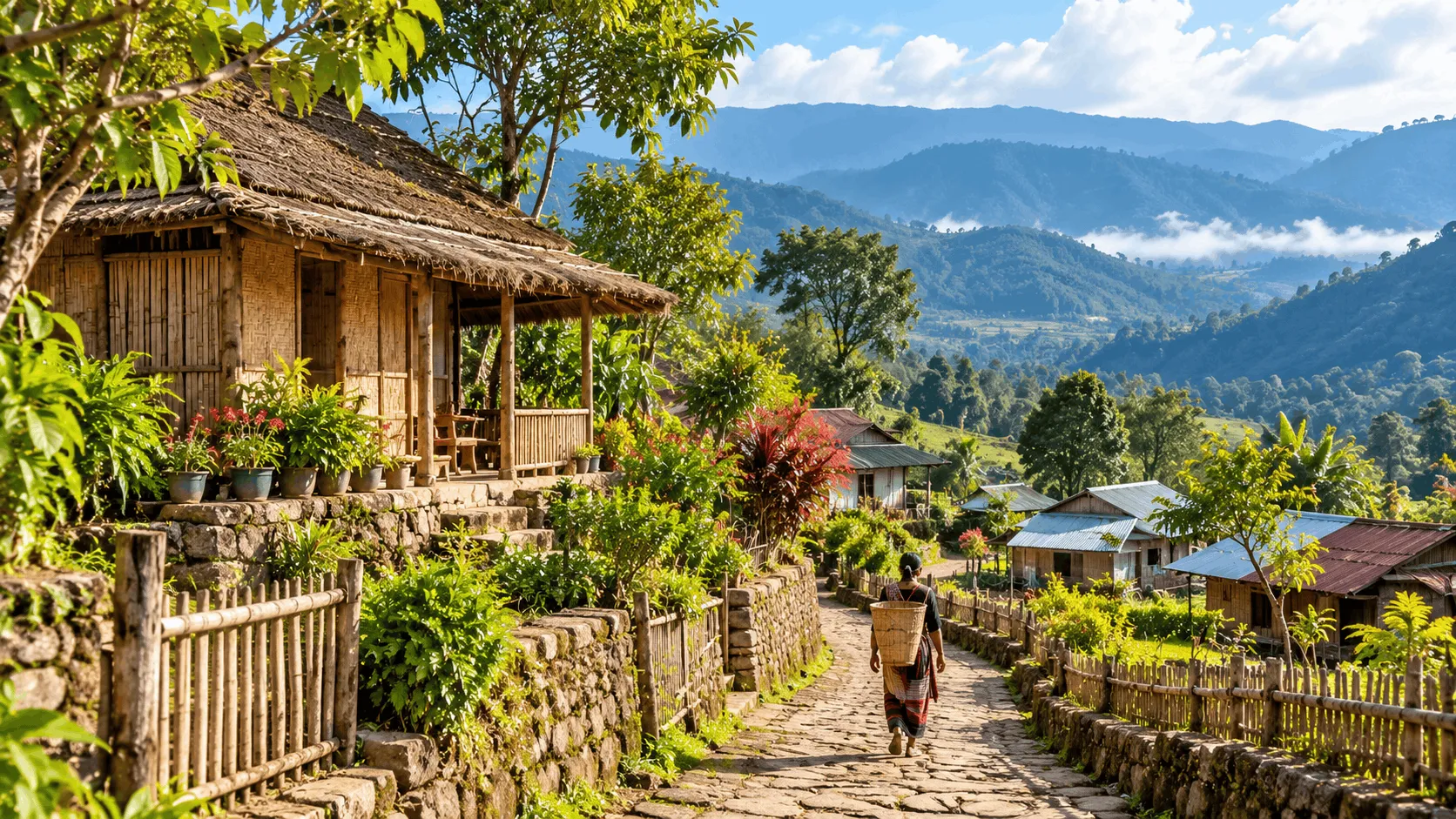
Most people who come to Meghalaya spend their time on waterfalls, caves and viewpoints. Rural life sits just behind those sights. Villages in the state are homes, farms, churches, schools and places with their own rules, and only some of them are set up to receive visitors.
That is the central idea of this guide. Village tourism works when the community decides what it shares, when and with whom. A good visit starts with a few questions: who runs this place, what is open to outsiders, and what should I leave alone?
The guide covers what village tourism means in Meghalaya, how communities and regions differ, which villages you can research, and how to plan, travel and behave. For the wider trip, see our Meghalaya travel guide.

What village tourism means in Meghalaya
Meghalaya Tourism describes the state's villages as places rich in heritage, storytelling, craftsmanship and sustainable living, and says it has positioned local communities as key players in creating visitor experiences. Its stated aim is tourism that generates employment without displacing people or disrupting their way of life.
In practice, village tourism takes several forms:
- Staying in a locally run homestay and eating with the host family
- Walking with a local guide through a village, forest or farmland
- Visiting a community-managed site such as a sacred grove
- Buying produce or crafts directly from the people who make them
The state also recognises villages formally. In 2024 the Union Ministry of Tourism named Umden (Craft category) and Mawphlang (Heritage category) as winners of its Best Tourism Village competition, and Kongthong won a bronze award in 2023. These awards signal that a village has put effort into hosting visitors. They do not mean every neighbouring village is open, and they do not mean a visit is available on demand.
Village tourism is not performance. Daily customs, church services and ceremonies belong to the people who practise them. You are a guest in someone's neighbourhood, and the hosts set the terms.
Understanding differences between communities and regions
Meghalaya has three main indigenous communities: the Khasi, the Jaintia (Pnar) and the Garo. Each has its own language and customs, and the Khasi and Jaintia languages belong to a different family from Garo. Matrilineal descent is well documented across all three, though practices vary and are changing. Our guide to the tribes of Northeast India gives the wider context.
The regions are broadly the Khasi Hills in the centre, the Jaintia Hills in the east and the Garo Hills in the west. Faiths include Christianity and indigenous belief systems, and both can be present in a single village.
Governance also differs, and it affects who you ask for permission:
- In many Khasi villages, the Dorbar Shnong is the traditional village council, led by a headman called the Rangbah Shnong.
- In Garo villages, the Nokma, the head of the clan, is responsible for land and community leadership, and a village council takes decisions.
- Jaintia and other local arrangements differ again, so ask locally rather than assuming.
The practical point is simple. A rule that applies in one village may not apply in the next, and the same custom may carry a different meaning. Ask a local host or guide before you assume.
Village areas and experiences travellers can research
This guide names only places that official or well-documented sources describe as receiving visitors. Confirm current access before you go, since arrangements change.
Mawphlang, East Khasi Hills
Meghalaya Tourism places Mawphlang about 26 km from Shillong. The village is known for its sacred grove, a forest the Khasi community has protected for generations. Visitors enter only a small section and must be accompanied by guides from the managing clans, who explain what is forbidden before you go in. Nothing may be touched or removed, not even a leaf, and nothing may be left behind. Meghalaya Tourism advises arranging a local guide familiar with the place and language.
The community is involved in running visits. A 2024 government press release names the president of the Mawphlang Sustainable Tourism Society among the village representatives who received the national award.
Mawlynnong, East Khasi Hills
Mawlynnong became well known after Discover India magazine called it Asia's cleanest village in 2003. Waste is segregated, bamboo dustbins line the paths, and residents take part in cleaning drives, according to a 2026 Outlook Traveller report. Many families have moved from farming to homestays, cafés and stalls.
The village is also an example of a community setting limits. Since January 2026 the village council has not allowed day visitors on Sundays, which are kept for church services, family time and community activities. Overnight guests in local homestays are exempt. The same report says that on busy Saturdays as many as 1,000 visitors can arrive in a village of about 600 residents. Plan a day trip for Monday to Saturday.
Kongthong, East Khasi Hills
Kongthong is known for jingrwai iawbei, a tradition in which each person has a melody composed for them, usually described as the song of the clan's first woman. Meghalaya Tourism describes it as a daily practice that can be heard in the evening as families call children home. It is not a show, so do not ask residents to perform.
The official trek page notes a village rule: visitors may not roam around Kongthong after 10 PM. It also encourages visitors to buy the village's oranges and honey. Community homestay accommodation exists, but details vary between sources, so confirm what is available before travelling.
Umden, Ri-Bhoi
Umden won the 2024 national award in the Craft category for its eri silk weaving. State sources describe eri silk, known as Ryndia, as woven and dyed sustainably in villages such as Umden. Published sources do not say whether or how visitors can see weaving there, so contact the community or Meghalaya Tourism before planning a visit.
Garo and Jaintia Hills
Both regions have villages with strong traditions, but this guide could not confirm specific visitor programmes, so it names none. Meghalaya Tourism's accommodation listing includes a homestay category, and a local operator can say which communities welcome visitors.
Everyday life, local work and community activities
Rural life in Meghalaya is shaped by farming, forest use, crafts and church or ritual calendars. Meghalaya Tourism names bamboo and cane work and weaving as the backbone of the state's artisanal heritage, and the Khasi, Garo and Jaintia each have their own styles.
What you see depends on the hour and the season. Mornings are often for fieldwork and markets, and Sundays in many Christian villages are for church. Do not expect activity on demand.
Some good ways to learn without intruding:
- Eat meals prepared by your host and ask how dishes are made.
- Ask a guide to explain farm or forest practices instead of walking through fields alone.
- Buy crafts and produce from the maker or grower.
Avoid treating daily tasks as photo opportunities. A woman weaving or a farmer carrying a load is working.

Cultural etiquette and appropriate visitor behaviour
Etiquette changes by village, so treat these as starting points and follow your host.
- Greet people politely and let hosts lead.
- Dress modestly in villages and near religious sites.
- Ask before entering a compound, a church, a sacred site or a ceremony.
- Do not remove anything from sacred places. At Mawphlang the rule applies to plants, stones and soil alike.
- Respect local curfews and visiting rules, such as Kongthong's 10 PM limit.
- Keep Sundays in mind in villages with church traditions.
- Ask about alcohol, smoking and waste. Mawlynnong discourages single-use plastic and smoking.
Do not treat ceremonies or festivals as shows. Some are open to visitors and many are not. Dates change, so confirm with organisers or tourism offices.
Asking permission before photography
Photography is where visitors most often cause offence. A rule of thumb that fits Meghalaya well is to ask first, every time, and to accept a refusal without argument.
- Ask before photographing people, homes, textiles, ceremonies and children.
- Show the picture if the person asks to see it.
- Never photograph sacred objects or rituals without clear permission.
- Ask your guide or host about restrictions inside sacred groves and at community sites.
- Be careful what you post. Captions should name the village and community accurately, and you should not geotag private homes.
- Skip drones unless the community or local authority has said yes.
Residents of busy villages have spoken about the loss of privacy. A former Meghalaya Tourism Development Forum official who advised Mawlynnong early on has voiced concern about the effect of visitor numbers on residents' daily lives. Your camera adds to that pressure.
How to plan a village visit
- Start with who hosts. Look for villages that a government source, a community organisation or a reputable local operator confirms receive visitors. Do not turn up in a village that does not.
- Contact in advance. Use official channels or a local host, and confirm days, fees and rules. Do not assume any fee or service exists unless you are told.
- Choose your timing. Avoid Sundays in Mawlynnong unless you are an overnight guest. Check weather, since Meghalaya Tourism advises packing for rain in the monsoon and for cold in winter.
- Book a local guide where required or advised. Mawphlang's grove is entered with a guide.
- Plan for the community's schedule. Festivals, church days and harvest may limit access.
- Pack for rural conditions. Carry a reusable bag and bottle, cash, rain gear, sturdy shoes and a small first-aid kit.
- Set realistic expectations. Facilities may be simple, and mobile signal can be weak.
If you would rather have a planned trip, browse our tours catalogue and read each itinerary to see what it includes. Do not assume a tour includes a village visit unless the itinerary says so.
Transport, facilities and accessibility
Village roads in the hills are narrow and winding, and heavy rain can slow travel or cause landslides. Our Travel Guide notes that Mawlynnong lies about 72 km from Shillong, and a hired car with driver is usually the most practical way to reach several places.
Some examples of what to expect:
- Mawphlang is a short drive from Shillong at about 26 km, according to Meghalaya Tourism.
- Kongthong is reportedly around three hours by road from Shillong. On the official Whistling Village Trek, Meghalaya Tourism says buses and taxis run to the start point at Lyndem, but village transport schedules can change unexpectedly, so a dedicated vehicle from Shillong is recommended.
- Mobile coverage varies. The trek page says Jio and Airtel work best along that trail, and our Travel Guide warns that signal can be weak in rural areas.
On accessibility, many village paths involve steps, steep slopes and wet ground. The Nongriat trek, for example, is described as about 3,500 stone steps. If you or a companion have limited mobility, ask hosts about the terrain before booking, and be prepared to choose villages with road access.
Meghalaya Tourism has also announced Tourist Buddies at Shillong, Sohra, Dawki and Mawlynnong, a scheme to guide travellers and offer work to local youth. Check current availability before relying on it.
Supporting local businesses and community initiatives
Money does the most good when it reaches the people who live in the village. Practical ways to do that:
- Stay in locally run homestays where available. Meghalaya Tourism's accommodation listing has a homestay category, and the state runs a homestay scheme.
- Eat at family-run cafés and buy from village stalls.
- Buy Kongthong's oranges and honey, which Meghalaya Tourism encourages, or other products directly from producers.
- Hire local guides and pay a fair rate.
- Respect fixed community rules and any fees the community sets.
Be wary of claims about community benefit. This guide cannot confirm how any one village shares tourism income, so repeat such claims only if they come from the community itself.
Responsible tourism: what to do and what to avoid
Do
- Ask permission before entering, photographing or joining anything.
- Follow the village council's rules and your guide's instructions.
- Take your rubbish with you or use designated facilities.
- Learn a few words of greeting, and use the community's own name for itself.
- Check that experiences are genuinely offered before you arrive.
- Spend locally and be patient with simple facilities.
Avoid
- Treating villages as attractions you can enter freely.
- Asking people to perform customs, dances or songs.
- Photographing sacred objects, rituals or children without permission.
- Removing plants, stones or objects from sacred sites.
- Flying drones, playing loud music or leaving litter.
- Making generalisations about "tribal" life in what you post or say.
One responsible-tourism commentator quoted by Outlook Traveller argues that tourism sits comfortably beside tradition only when the community keeps the authority to say no. That is a useful test for any visit you plan.
Frequently asked questions
Can I visit any village in Meghalaya?
No. Villages are private communities, and only some host visitors. Look for places that official sources or reputable local operators confirm are open, and ask before you go.
Do I need a guide?
Sometimes. At Mawphlang's sacred grove, visitors are accompanied by guides from the managing clans. Elsewhere a guide is not always required but is a good way to learn local rules.
Can I take photos in villages?
Ask first, every time. Do not photograph ceremonies, sacred objects or children without clear permission, and accept a refusal.
What is the best day to visit Mawlynnong?
Day visitors can visit from Monday to Saturday. Since January 2026 the village council has not allowed day visitors on Sundays, though overnight homestay guests are exempt. Confirm the current rule before you travel.
Is it appropriate to ask residents to demonstrate local customs?
It is better not to. Practices such as Kongthong's melodic names are daily life, not performances. If a community offers a cultural programme, follow its rules.
Are homestays available in villages?
Some are. Meghalaya Tourism lists a homestay category in its accommodation listing. Details differ by village, so confirm with the host and do not assume facilities.
How can I make my visit more responsible?
Go through a local host, stay or eat locally, follow village rules, ask before photographing, carry out your waste and keep your group small.