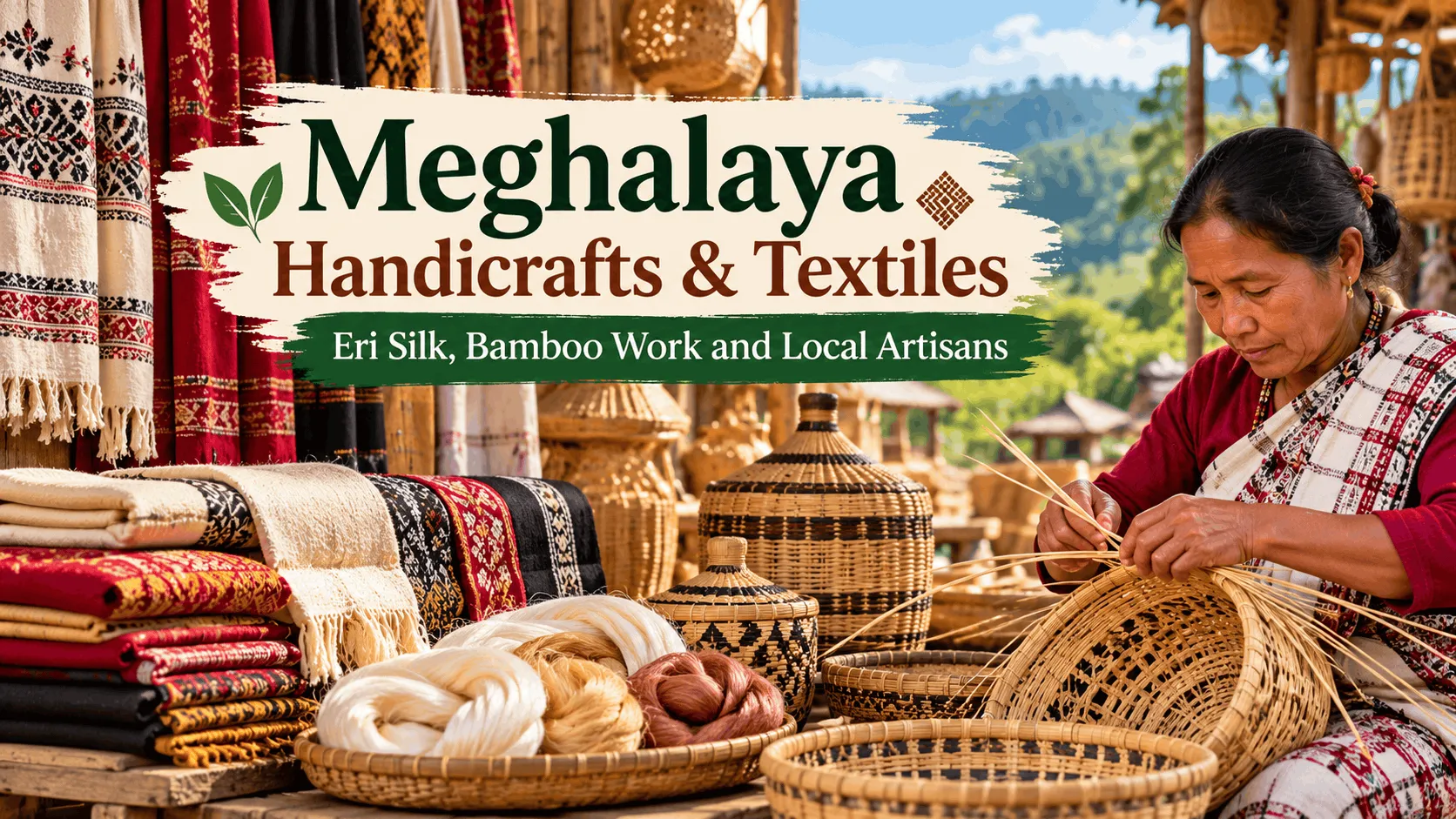
Meghalaya handicrafts are closely tied to the land and to the three communities who call these hills home: the Khasi, Jaintia and Garo. Meghalaya Tourism describes the state's arts and crafts as rooted in cultural heritage, with bamboo and cane work and handloom weaving at the centre. Baskets, mats and rain shields come from the region's bamboo and cane. Shawls, wraps and eri silk, known locally as ryndia, come from the loom.
This article explains the main crafts, how they differ between the three communities, what travellers may come across, and how to shop in a way that is fair to the people who make these things. Use it alongside our Meghalaya travel guide when you plan your route.

Overview of Traditional Meghalaya Handicrafts
Two official sources agree on the core of the picture. Meghalaya Tourism names bamboo and cane work and weaving as the main crafts, with wood carving, musical instruments, beadwork and silver jewellery also part of the tradition. The Indira Gandhi National Centre for the Arts (IGNCA) lists cane and bamboo work, artistic weaving and wood carving as the significant crafts of the state.
In broad terms, the crafts fall into three groups:
- Bamboo and cane: baskets, mats, rain shields, umbrellas, sieves and furniture.
- Weaving: handloom textiles among the Khasi, Jaintia and Garo communities, including eri silk.
- Other crafts: wood carving, beadwork, silver jewellery and pottery.
Bamboo is not one material. IGNCA lists many species found in Meghalaya, some growing wild and some cultivated, and notes that different species suit different jobs, such as construction, fencing, binding or house walls. That is part of why two baskets that look similar can feel quite different in the hand.
If you are building a longer trip, our Northeast India travel guide shows how Meghalaya fits alongside the neighbouring states.
Eri Silk and Traditional Textile Practices
Eri silk is called ryndia in Khasi. Meghalaya Tourism describes ryndia as eri silk woven and dyed sustainably in villages such as Umden. One published account describes it as traditionally handspun and handwoven, worn by both men and women, and produced by women who rear the silkworms, spin, weave and dye in their own homes or in clusters.
A few verified points help place it:
- Where: Ri-Bhoi district, in the Khasi Hills, is the region most closely linked to eri weaving in Meghalaya.
- Eri Silk Village: The state's Department of Textiles declared Umden-Diwon in Ri-Bhoi the first Eri Silk Village of the state on 12 February 2021.
- GI recognition: In 2025, Ryndia and Meghalaya Khasi Handloom Products received Geographical Indication (GI) recognition, which the state government celebrated on National Handloom Day that year.
- Recent investment: In August 2026, the Chief Minister inaugurated a Centre of Excellence for eri silk weaving in Ri-Bhoi, aimed at passing on the skill and encouraging innovation.
If you are shown a piece described as eri silk, ask the seller four things: what fibre it is, whether the yarn was handspun, what dyes were used, and who wove it. A good seller will be happy to answer.
Bamboo and Cane Craftsmanship
According to IGNCA, bamboo and cane products fall into two broad types: everyday articles made for local use, and finer decorative or functional pieces made for more selective markets. Many artisans, it notes, work the craft when farm work allows. IGNCA also points to practical difficulties, including harvesting bamboo in the Garo Hills, transport, and the capital needed to start. That context helps explain why well-made pieces take time and cost more than factory items.

Items described by IGNCA and Meghalaya Tourism include:
- Khoh: a coarse, closed-weave basket used for marketing and carried on the back with a head strap.
- Knup: a rain shield made of two woven layers with palm leaves sandwiched between them.
- Kurup: the local name for Khasi umbrellas, made in light and medium qualities.
- Shang: a shallow storage and display basket woven from split bamboo.
- Coiled cane containers: cylindrical lidded containers from Shillong, sold in nesting sets.
- Meghum khok: decorative baskets used to store clothes and valuables.
- Poker work: designs burnt into bamboo with a heated metal rod.
- Bamboo combs: assembled from many fine splits and bound with thread.
Khasi, Jaintia and Garo Craft Traditions
These are three distinct communities, and their crafts should not be treated as interchangeable. The table below lists examples that Meghalaya Tourism and IGNCA attribute to each. It is not a complete inventory, and it does not mean other communities never make similar things. For wider context on the peoples of the region, see our guide to the tribes of Northeast India.
| Khasi | Jaintia | Garo | |
| Bamboo and cane | Khoh, knup, kurup, mats, sieves, fruit and storage baskets, bamboo comb | Tlieng mats, shang basket, fish traps, utility baskets | Basketry, meghum khok, poker work, storage containers, decorative panels |
| Textiles | Ryndia (eri silk), jainsem, Khasi handloom products | Loin-loom weaving, jainkup and variations | Dakmanda, woven on backstrap looms |
Details matter here. IGNCA notes that the Jaintia shang and a Khasi shallow basket share the same weave structure but differ in rim and side strengthening. Meghalaya Tourism also notes that the Khasis are less active in weaving today, though traditions continue through the jainsem and ryndia. Ask makers and sellers which community and area a piece comes from rather than assuming.
Traditional Clothing, Weaving and Decorative Designs
- Jainsem (Khasi): a draped garment worn by women.
- Dakmanda (Garo): a handwoven, ankle-length lower garment worn by Garo women. Meghalaya Tourism says it is woven on backstrap looms, often with bold geometric designs and local natural pigments. Garo Dakmanda textile also holds GI registration. Because one published summary of the registration mentions acrylic yarn, ask about fibre and dye rather than assuming.
- Jainkup (Jaintia): Jaintia weavers use loin looms to produce variations of traditional garments such as the jainkup, often in subdued tones suited to everyday and ceremonial use.
- Khasi hat: IGNCA describes a large round hat with a circular bamboo frame, a thick brim covered in cloth, and a lattice of cane at the edge and top.
Motifs and patterns may carry meaning for particular families or communities. We have not listed meanings here because the sources do not establish them. If a pattern interests you, ask the maker.
Handmade Items Travellers May Find
Availability varies by season, town and seller, so treat this as a list of possibilities rather than a promise.
- Eri silk (ryndia) fabric and shawls
- Khasi, Jaintia and Garo handloom textiles
- Baskets in a range of shapes and sizes
- Woven mats
- Coiled cane containers
- Poker-worked bamboo items
- Bamboo combs and small household items
- Larnai black pottery (GI-registered), reported at Iewduh Bazaar in Shillong by Incredible India
- Beadwork, silver jewellery and wood carving
Do not assume every item on sale was made locally. Ask.
Where to Look for Local Handicrafts
We have deliberately not listed shop addresses, opening hours or prices, because these change and we could not verify current details. Here are places to start asking.
- Iewduh (Bara Bazaar), Shillong: Incredible India describes it as the oldest traditional market in the city, called Lewduh Market by locals.
- Police Bazar area, Shillong: Incredible India lists the Meghalaya Handloom and Handicrafts Development Emporium near Police Bazaar, noting its Jaintia and Garo fabrics. Confirm that it is open before you go.
- Ri-Bhoi district: home to the Umden-Diwon eri weaving area. Weaving happens in homes and cooperatives, so contact people before visiting rather than arriving unannounced.
- Tura and Jowai: Meghalaya Tourism lists these as the main towns of the Garo Hills and Jaintia Hills. Local markets there may stock regional items, but availability varies.
- State handloom events: the Department of Textiles marks National Handloom Day each August, and recent celebrations have included exhibitions of weavers' work.
How to Buy Directly and Support Artisans
- Ask who made it. Where possible, buy from the maker, a weaving group or a government emporium, and ask where the piece was made.
- Ask how it was made. Questions about fibre, dye, loom and time spent are reasonable, and the answers tell you a lot.
- Ask about made-to-order. If you want a specific piece, ask whether it can be made and how long it would take. Handloom work is not quick.
- Buy fewer, better pieces. One well-made item is usually more satisfying than a bag of souvenirs.
- Photograph with permission. Ask before photographing people or workspaces, and consider buying something rather than only taking pictures.
- Travel with local guidance. If you would rather have help finding trustworthy sellers, you can browse Tribal Discovery Tour's tours.
Fair Prices, Authenticity and Responsible Shopping
We cannot give you price ranges, because we have not verified any. What we can say is how to judge fairness.
- Compare before buying. Look at similar items from a few sellers. Very low prices for something described as handloom may be a reason to ask more questions.
- Treat labels as starting points. "Handmade", "natural dye", "organic" and "ethically sourced" are claims, not proof. Ask how.
- Understand GI. Ryndia, Khasi handloom products, Garo Dakmanda textile and Larnai pottery hold GI registration. A GI recognises a product's link to a place and tradition. It is not a guarantee about any single item in a shop.
- Negotiate with care. Bargaining customs vary. At fixed-price outlets, ask before haggling, and avoid pressing hard on labour-intensive handwork.
- Respect what is not for sale. If something looks like part of a household or ceremony rather than made for sale, do not ask to buy it.
Caring for Textiles and Handmade Products
This is general guidance rather than sourced fact. Follow any instructions the maker gives you first.
- Handwoven textiles: Ask whether the piece can be washed. If it can, use cool water and mild detergent, and test natural dyes for bleeding before washing with anything else. Dry in shade and store clean, dry and folded.
- Eri silk: Handle gently and avoid wringing. Ask the seller about washing and ironing.
- Bamboo and cane: Keep them dry and away from direct heat. Dust with a soft brush, and wipe with a barely damp cloth if needed.
- Poker-worked bamboo: Avoid soaking, which can affect the burnt designs.
Frequently Asked Questions
What are the main traditional crafts of Meghalaya? Bamboo and cane work and weaving are the main ones, along with wood carving, beadwork, silver jewellery and pottery, according to Meghalaya Tourism and IGNCA.
What is eri silk, or ryndia, in Meghalaya? Ryndia is the Khasi name for eri silk. It is a handloom fabric traditionally associated with Ri-Bhoi district, where Umden-Diwon was declared the state's first Eri Silk Village in 2021.
Do the Khasi, Jaintia and Garo communities make the same crafts? Not exactly. All three work with bamboo, cane and handlooms, but sources name different items for each community, such as the Khasi knup, the Jaintia shang and the Garo meghum khok.
What is dakmanda? A handwoven, ankle-length lower garment worn by Garo women. Meghalaya Tourism says it is woven on backstrap looms. Garo Dakmanda textile holds GI registration.
What bamboo and cane items might I find? Baskets, mats, coiled cane containers, poker-worked bamboo and combs are among the items described by IGNCA and Meghalaya Tourism. Availability varies.
Where can I buy Meghalaya handicrafts in Shillong? Iewduh (Bara Bazaar) and the Police Bazar area are good places to start asking, including a government handloom and handicrafts emporium near Police Bazaar. Confirm opening details locally.
How do I know a product is handmade and locally produced? Ask who made it, where, and how. Be cautious with any label that claims "handmade" or "natural" without an explanation.
Is a GI tag proof that an item is authentic? A GI recognises a product's link to a specific place and tradition. It does not guarantee that any individual item is handmade, so keep asking questions.
Can I visit weavers or workshops? Some weaving happens in homes and cooperatives. Contact people beforehand, ask permission, and do not turn up unannounced.
How should I care for eri silk and bamboo items? Follow the maker's instructions. As general practice, wash gently if advised, dry in shade, and keep bamboo and cane dry.
Closing Thoughts
Meghalaya handicrafts reward travellers who ask questions. A basket, a mat or a length of ryndia tells you something about the hands and the hills that produced it, but only if you take the time to find out. Buy with curiosity, pay with respect, and remember that three different communities, not one, are behind the work you see.