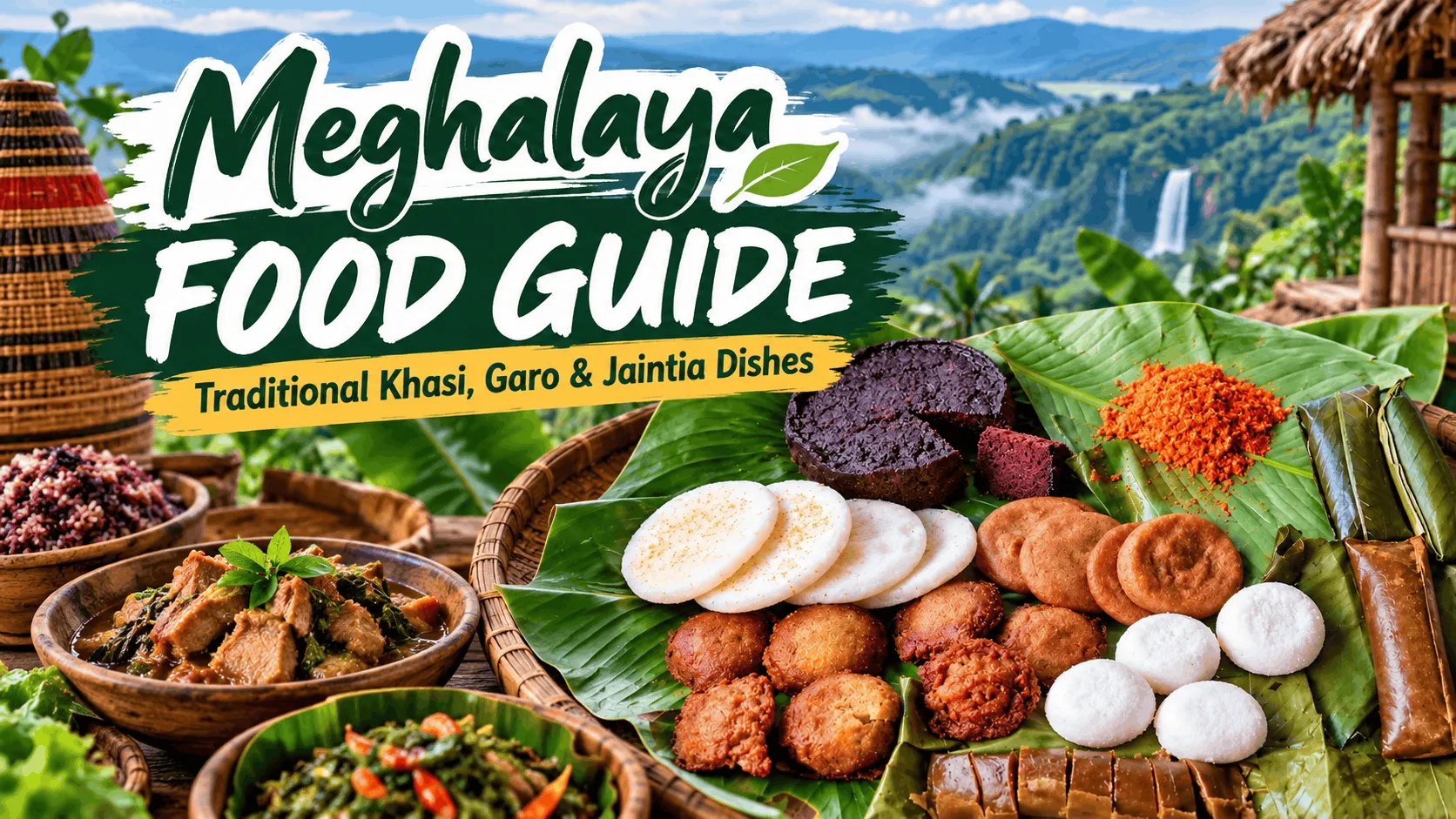
Meghalaya traditional food is built around rice, pork, fish (fresh, dried and smoked), local greens, bamboo, black sesame and fermented ingredients. The three main communities, the Khasi, Jaintia (Pnar) and Garo, share many staples but have distinct dishes and techniques. Khasi food is known for jadoh (rice cooked with pork) and tungrymbai (fermented soybeans with black sesame). Jaintia kitchens are associated with putharo (steamed rice-flour bread) and dohjem. Garo cooking is known for alkaline preparations such as kapa, made with an ash-based alkali, and dried-fish dishes such as nakham bitchi.
This guide introduces the dishes, ingredients and techniques documented by Meghalaya Tourism and other published sources, and explains how visitors can try local food respectfully. Spellings vary between sources and communities; where they differ, we note it.

The communities behind the food
Meghalaya is home to several communities, the largest being the Khasi, Jaintia (Pnar) and Garo. Each has its own language, customs and food traditions, and practices vary between families, villages and regions. For wider cultural context, see our guide to the tribes of Northeast India.
Some dishes are widely shared across the state; others are closely associated with one community. Meghalaya Tourism, for example, lists doh khlieh (pork salad) under both Khasi and Jaintia cuisine, which suggests it is widely shared in the Khasi and Jaintia Hills.
Shared ingredients and techniques
Staples
- Rice: the foundation of most meals, also ground into flour for breads and snacks.
- Pork: central to many Khasi, Jaintia and Garo dishes.
- Fish: fresh, dried and smoked.
- Chicken: common in Garo dishes such as kapa.
- Vegetables and foraged foods: Meghalaya Tourism lists herbs, edible ferns, bamboo shoots, mushrooms, roots and banana flowers among foraged or local ingredients.
- Black sesame: used in several Khasi and Jaintia dishes.
- Potatoes, pumpkin, yams and tapioca: common staples in different areas.
Techniques
Meghalaya Tourism describes several traditional methods:
- Fermentation: described as central to Meghalaya's culinary identity, used for soybeans (tungrymbai) and bamboo shoots, among others.
- Smoking: for preserving and flavouring meat and fish.
- Cooking in bamboo: rice, fish, meat and vegetables cooked inside bamboo tubes over fire.
- Alkaline cooking: potash made from burnt plant matter or ashes, used to tenderise meat and greens.
- Stone cooking: hot river stones used to grill fish or simmer stews.
Regional products
- Lakadong turmeric: grown in the Jaintia Hills and holding a Geographical Indication (GI) tag, according to Meghalaya Tourism.
- Kongthong honey: harvested in Kongthong village.
- Wild fruits and berries: Meghalaya Tourism lists many local fruits, including soh-shang, soh-iong, soh-phlang and soh-broi.
Khasi dishes to try
Jadoh
Rice cooked with pork, often served with doh khlieh and tungrymbai. One of the best-known Khasi dishes and widely available in Shillong.
Tungrymbai
Fermented soybeans cooked with black sesame seeds. Strong-flavoured and distinctive. (Meghalaya Tourism spells it both "Tungrymbai" and "Tyngrymbai".)
Doh khlieh
A pork salad, commonly with onions, green chillies and salt. Also spelled dohkhleh or doh khleh.
Ktung bain nei-iong
Dry fish (ktung bain) cooked with black sesame seeds and served with rice.
Phan and tungtap
Tungtap, a fermented dry-fish chutney, eaten with boiled potatoes (phan), and often with red tea, according to Meghalaya Tourism.
Ja tyndong
Rice, fish, meat and vegetables cooked in fresh bamboo tubes sealed with banana leaves, and baked over fire. Meghalaya Tourism associates it with rural farmers.
Jingbam dihsha (rice snacks)
Rice-flour snacks made with water and sugar or jaggery, often eaten with red tea. Meghalaya Tourism lists:
- Ja shulia: sticky rice
- Pu khlein: fried rice cake
- Pu maloi: steamed rice cake
- Pu sla: rice cake steamed in a leaf
- Pu doh: steamed rice cake with pork strips
Jaintia (Pnar) dishes to try
Putharo with dohjem
Putharo is a soft, spongy flatbread made from ground rice flour, steamed in a special pot. It is paired with dohjem, a pork curry with black sesame seeds.
Doh sniang nei-iong
Pork cooked with sesame seeds, served with steamed rice. Meghalaya Tourism describes it as common in Pnar homes.
Kharang (dakharang)
Smoked fish, prepared as a curry, chutney or salad.
Doh khleh
Pork salad with onions, green chillies and salt, which Meghalaya Tourism describes as common at roadside food stalls in the Jaintia region.
Garo dishes to try
Kapa
A Garo preparation of meat (pork, chicken or fish), cooked with ginger, chillies and herbs, and with kalchi, an alkali that softens the meat. According to Garo chef Nambie Jessica Marak, kalchi is made by mixing bamboo ash with water and using the clear liquid that settles on top, and is used in many dishes in place of oil.
Do'o kappa
Chicken cooked with natural potash, finished with coriander and chillies, according to Meghalaya Tourism.
Nakham bitchi
A spicy dry-fish gravy served with rice. Dry fish (na'kam) is a staple of Garo cooking; Chef Marak describes it as being cleaned, dried, fermented and smoked.
Wak pura
Pork cooked with pura, which Meghalaya Tourism describes as a potash made from burnt plant matter that gives a soft texture and mild alkaline flavour.
Note on "pura": sources describe the word differently. Meghalaya Tourism uses it for the potash; Chef Marak describes pura as a broth or congee made with rice flour and vegetables, and kalchi as the alkali. Ask locally how the term is used.
Me.kin / sobok chatni
A chutney made from banana flowers, which Meghalaya Tourism says is served with most Garo meals.

Quick reference: traditional food of Meghalaya
| Dish | Associated community | Main ingredients | Notes |
| Jadoh | Khasi | Rice, pork | Widely available in Shillong |
| Tungrymbai | Khasi | Fermented soybeans, black sesame | Strong flavour |
| Doh khlieh | Khasi and Jaintia | Pork, onion, chilli | Pork salad |
| Ktung bain nei-iong | Khasi | Dry fish, black sesame | With rice |
| Phan and tungtap | Khasi | Potatoes, fermented dry fish | Often with red tea |
| Ja tyndong | Khasi | Rice, fish, meat, vegetables | Cooked in bamboo |
| Pu maloi, pu khlein and others | Khasi | Rice flour | Snacks with tea |
| Putharo with dohjem | Jaintia | Rice flour; pork, black sesame | Steamed bread with curry |
| Doh sniang nei-iong | Jaintia (Pnar) | Pork, sesame | Home cooking |
| Kharang | Jaintia | Smoked fish | Curry, chutney or salad |
| Kapa | Garo | Meat, kalchi (alkali) | Little or no oil |
| Do'o kappa | Garo | Chicken, potash | Coriander, chillies |
| Nakham bitchi | Garo | Dry fish | Spicy gravy |
| Wak pura | Garo | Pork, potash | Soft, mildly alkaline |
| Me.kin / sobok chatni | Garo | Banana flower | Served with most meals |
Street food in Shillong
Meghalaya Tourism lists popular Shillong street foods including Shillong aloo muri (a spicy potato snack), momos, pani puri and smoked meat. These are part of the city's everyday food scene rather than traditional community dishes.
Dietary considerations
Meat and fish
Pork, fish and chicken appear in many traditional dishes, and some vegetable dishes may be cooked with meat, fat or fish. This reflects local food traditions; it is not true of every meal or every household.
Fermented foods
Fermented soybeans, fermented fish and pickled bamboo shoots have strong flavours and aromas. Try a small amount first.
Vegetarian and vegan visitors
- Rice, boiled vegetables, rice-flour snacks and some chutneys may be meat-free, but always ask.
- Ask specifically about pork fat, dried fish, fermented fish and meat stock.
- Vegans should also ask about any animal-based ingredients in snacks or sweets.
- Arrange meals with your accommodation in advance in smaller towns.
Allergies
Sesame, soy, fish and shellfish appear in several dishes. Carry a written note of your allergy and tell cooks before food is prepared.
How to communicate dietary needs
- Ask clearly: "Does this have pork, fish, dried fish or meat stock?"
- Ask your host or guide to explain your needs in the local language.
- Accept that some dishes cannot be adapted, and choose something else politely.
Where to try local food
We have not named specific restaurants, as menus and businesses change. Practical tips:
- Shillong: the widest choice of local eateries, cafés and street food. Ask hotel staff or local guides for current recommendations. Our Shillong travel guide covers the city more broadly.
- Homestays: often the best way to try home-style cooking. Ask in advance what will be served.
- Markets: markets such as Iewduh (Bara Bazaar) in Shillong are good places to see local ingredients.
- Jaintia and Garo Hills: ask locally about eateries serving regional dishes; options may be fewer than in Shillong.
- Festivals and community events: food may be part of celebrations, but join only when invited.
For wider trip planning, see our Meghalaya travel guide. If you prefer a planned trip, our Meghalaya Explorer tour (Shillong, Dawki and Cherrapunjee) passes through Shillong and Sohra, where local eateries are easy to find.
Food etiquette and responsible engagement
- Accept hospitality graciously. If you cannot eat something, decline politely and explain briefly.
- Ask before photographing people eating, cooking or serving food, and inside homes.
- Do not mock or react strongly to unfamiliar flavours or ingredients.
- Ask questions respectfully. Many hosts are happy to explain dishes.
- Do not assume every community eats the same way; practices differ.
- Support local producers by buying regional ingredients such as Lakadong turmeric or local honey from genuine sources.
- Reduce waste: take only what you will eat.
Details that may vary or need checking
- Spellings of dish names, which differ between sources and communities
- Availability of specific dishes, which depends on season, place and household
- The term "pura", described differently in different sources
- Restaurant and eatery options, which change frequently
Frequently asked questions
What is the most famous traditional food of Meghalaya? Jadoh, a Khasi dish of rice cooked with pork, is one of the best-known. Others include tungrymbai, doh khlieh, putharo with dohjem and Garo kapa.
What is tungrymbai? Fermented soybeans cooked with black sesame seeds, a Khasi dish with a strong flavour. It is also spelled tyngrymbai.
What is kapa in Garo cuisine? A preparation of meat cooked with ginger, chillies, herbs and kalchi, an alkali made from bamboo ash and water that softens the meat and is often used instead of oil.
Is Meghalaya food suitable for vegetarians? Many traditional dishes contain pork or fish, and some vegetable dishes may use meat or fish. Vegetarians can find rice, vegetables and rice snacks, but should ask about ingredients each time.
What is putharo? A soft, spongy steamed flatbread made from rice flour, associated with Jaintia cooking and often served with dohjem, a black sesame pork curry.
Where can I try Khasi food in Shillong? Local eateries, homestays and markets across the city. Ask your hotel or a local guide for current recommendations.
Conclusion
Meghalaya traditional food reflects the land and the people who live on it: rice and pork, smoked and dried fish, foraged greens, black sesame and fermentation. Khasi, Jaintia and Garo kitchens each have their own dishes and techniques. Try them with an open mind, ask questions, communicate dietary needs clearly, and treat every meal as a chance to learn about the people who cooked it.