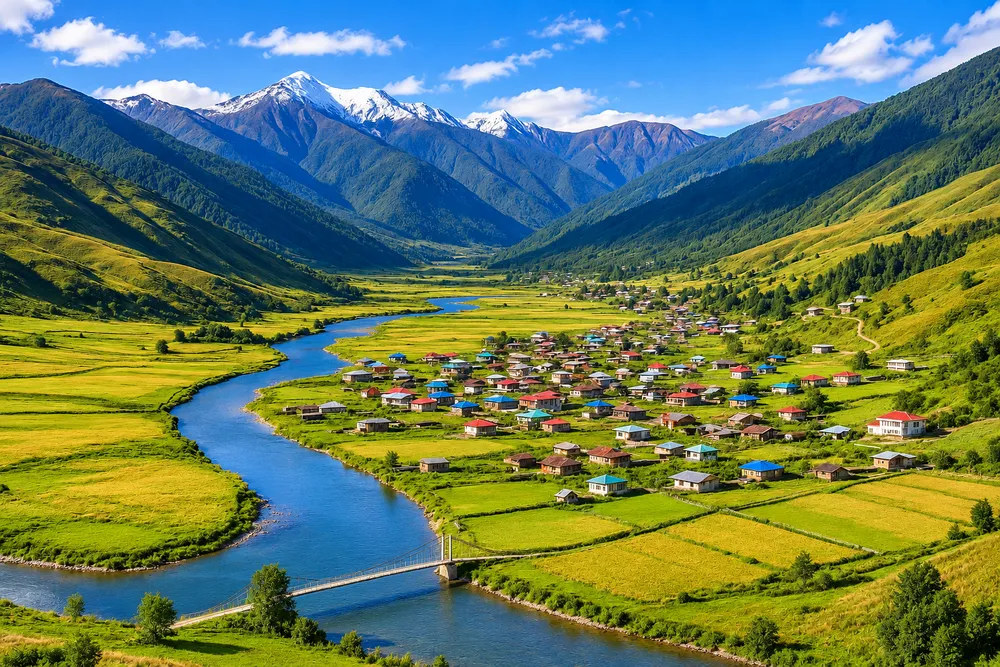
Mechuka sits in a wide, forested valley in Shi Yomi district, close enough to the Indo-Tibet border that snow-capped ridgelines are visible from the village itself. It's one of the more remote corners of Arunachal Pradesh, reached by a long road journey rather than any direct flight, and that journey is a big part of why people go. The valley is home to the Memba community, who follow Tibetan Buddhist traditions, along with Adi villages further downriver, and the pace of a Mechuka trip is set by geography as much as by choice: winding mountain roads, a handful of homestays, and a landscape that rewards slow travel over ticking off sights.
This guide covers what's actually in Mechuka, how to get there, when to go, and how to plan a realistic trip. If you're used to better-connected parts of Arunachal Pradesh like Bomdila or Ziro, budget extra time here. The roads are longer, the infrastructure is thinner, and a lot of what makes Mechuka worth visiting only shows up once you slow down.
Why Visit Mechuka?
The valley itself is the draw. Mechuka sits at roughly 6,000 feet, ringed by pine-covered hills that turn into higher, snow-dusted peaks toward the border, and the Yargyap Chu (also called the Siyom in its lower stretches) runs through the middle of it. Wooden houses, prayer flags, and terraced fields sit against that backdrop, and the light changes it through the day in a way that photographers tend to notice quickly.
Beyond the scenery, there's a genuine cultural layer: the Memba villages around Mechuka carry visible Tibetan-Bhoti influence in architecture, dress, and religious practice, centred on the old monastery above the valley. None of this is staged for visitors. Village life continues at its own pace, which means the reward is in walking around and paying attention, not in a checklist of attractions.
Mechuka also works well for people who like their outdoor time unstructured — short valley walks, a morning at a viewpoint, an afternoon with nothing scheduled. It isn't set up for high-adrenaline adventure tourism, and that's arguably the point.
Where Is Mechuka?
Mechuka is the headquarters of Shi Yomi district in western Arunachal Pradesh, positioned north of West Siang district and close to the international border with Tibet. The nearest sizeable town with road connections onward is Aalo (also spelled Along), the headquarters of West Siang, which functions as the practical gateway to Mechuka for most travellers.
There's no direct commercial flight into Mechuka — the local airstrip is a military-first Advanced Landing Ground, not a civilian airport — so almost everyone arrives by road via Aalo. That last stretch, Aalo to Mechuka, runs through hill terrain and can take the better part of a day depending on road conditions, which is exactly why so many trip reports describe the drive as central to the experience rather than a formality before it.
(Route timings and road conditions change with landslides and repair work — check current status closer to your travel dates.)
Places to Visit in Mechuka
Samten Yongcha Monastery
This monastery sits above the valley in Neh village and is one of the oldest Buddhist institutions in the region, tied closely to the Memba community's religious life. It's worth visiting for the setting as much as the building — the views over the valley from up here are some of the best around Mechuka. Plan on an hour or so, including the walk up. Dress modestly and ask before photographing inside.
Mechuka Suspension Bridge
A wooden suspension bridge crosses the Yargyap Chu near the main village, and it's one of the most photographed spots in the valley, with mountains framing the water on both sides. It takes only a few minutes to cross but is worth lingering at, especially early morning or late afternoon when the light is softer.
Dorjeeling Village
Not to be confused with the hill town in West Bengal, this small hamlet near Mechuka gives a closer look at Memba village life — traditional wooden houses, quiet lanes, and the kind of unhurried atmosphere that's harder to find in the more visited parts of the valley. A couple of hours is enough to walk through, though it's easy to linger longer.
Hanuman Top
A viewpoint above the valley, reachable by a short drive or walk, that opens up wide views of Mechuka and the peaks beyond it. It's a good sunset or sunrise spot if the weather cooperates, though visibility depends heavily on cloud cover, especially outside the clearer autumn and spring months.
Mechuka Lake and the Siyom Valley
The high-altitude lake near the village and the surrounding river valley are worth a half-day for anyone interested in easy walks and river scenery. The Siyom (Yargyap Chu) also supports rafting and angling in season, though availability of guides and equipment varies and is worth confirming locally rather than assuming.
Mechuka Valley and Mountain Landscape
What sets Mechuka apart from other Arunachal destinations is the shape of the valley itself — broad and flat at the base, unusual for this part of the Himalaya, with hills rising sharply on either side. That openness is what makes the light and the mountain views so striking, and it's also why so many visitors end up spending unplanned hours just walking the valley floor rather than moving between fixed sights.
Photography here rewards patience: early morning mist over the river, the monastery lit up at golden hour, the contrast between green valley floor and snow on the higher ridges in winter and early spring. There isn't a defined network of marked trails for casual trekking, so any longer walk into the surrounding hills is best done with a local guide who knows current conditions.
Local Culture and Communities
Mechuka's identity is shaped by the Memba community, who practice Tibetan Buddhism and trace cultural roots to across the border, alongside Adi villages that become more prominent as you move downriver toward Aalo. Traditional wooden architecture, prayer flags, and the monastery at Neh are the most visible markers of this, but the culture is really in daily life — farming, weaving, and the rhythms of a valley that sees relatively few outside visitors compared to the rest of the state.
Local food is worth seeking out on its own terms: dishes built around rice, millet, and buckwheat, along with regional preparations that vary from homestay to homestay. Approach this as a guest rather than a spectator. Ask before photographing people, especially at homes and during any informal gatherings, and be mindful that this isn't a destination built around tourism infrastructure — a lot of what you'll see is simply how people live.
Things to Do in Mechuka
- Walk between the main village, the suspension bridge, and Dorjeeling Village
- Visit Samten Yongcha Monastery at Neh
- Spend a morning or evening at Hanuman Top for valley views
- Spend time at Mechuka Lake and along the Siyom
- Talk to homestay hosts about village walks or short treks in the surrounding hills — conditions and guide availability vary, so confirm locally rather than planning around it in advance
- Photograph the valley at different times of day, since the light shifts noticeably from morning to evening
Anything beyond a short, well-known walk should go through a local guide. Trail conditions, river levels, and weather in this part of Arunachal Pradesh change quickly enough that outside information goes stale fast.
How to Reach Mechuka
There's no direct flight or train to Mechuka. The usual approach:
- Fly or take the train to Dibrugarh (Assam), or fly into Donyi Polo Airport near Itanagar.
- Travel by road to Aalo in West Siang district, typically via Pasighat. This leg alone can run several hours depending on the route and road conditions.
- Continue from Aalo to Mechuka by shared vehicle or private taxi, a mountain road that most travellers cover in a full day, sometimes with an overnight stop if road or weather conditions require it.
Shared vehicles (often called Sumos in this region) run this route regularly and are the standard way locals and budget travellers cover the Aalo–Mechuka leg; private taxis are more comfortable but cost more. There's no self-drive infrastructure to speak of, and mobile network coverage drops out for long stretches, so build in flexibility rather than a tight schedule.
(Exact fares, shared-vehicle timings, and current road status are worth confirming close to your trip — these change often in this region.)
Best Time to Visit Mechuka
Winter (December–February): Cold, often below freezing at night, with a real chance of snow at higher points around the valley. Some travellers come specifically for this, but road conditions can be affected, and it's the least forgiving season for a first visit.
Spring (March–May): Widely considered one of the best windows. Days are pleasant, visibility is generally good, and the valley turns green. Nights are still cool.
Summer/Monsoon (June–September): The monsoon brings heavy rain to this part of Arunachal Pradesh, and road conditions between Aalo and Mechuka can deteriorate significantly, with landslides a realistic risk. This is the hardest season to plan around and isn't recommended unless you have a strong reason and real flexibility in your dates.
Autumn/Post-monsoon (October–November): The other strong window. Clear skies, crisp air, and good mountain visibility as the monsoon clears, before winter cold sets in.
In short: aim for October–November or March–May. Treat June–September as a season to avoid unless conditions on the ground say otherwise, and treat winter as doable but weather-dependent.
How Many Days Are Enough for Mechuka?
2 days: Workable only if you've already built in the travel time separately — for example, if you're overnighting in Aalo before and after. Inside Mechuka itself, two days covers the monastery, the suspension bridge, and Dorjeeling Village, but leaves little room for anything unplanned.
3 days: A more comfortable minimum once you count the road journey in both directions. This allows the main sights plus some slower time in the valley — a walk to Hanuman Top, an afternoon by the river, no need to rush.
4 days: Gives you a buffer for road delays (common enough in this region to plan for) and time for a village walk or short local trek with a guide, without feeling rushed on any single day.
Given how much of a Mechuka trip is travel time, most people find it easier to think in terms of total trip length — Dibrugarh or Itanagar to Mechuka and back — rather than days in Mechuka alone. Four to six days for the full loop is a realistic range for most travellers.
Suggested Mechuka Itinerary
Day 1: Arrive Dibrugarh (or Itanagar). Overnight there or begin the drive toward Pasighat/Aalo depending on timing.
Day 2: Continue to Aalo, overnighting there before the final push into the mountains.
Day 3: Drive from Aalo to Mechuka. Expect this to take most of the day. Settle into your homestay in the evening.
Day 4: Full day in Mechuka — Samten Yongcha Monastery in the morning, the suspension bridge and Dorjeeling Village in the afternoon.
Day 5: Hanuman Top at sunrise if weather allows, followed by time at Mechuka Lake or a village walk. Begin the return journey to Aalo, or stay a final night if your schedule allows.
Day 6: Return drive to Aalo and onward toward Dibrugarh/Itanagar.
Adjust this around road conditions and your own pace — this region rarely rewards a tightly timed schedule.
Where to Stay in Mechuka
Homestays are the backbone of accommodation in Mechuka and generally the best way to experience the valley, offering home-cooked meals and direct contact with a Memba or Adi household. A small number of guesthouses also operate in and around the main village. There isn't large-scale hotel infrastructure here, and that's unlikely to change quickly given the remoteness of the location.
(Specific property names, prices, and current availability aren't included here since they change often — check directly with homestay owners, a local tour operator, or the Arunachal Pradesh tourism department before booking.)
Permits and Travel Requirements
Indian citizens need an Inner Line Permit (ILP) to enter Arunachal Pradesh, applied for online through the state's official eILP portal or in person through a Deputy Commissioner's office or Arunachal Bhawan. Foreign nationals require a Protected Area Permit (PAP), typically arranged through a registered tour operator.
Given Mechuka's location near the international border, expect permit checks at points along the route, including at Pasighat and Aalo. Carry both physical and digital copies of your permit.
(Permit fees, validity periods, and application procedures change from time to time — confirm current requirements on the official Arunachal Pradesh ILP portal before you travel.)
Practical Travel Tips
- Pack for cold weather even outside winter — nights in the valley stay cool year-round, and layers matter more than any single heavy jacket.
- Bring sturdy, closed footwear for uneven village paths and any walking beyond the main road.
- Carry cash. ATMs in this region are unreliable, and digital payments depend on network coverage that isn't consistent.
- Expect patchy mobile connectivity for long stretches of the journey and within Mechuka itself.
- Keep fuel and supplies in mind if travelling by private vehicle — fill up in Aalo before continuing.
- Carry basic medicines for the road, including anything for motion sickness given the length of the mountain drive.
- Ask before photographing people, particularly at monasteries, homes, and any informal gatherings.
- Respect restricted zones. Given the proximity to the border, some areas near military installations are off-limits to photography — follow local signage and guidance.
Frequently Asked Questions
Where is Mechuka? Mechuka is the headquarters of Shi Yomi district in western Arunachal Pradesh, close to the Indo-Tibet border.
Is Mechuka worth visiting? Yes, particularly for travellers interested in mountain scenery, Memba culture, and slower-paced travel rather than a packed sightseeing schedule.
How do I reach Mechuka? By road via Aalo (West Siang district), typically reached from Dibrugarh or Itanagar. There's no direct flight or train.
What is the best time to visit Mechuka? October–November and March–May offer the clearest weather and best road conditions. Avoid the June–September monsoon if possible.
How many days are needed for Mechuka? A minimum of 3 days in the valley is comfortable, though most trips run 4–6 days once travel time from Dibrugarh or Itanagar is included.
What are the best places to visit in Mechuka? Samten Yongcha Monastery, the Mechuka suspension bridge, Dorjeeling Village, Hanuman Top, and Mechuka Lake.
Is Mechuka suitable for families? It can work for families comfortable with long road travel and basic infrastructure, but it isn't a destination for those wanting quick access or polished facilities.
Is Mechuka accessible in winter? Yes, though it's cold and road conditions can be affected by weather. It's manageable but not the easiest season for a first visit.
Do I need a permit to visit Mechuka? Yes. Indian citizens need an Inner Line Permit for Arunachal Pradesh; foreign nationals need a Protected Area Permit, usually arranged through a registered tour operator.
What should I pack for Mechuka? Warm layers regardless of season, sturdy footwear, cash, basic medicines, and a flexible mindset around road and weather conditions.