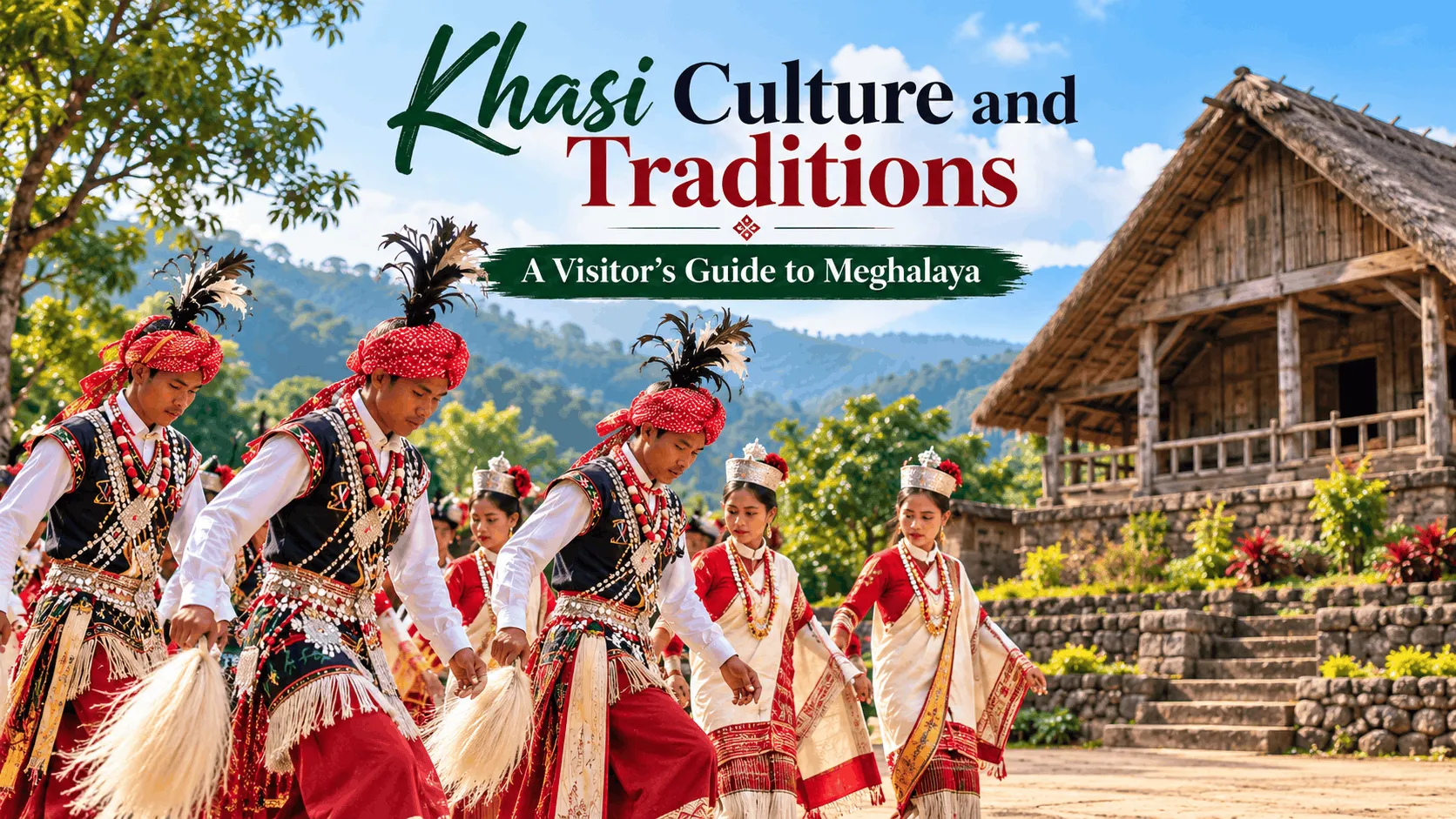
Khasi culture is not something you only see at festivals or in a museum. It is lived every day in Shillong’s markets, in village kitchens, in clan gatherings, in churches and in the meetings of village councils. For a visitor to Meghalaya, that changes the question from “what should I see?” to “how should I behave as a guest?”
This guide introduces Khasi culture and traditions for travellers who want to understand what they are seeing and avoid common mistakes. It draws on Meghalaya Tourism, government and census sources, and scholarly writing, including work by Khasi authors. Where sources disagree, or where practice varies between families and villages, we say so. Nothing here replaces listening to the people you meet. If you want the wider regional picture first, our guide to the Tribes of Northeast India explains how Khasi culture sits alongside many other communities.

Who Are the Khasi People?
The Khasi are one of the three principal tribal communities of Meghalaya, alongside the Jaintia (Pnar) and the Garo, as Meghalaya Tourism describes the state. They live mainly in the Khasi Hills, which include East Khasi Hills, West Khasi Hills and Ri-Bhoi, and there are smaller Khasi populations in Assam and Bangladesh.
A Parliament document citing Census 2011 reports more than 13 lakh Khasi speakers, about 46.5 per cent of Meghalaya’s population. That counts speakers of the language, not everyone who identifies as Khasi, so treat it as a guide to scale rather than an exact headcount.
Khasi, Pnar and Garo are different communities. This matters for accuracy:
- Khasi and Pnar (Jaintia) are closely related, and both speak Austroasiatic languages and follow matrilineal descent. Government lists sometimes group them together, but they have distinct dialects, festivals and institutions. Behdienkhlam, for example, is a Jaintia festival, not a Khasi one.
- The Garo speak a Tibeto-Burman language and have their own festivals, such as Wangala, and their own indigenous religion. They are also matrilineal, but their customs are not the same as Khasi customs.
Within the Khasi community there are regional groups with their own names and dialects. People may describe their identity differently from official categories, so ask how someone prefers to be described rather than assuming.
Language, Identity and Community Life
Khasi is an Austroasiatic language, distinct from the Tibeto-Burman and Indo-Aryan languages around it. Under the Meghalaya State Language Act, 2005, Khasi and Garo are associate official languages of the state. Khasi is written in the Latin script, which came into use through missionary work in the 19th century, and the community has a strong oral tradition as well.
For many Khasis, the clan (kur) is the main marker of identity. One Khasi scholar writes that the clan is the main identity of every Khasi, and descent from a common ancestral mother is central to how people understand kinship. Alongside clan, the village (shnong) is the everyday unit of community life, with its own council and customs.
Most Khasis today are Christian, and a minority follow the indigenous faith, known as Niam Khasi or Niamtre. Published estimates of the proportions vary, so this guide gives no precise figure. Meghalaya Tourism describes the indigenous faith as built around a principle often rendered as Tip Briew Tip Blei, “know man, know God”, emphasising moral conduct and community harmony. Both Christian and indigenous practice shape Khasi life, and it is wrong to assume that a person follows one or the other.
Family Traditions and Matrilineal Kinship
Khasi society is matrilineal: descent is traced through the mother, and children take their mother’s clan name. Traditionally the youngest daughter, Ka Khadduh (also spelled Khatduh), keeps the ancestral home, looks after elderly parents and holds a central role in family ceremonies. After marriage her husband usually moves into her household.
Three points keep this accurate:
- Matrilineal does not mean matriarchal. Academic and community sources describe a system where clan descent and family property pass through women, while the maternal uncle (kni) plays an important role in clan decisions and men hold prominent public roles in village and chiefly institutions.
- Not everything goes to the youngest daughter. One Khasi scholar notes that the idea of the Khadduh as sole heir is a common assumption that does not match tradition. Her house is also described as the clan’s religious house, and other siblings can receive property too.
- Practice varies and is changing. Families, regions, faiths and modern law all shape what happens in practice. Public debate about inheritance, including proposals to change the rules, shows that Khasis themselves do not agree on every point.
As a visitor, avoid prying questions about property, and avoid statements like “so women run everything here.”
Traditional Attire, Crafts and Cultural Expression
Most Khasis wear everyday modern clothes, and traditional dress appears mainly at festivals, weddings and ceremonies. The East Khasi Hills district website describes traditional women’s dress as made of several pieces of cloth, giving the body a cylindrical shape. The jainsem involves two pieces pinned on each shoulder, usually worn with a shawl. Men’s ceremonial dress includes the jymphong, a sleeveless coat without a collar fastened at the front, worn with a dhoti or sarong, a decorative waistband and sometimes a turban.
Garment names are not always used the same way in different sources. The dhara, for example, is described as Khasi in some sources and as Jaintia in others, so avoid labelling a garment or wearer without checking.
Eri silk (ryndia) weaving is a well-known craft in Meghalaya, and weaving is primarily done by women. If you buy textiles, buy directly from makers where you can and ask about materials.
Meghalaya Tourism lists traditional Khasi instruments including the duitara (a four-stringed lute), tangmuri (a wind instrument), ksing (drums), besli (flute) and padiah (a single-faced drum), and mentions chant-like phawar songs. Dance and music carry religious and social meaning, and are not simply performance.

Festivals and Ceremonial Traditions
Two major Khasi festivals often come up for visitors.
- Shad Suk Mynsiem is held in April, according to Meghalaya Tourism’s cultural festivals brochure, and the official site calls it the most significant festival of the Khasis. Unmarried men and women dance in traditional dress, and the brochure translates the name as “Dance of the Joyful Heart”. Other sources translate it as “Dance of the Peaceful Hearts”, so translations vary.
- Nongkrem (Pomblang Nongkrem) is held at Smit, in the residence of the Syiem (chief) of Khyrim, and Meghalaya Tourism describes it as a five-day celebration with sacred rituals. The brochure says it includes the Pomblang, a goat sacrifice described as a solemn act believed to ensure the prosperity and protection of the chiefship and its people. Some sources place it in October or November, but the official pages we reviewed do not give fixed dates, so confirm locally.
Other dances, such as Shad Kynjoh, are performed at house-blessing ceremonies. Behdienkhlam and Wangala belong to the Jaintia and Garo communities and should not be described as Khasi festivals.
Some parts of these events are public and others are sacred rituals carried out by particular clans or officiants. Ask organisers or local hosts what is open to visitors, follow instructions, and do not treat ceremonies as a show that exists for photographs. Never assume you can join a ritual, even if a festival is publicly advertised.
Food and Hospitality
Rice is central to Khasi meals. Common dishes mentioned across tourism sources include jadoh (rice cooked with meat such as pork or chicken), dohneiiong (pork cooked with black sesame) and tungrymbai (fermented soybean). Smoking and fermentation are widespread, and spice levels are generally modest. Meat features widely, so vegetarian visitors should ask clearly about ingredients in advance, since even some vegetable dishes may be cooked with stock or meat.
Hospitality often includes kwai, areca nut offered with betel leaf. Writers on Khasi life describe it as a gesture of friendship and respect, and many households offer it to guests. If you are offered kwai and do not wish to take it, decline politely and warmly, or ask your host how to decline gracefully. Accept food and drink with thanks. Meals in a family home are invitations, not transactions.
Community Institutions and Social Customs
Khasi society has long had its own self-governing institutions. The village council, the Dorbar Shnong, handles local affairs and is typically led by a Rangbah Shnong or Sordar Shnong. Groups of villages form a Raid, and larger chiefly units called Hima are headed by a Syiem, with councils at each level. The Khasi Hills Autonomous District Council, set up under the Sixth Schedule of the Constitution, describes 54 traditional institutions (Hima or Elakas) in the Khasi Hills, each with administrative and judicial functions.
For visitors, the practical meaning is that villages have rules, and those rules are enforced by community institutions rather than outsiders. Entry arrangements, local contributions and behaviour at sacred sites may be decided by a village dorbar. A custom often described in scholarly and community writing is that people of the same clan do not marry each other; that applies within the community and is not something visitors need to discuss.
Visiting Khasi Villages Respectfully
- Go through a host. Arrange visits through a local guide, homestay or the village headman, and treat the visit as entering someone’s home, not a public attraction.
- Ask about arrangements. Ask what fees or contributions are normal and who should receive them, rather than assuming.
- Dress modestly in villages and at religious sites.
- Do not ask people to perform. Songs, dances and rituals are not on-demand entertainment.
- Pay fairly for guides, meals and crafts, and buy from makers where possible.
- Follow local rules about where you can walk, what you can touch and when you can visit.
- Leave nothing behind, and carry your waste out.
For trip-planning basics such as routes, seasons and bases, see our Meghalaya Travel Guide. If you are combining Meghalaya with other states, our Northeast India Travel Guide covers wider planning.
Photography, Sacred Places and Permission
- Ask before photographing people, their homes, their clothing and especially ceremonies. Accept a refusal without argument.
- Sacred groves are not ordinary parks. Meghalaya Tourism says Mawphlang Sacred Grove has been preserved by Khasi communities for centuries, is believed to hold spirits, and that cutting trees or disturbing the land is forbidden. Stay with your guide and take nothing.
- Stone monuments carry meaning. Meghalaya Tourism describes the upright and table-like stones at Mawkyrduk as memorials for the dead. Do not climb on them, move them or pose on them.
- Do not publish what you were not given permission to share, including photos of rituals, private spaces or children.
- Follow your guide’s lead. Rules vary by village, and a place that allows photos one day may not on another.
Common Misconceptions About Khasi Culture
- “Women rule Khasi society.” Matrilineal descent is not the same as female rule, and men hold prominent roles in institutions.
- “The youngest daughter gets everything.” This simplifies a more nuanced custom, and practice varies.
- “All Meghalaya tribes are the same.” Khasi, Pnar and Garo communities have different languages, festivals and institutions.
- “All Khasis follow one religion.” Most are Christian today, and a minority follow the indigenous faith.
- “Culture means costume.” Most people wear modern clothes every day, and culture is in family life, language and community.
- “Traditions are frozen in the past.” Khasi society is changing, and members debate those changes themselves.
- “Festivals are shows for tourists.” Many are religious and community events, and visitors are guests.
Frequently Asked Questions
What are Khasi culture and traditions known for? Matrilineal kinship, clan identity, village councils, festivals such as Shad Suk Mynsiem and Nongkrem, traditional music and dance, Eri silk weaving and distinctive food and hospitality.
Is Khasi society matriarchal? No. It is matrilineal, meaning descent and family property are traced through women. Men play important roles, including maternal uncles within clans and leaders in public institutions.
Do all Khasi families follow the same inheritance practice? No. Practice varies and is changing, and the idea that one daughter inherits everything is an oversimplification.
Are the Khasi and Jaintia the same people? They are closely related but distinct. Behdienkhlam, for instance, is a Jaintia festival. Ask people how they identify themselves.
Can visitors attend Khasi festivals? Parts of some festivals are open to visitors, but others are sacred and restricted. Dates can vary, so check with local organisers or Meghalaya Tourism, and follow instructions on the day.
Is it okay to take photos in Khasi villages? Only with permission. Ask before photographing people, homes and ceremonies, and never photograph sacred objects or rituals without clear consent.
Do your tours include cultural activities? You can browse the Tribal Discovery Tour tours catalogue and check each tour page for what it covers. Contact the team if you want to ask about cultural activities, since this guide does not assume that any tour includes them.
A Closing Note
Respect is the simplest rule for visiting Khasi communities: ask, listen, follow local guidance, and let people decide what to share. Treat everything above as an introduction, then read and listen to Khasi voices for the rest.