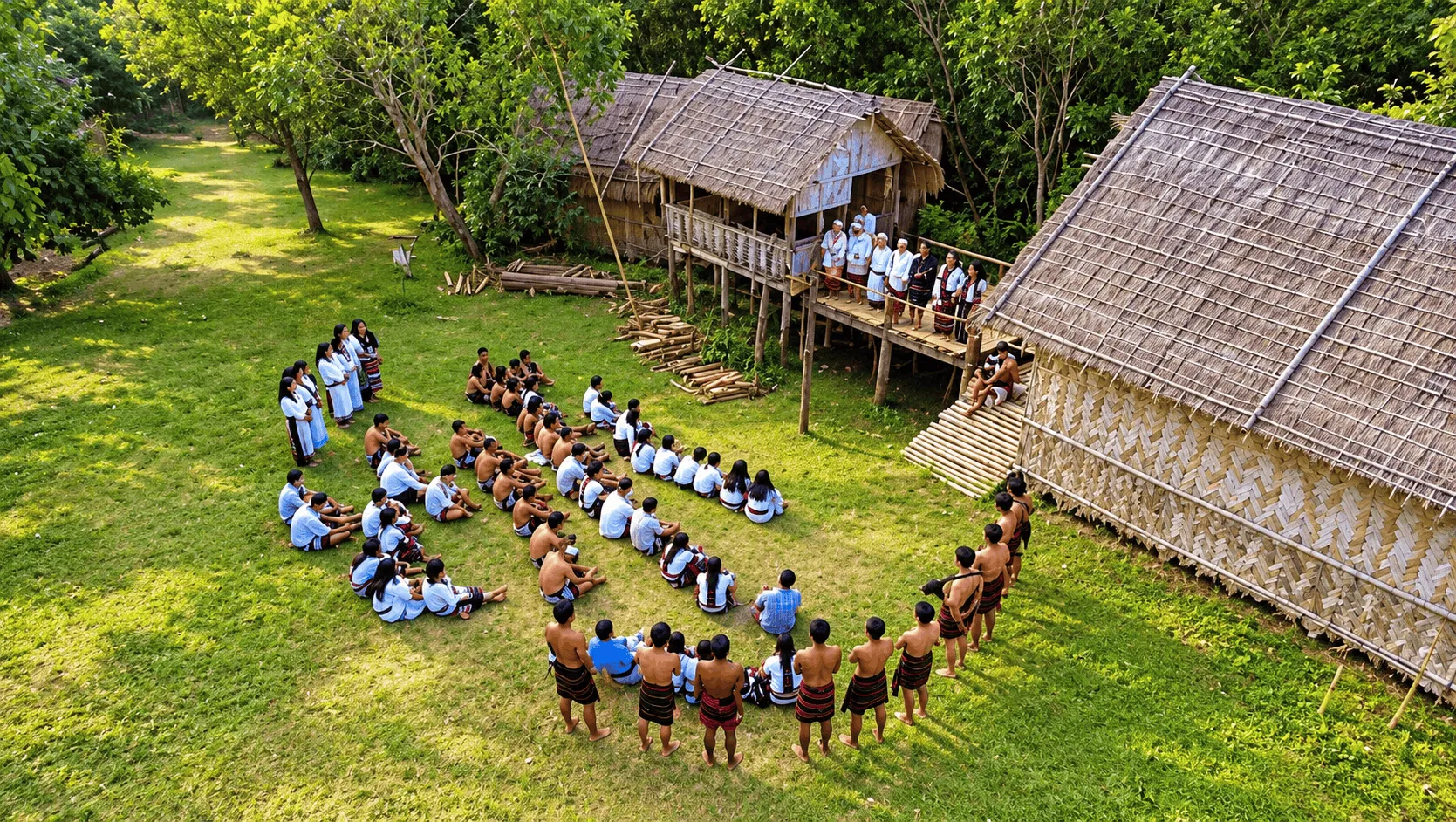
Falkawn Heritage Village is a constructed village. That sentence is the most useful thing to know before you go. It was built by a government department as a cultural centre, with replica houses and displays meant to show how a traditional Mizo village was arranged. It is not a living village in the ordinary sense, and it does not show every aspect of Mizo life, which varies between communities and has changed a great deal over time. What it can do is give you a physical sense of structures you will otherwise only read about: the chief's house, the bachelors' dormitory, the blacksmith's workshop.
This guide explains where Falkawn is, what official sources say about its purpose and contents, what visitors may expect, how to reach it and how to visit respectfully. It gives only the details that official sources support, and it flags the rest for local confirmation. For the wider state and how its regions connect, see our Mizoram travel guide.
Where Is Falkawn Heritage Village?
Falkawn is a small village south of Aizawl, in Aizawl district. The Aizawl district website places it about 18 kilometres south of the city, while another government tourism listing says 22 kilometres, so treat any distance as approximate and ask your driver. The same district page says a taxi or rented car from Aizawl takes about one hour and twenty minutes, but that figure is undated and road conditions change, so we are not promising it.
The site goes by several names, which can confuse searches. Official sources call it Zokhua, Zokhua Falkawn, the Typical Mizo Village or a Mizo traditional houses and heritage village. They all refer to the same cultural centre.
Falkawn lies south of the city, on the side toward Hmuifang and the road to Thenzawl and Lunglei. The Ministry of Tourism's sample itinerary for a day trip south of Aizawl includes Falkawn alongside Hmuifang, with the village visited as a stop in the morning, which is a useful clue about how the geography works. Our Aizawl travel guide covers the city, and our Hmuifang travel guide covers the hill you might pair it with.

History and Purpose of the Heritage Site
According to the Aizawl district website, the Art and Culture Department of the Government of Mizoram set up a cultural centre, called Zokhua, at Falkawn in 1992. The district page describes it as a mini live-museum depicting the lifestyle and culture of a typical Mizo village. The Ministry of Tourism says the goal of Zokhua Falkawn is to showcase traditional Mizo practices, artwork, social system and festivities.
Two points follow. First, the centre was created in the early 1990s as a deliberate project, so what you see is a reconstruction and not a surviving historic village. The Ministry of Tourism describes the structures as replicas. Second, "live-museum" does not tell us whether people live on the site, whether there are demonstrations or how the displays are staffed. The district page mentions only that a part-time caretaker, called a chowkidar, is engaged and that the centre is frequently receiving public visitors. We could not verify any resident community, guided tours or performances.
Some sources describe the village as typifying the Lusei village of earlier times. Mizoram is also home to other communities with their own traditions, so the site shows one tradition and one period, and should not be read as the whole story.
What Visitors May See
The district website lists these structures and features. Their presence is confirmed there, but details such as condition, labelling and access are not.
- Zawlbuk, the dormitory for young men.
- Lal In, the chief's house. Lal means chief and in means house.
- Pum, the blacksmith's workshop.
- Other typical Mizo houses.
- Freedom fighter memorial stones and a commemoration stone named Taitesena.
A film synopsis from the Northeast India AV Archive adds the houses of the chief's elder and of a widow, and says a large stone commemorates seven Mizo patriots who died resisting British colonisation. That is a secondary source and does not match the district page exactly, so we are not stating these details as fact. Ask on site what each structure represents.
The Ministry of Tourism's page also says visitors can notice the colourful and complex patterns of traditional Mizo attire, but it does not say whether textiles are displayed on site. We could not verify any displays of clothing, tools, objects or artwork inside the houses, so do not plan on them.
The Aizawl district website lists an entry fee of Rs 20 for adults and Rs 10 for children. The page is undated, so treat the figure as indicative and confirm it before you go. We could not verify opening hours, closing days, guides, toilets, parking, a café or any other facilities, and we are not describing any.
Traditional Mizo Architecture and Cultural Displays
The structures at Falkawn are meant to illustrate the layout of a traditional village, and each building type points to something about how society worked.
The zawlbuk was a young men's dormitory and community centre. A recent feature in the Daily Pioneer describes it as a youth centre through which traditional practices of decision-making, cooperation and culture were passed on over generations, and notes that food played a vital role in reinforcing community bonds. It was a place of learning and shared responsibility, not just sleeping quarters.
The lal in is the chief's house. The Ministry of Tourism says touring the replica allows visitors to visualise the chief's lifestyle and social role within the community. Chiefs held a central position in traditional Mizo society, and the house reflects that.
The pum, the blacksmith's workshop, points to the craft skills a village needed. Beyond that, we could not verify what is shown inside, so ask what a blacksmith's place was in the community.
We have not described building materials, construction methods or dimensions, because we could not find a reliable source for the replicas at Falkawn. Ask on site, or look at the labelling, and do not assume that a replica copies every detail of an original.

Cultural Context: What to Understand Before Visiting
A few ideas will make the visit richer and keep your expectations realistic.
This is a representation. The village shows a way of life that largely belongs to the past. Most Mizos are now Christians following the work of missionaries from the 1890s, according to a paper on Mizo cuisine by researchers at North-Eastern Hill University and Mizoram University, and institutions such as the zawlbuk no longer function as they once did. If you want to understand life today, talk to people, visit a working village through a host and spend time in towns and markets.
It reflects one community's tradition. "Mizo" is used as an umbrella term for closely related communities, and Mizoram also has the Mara, Lai, Chakma, Bru and others, whose traditions differ. Do not treat the site as typical of all of them.
Memorials deserve respect. The stones for freedom fighters and the Taitesena commemoration are memorials. Treat them as such.
Heritage can be contested. Different people tell stories about the past differently, and a site like this reflects choices made by whoever designed it. Ask questions, listen and avoid assuming that any single account is complete.
How to Reach Falkawn
Most visitors start in Aizawl, which has Lengpui Airport and, since 2025, a rail link to Sairang near the capital. Check current flights and train services before you plan.
From Aizawl, Falkawn is reached by road, heading south. The district website says tourists can take a taxi or rent a car from Aizawl, and gives about one hour and twenty minutes, but we could not verify the current route, journey time or road condition. Ask your driver, confirm the destination by its several names and check the road in the wet season.
We found no verified information on public transport, shared vehicles or schedules to Falkawn, so do not assume it is served. A hired vehicle with a driver who knows the way is the safest plan, and it lets you combine Falkawn with other stops on the same road. Local transport is informal, and services may be limited on Sundays and holidays.
Visitors from other parts of India have generally needed an Inner Line Permit to enter Mizoram, and foreign nationals have separate arrangements. Local reporting in 2026 said new guidelines had been approved, with details not fully published at that time, so check official Mizoram government channels before you travel.
How Much Time to Allow
We could not verify how long a visit takes. Falkawn is a small site, so an hour or two on the grounds is a reasonable planning assumption, but that is our estimate and not a published figure. Add travel time each way, which the district page puts at about one hour and twenty minutes by car, though we cannot confirm it.
Treat Falkawn as a half-day outing from Aizawl, or as one stop on a longer day south of the city. The Ministry of Tourism's sample itinerary places it alongside Hmuifang in a single day trip, with other stops. If you try the same, leave room for slow roads and do not stack too many stops. If you are interested in a similar site on the other side of Aizawl, our Reiek Hills travel guide covers a hill with its own heritage village, and the two are in different directions from the city.
Best Time to Visit
We found no official seasonal advice for Falkawn, so this section reflects general conditions in Mizoram. The village is outdoors, with paths on a hillside, so weather matters.
The cooler, drier months, roughly October to March, usually bring clearer skies, firmer paths and easier roads. The monsoon, roughly late spring to early autumn, brings heavy rain, slippery ground, leeches and slower roads, and landslides can interrupt journeys south of Aizawl. If you go then, wear shoes with good grip and keep your plans flexible.
Check the forecast close to departure. A morning visit may suit you if you are combining several stops, because afternoons can be cloudy, but conditions vary. Sundays are generally quiet in Mizoram, so confirm whether the site is open before you set out.
Photography, Etiquette and Responsible Tourism
- Ask the caretaker or staff about photography rules before you start, including drones, tripods and any restricted areas.
- Do not climb on structures, lean on walls or enter areas that are closed off. These are reconstructions that need to last.
- Treat the memorial stones with respect. Do not sit on them, stand on them or pose in a way that disrespects what they commemorate.
- Do not remove or move objects, and do not write or carve on anything.
- Ask before photographing other visitors, staff or local people, and accept a refusal.
- Keep voices low and do not play music, especially near memorials.
- Carry out all rubbish, and avoid single-use plastic.
- Do not treat the site as a costume backdrop. If you want to wear traditional dress for a photo, ask first and consider whether it is appropriate.
- Support the local economy by hiring a local driver, buying from local sellers nearby and paying any fees honestly.
- Be open to questions and corrections. If someone tells you a display is wrong or incomplete, listen.
Practical Travel Checklist
Confirm before you go:
- Opening days and hours, and whether the site is open on Sundays and holidays.
- The current entry fee, which the district website lists at Rs 20 for adults and Rs 10 for children, and how to pay.
- Whether guides, demonstrations or interpretation are available.
- Facilities such as toilets, drinking water, parking and food.
- The route and current road condition from Aizawl, and any landslide reports.
- Inner Line Permit requirements, which were reported as being revised in 2026.
Bring:
- Cash for the entry fee and small purchases, since digital payments may be unreliable.
- Shoes with good grip, rain gear and a warm layer.
- Water, snacks and sun protection.
- A power bank and offline maps, since mobile coverage can be patchy.
- A notebook if you want to record what you learn.
Frequently Asked Questions
Where is Falkawn Heritage Village?
Falkawn is a small village about 18 kilometres south of Aizawl, according to the district website, though another government listing says 22 kilometres. Confirm the route with your driver.
What is Falkawn Heritage Village?
It is a cultural centre called Zokhua, set up by the Mizoram Art and Culture Department in 1992 to depict a typical Mizo village. It is a reconstruction and not a living village.
What can I see at Falkawn?
The district website lists a zawlbuk, a Lal In chief's house, a pum blacksmith's workshop, other typical Mizo houses and freedom fighter memorial stones. We could not verify other exhibits.
Is there an entry fee?
The district website lists Rs 20 for adults and Rs 10 for children, but the page is undated. Confirm the current fee and opening hours before you go.
How do I reach Falkawn?
Most visitors go by taxi or rented car from Aizawl. The district website gives about one hour and twenty minutes, but check current conditions and do not rely on public transport.
Is Falkawn the same as Reiek Heritage Village?
No. They are separate sites in different directions from Aizawl. Our Reiek Hills guide covers the other one.
What is the best time to visit Falkawn?
The cooler, drier months, roughly October to March, are generally easier. The monsoon brings slippery paths and slow roads, and no official seasonal guidance was available.
Conclusion
Falkawn Heritage Village is a small, deliberately built window onto an older Mizo village, with a chief's house, a dormitory and a blacksmith's workshop laid out on a hillside. It works best as a prompt for questions, and not as a complete picture. Confirm its opening hours and fees before you go, treat the memorials with respect, and pair the visit with conversations and places that show Mizo life as it is lived today.