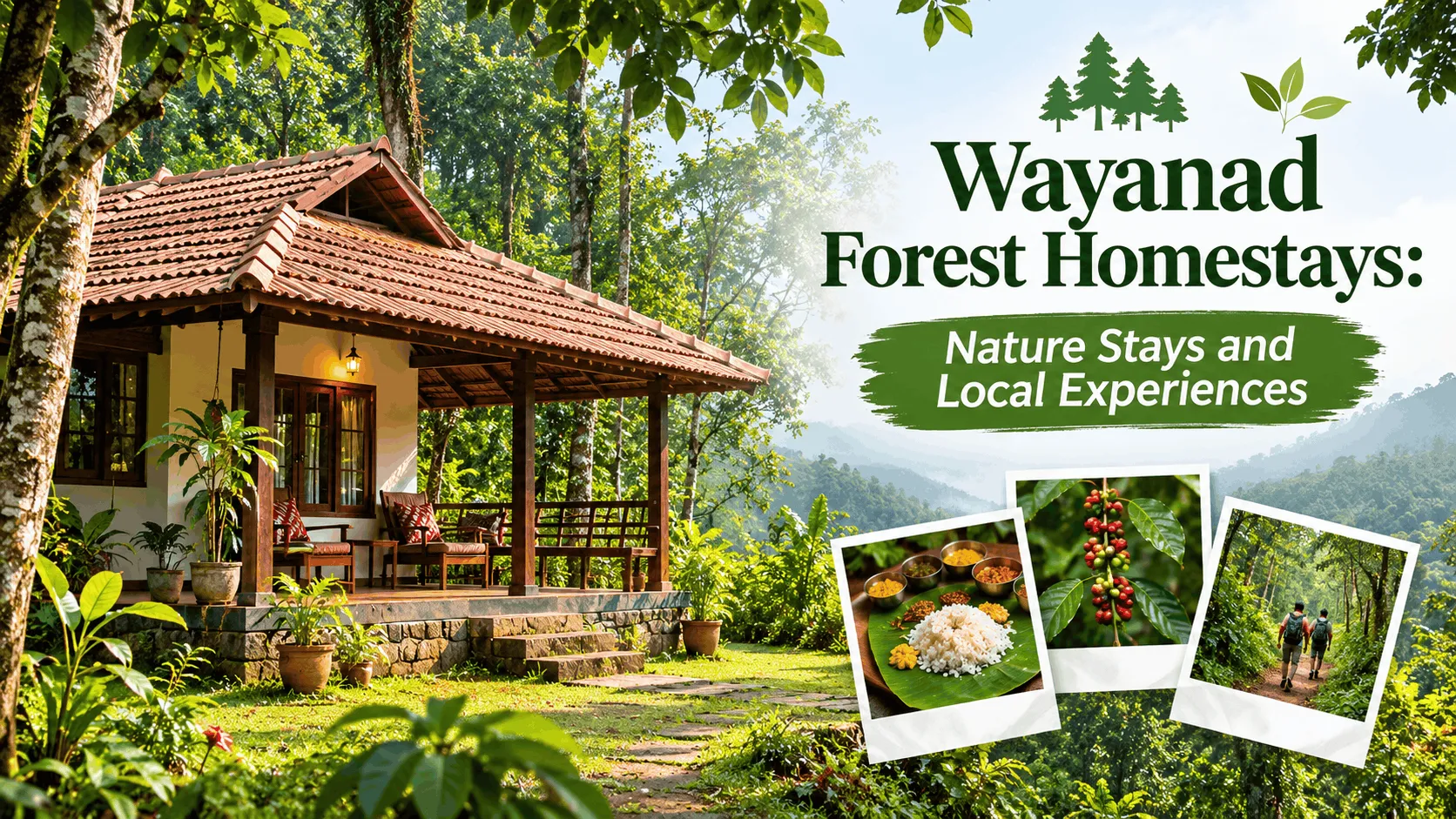
Wayanad lies in the Western Ghats of northern Kerala, and much of the district is hill, forest, plantation and paddy. A Wayanad forest homestay places you in that landscape instead of beside a highway or inside a large resort. Many are run by the owner's family, so meals, advice and conversation come from people who live nearby. That pace suits travellers who want a quiet break and some contact with the local community.
This guide explains what the term means, where to look, what to expect, how to choose a property and when to go. We do not name individual homestays, because facilities, prices and access rules change and should be confirmed with each property directly.
What Is a Forest Homestay?
A homestay is a small, family-run property where guests share the host's setting and often eat the host's cooking. Compared with a hotel or resort, a homestay in Wayanad tends to have fewer rooms, more personal service and less standardised facilities. A forest homestay adds a setting: it sits in or beside woodland, a plantation or a hill slope, and the stay is built around the surroundings. Nature-oriented accommodation often means simple design, open views and a day paced by light and weather. Local hospitality shows up as home-style meals and hosts who can explain the area.
One point needs care. A property surrounded by greenery is not automatically inside a protected forest. Much of Wayanad's green cover is coffee, tea and pepper plantation or private farmland. Protected areas such as Wayanad Wildlife Sanctuary, which has ranges at Sulthan Bathery, Kurichyad, Muthanga and Tholpetty, are managed by the forest department. Unless an official source confirms otherwise, "near the forest" is the accurate description.

Why Choose a Forest Homestay in Wayanad?
Quiet is the main draw. A Wayanad nature stay usually means fewer guests, less traffic noise and more time with the landscape. If you are still deciding how long the district deserves, our Wayanad travel guide with itineraries and routes helps you build a stay around the main sights.
Hospitality is the second reason. Hosts can often tell you which paths to avoid after rain, where to find a good local meal and when a place is least crowded. Many homestays also sit within reach of walking trails, waterfalls, plantations or sanctuary entrances, though being close does not guarantee access.
Cultural and community experiences are possible where a property genuinely offers them, such as plantation visits or time with local families. Treat them as a bonus to confirm, not an assumption. Kerala Tourism's responsible tourism pages list some community-led trails in Wayanad.
Areas to Explore for Forest Homestays in Wayanad
The areas below are described by general landscape. Confirm the exact location of any property before booking.
Vythiri and Lakkidi
Vythiri sits at about 700 metres and feels cooler than much of the district. Lakkidi lies at the crest of the Thamarassery ghat road and is often called the gateway to Wayanad. Many resorts operate here, so ask whether a listing is a true homestay.
Kalpetta and the Chembra Side
Kalpetta is the district headquarters and a practical base. Chembra Peak, the highest point in Wayanad, is a popular trek, but access is regulated, so check current rules.
Mananthavady, Tholpetty and Kuruva
Northern Wayanad has the Tholpetty range of the sanctuary and Kuruva Island, a river island. A stay nearby does not guarantee entry, and visitor numbers may be controlled.
Sulthan Bathery and Muthanga
The south-east combines plantations with the Muthanga range of the sanctuary and sights such as the Edakkal Caves.
Experiences to Expect at a Wayanad Forest Homestay
The list below shows common possibilities, not guaranteed services. Ask each property what it actually offers, who leads the activity and whether it costs extra.
- Nature walks: Some hosts arrange guided walks on plantation paths. Avoid forest edges alone at dawn and dusk, when wild animals may be moving.
- Birdwatching: Possible near wooded areas where permitted, and best with a local guide. For how forest-edge wildlife watching works elsewhere in the Western Ghats, see our guide to wildlife and birdwatching around Munnar.
- Local food and hospitality: Home-style Kerala meals are common. Menus and vegetarian options vary by host.
- Plantation or village experiences: Some coffee, tea and pepper holdings allow short visits when the owner or a neighbour arranges them.
- Relaxation: Verandas, quiet evenings and green views are the most dependable part of any stay.
Wildlife sightings cannot be promised. Elephants and other animals live in the region, so follow your host's advice.

How to Choose the Right Wayanad Forest Homestay
- Location and accessibility: Ask about the final approach road, since hill lanes can be narrow and steep. If you are arriving from the Kerala high ranges, our Munnar to Wayanad route guide explains why that journey needs a full day.
- Accommodation and facilities: Confirm room type, bathroom, hot water, power backup, mobile network and Wi-Fi.
- Food arrangements: Ask about meal timings, vegetarian options and whether meals are included.
- Families and groups: Check room capacity, stairs, open drops near the building and how far the nearest hospital is.
- Safety and verified guest information: Read recent reviews on more than one platform. Ask for registration or classification details and verify them with the tourism department.
- Environmental and community practices: Treat words such as "eco-friendly" as claims to check. Ask how the property handles waste and water, and whether it employs local people.
Best Time to Stay in a Forest Homestay in Wayanad
Wayanad has pleasant weather for much of the year, and many sources suggest October to May as the easiest period. Patterns change from year to year, so check forecasts before you travel.
- Winter (roughly October to February): Cooler and drier, with good conditions for walks and views.
- Summer (roughly March to May): Warmer, so plan outdoor time for early mornings and evenings.
- Monsoon (roughly June to September): Lush scenery, but heavy rain, leeches, slippery paths and possible road disruption. Wayanad has seen landslides during heavy rain, including deadly ones in 2024. Check local advisories and stay away from slopes and swollen streams.
Pack light layers, a rain jacket, closed shoes with good grip, insect repellent, a torch and a power bank. Leech socks help in the monsoon.
Responsible Tourism at Forest Homestays
Good habits matter more in a small community than at a large resort. Our guide to local life in Munnar village describes courtesy that applies in any hill village.
- Ask before photographing people or homes.
- Dress modestly and respect local customs, especially at temples and shared spaces.
- Carry out your litter, including plastic.
- Keep noise low, and never feed or approach wild animals.
- Follow property and forest-area rules, and stay on marked paths.
- Choose locally run services, guides and food where you can.
Travel Tips for Booking a Forest Homestay
- Confirm the exact location with a map pin and ask whether the property is inside or beside forest land.
- Check road access for your vehicle, including the last stretch and the rainy season.
- Verify amenities and meal arrangements in writing.
- Read the cancellation and booking conditions, including what happens in bad weather.
- Ask whether outdoor activities are included or charged separately.
- If you are driving from Karnataka, check night-travel restrictions on forest highways.
Frequently Asked Questions
Are there forest homestays in Wayanad?
Yes, many homestays and small stays sit beside forests, plantations and hills. Most are on private farmland, so confirm each property's exact location and whether any part lies within protected land.
What is the difference between a forest homestay and a resort?
A homestay is usually smaller, hosted by a family and more personal. A resort has more rooms, standard facilities and organised activities. Quality and price overlap, so judge each property by its details.
Which areas in Wayanad are suitable for nature stays?
Vythiri, Lakkidi, Kalpetta, Mananthavady and the Sulthan Bathery side are commonly used bases. Each has a different landscape and access, so choose by what you want to see.
Are forest homestays suitable for families?
Often, with some checks. Ask about stairs, open drops, child-friendly meals, the distance to medical care and any age limits on activities.
Can visitors experience wildlife near forest homestays?
Sometimes, but sightings are never guaranteed. You may hear birds and see small animals. Keep your distance from larger ones and follow your host's guidance.
What is the best season for a forest homestay?
October to February is usually comfortable for walking. March to May is warmer, and June to September brings heavy rain, which suits flexible travellers who check advisories.
What should travellers check before booking?
Check the exact location, road access, amenities, meals, recent reviews, cancellation terms, activity charges and registration details.
Conclusion
A Wayanad forest homestay offers a quieter way to see the district, with local hosts, home-style food and a landscape that shapes the day. The best stays are honest about what they offer, clear about their location and respectful of neighbours and wildlife. Check the details, choose properties run by local people where possible, follow forest and community rules, and keep expectations realistic. Done that way, a nature stay supports the place you came to enjoy.