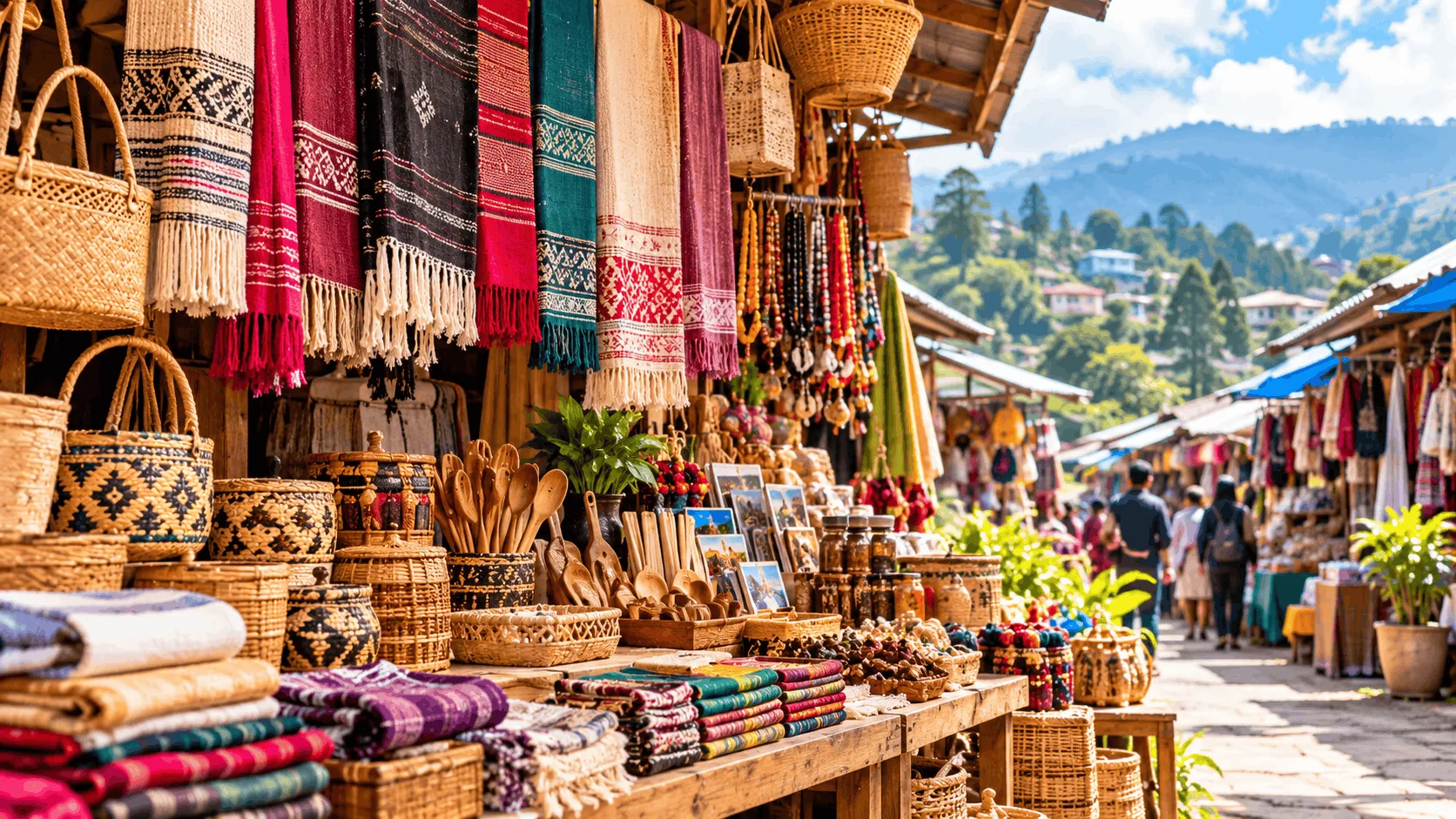
Shopping in Meghalaya comes down to knowing where things come from. A basket woven in the Khasi Hills, a Garo textile made on a backstrap loom and a packet of Lakadong turmeric each trace back to a particular community or place, and the state has secured Geographical Indication (GI) status for several of them. Other goods in the same lanes were made elsewhere in India or abroad. Telling the two apart is the most useful skill a visitor can bring.
Meghalaya Tourism describes bamboo and cane work and weaving as the backbone of the state's crafts, with the Khasi, Jaintia and Garo communities each keeping their own styles. Markets add another layer. Iewduh in Shillong, also called Bara Bazaar, is described in state government coverage as one of the oldest and largest traditional markets in the Northeast. The Khasi Hills Autonomous District Council administers it, and Hima Mylliem owns it.
This guide covers what to buy, where to look, how to check what you are holding and how to get it home. It centres on Shillong because most trips start there. For the wider itinerary, read our Meghalaya travel guide.

What to buy in Meghalaya
Start with a short list and let the trip fill in the rest. These are the product groups that official or well-documented sources tie to the state:
- Handwoven textiles, including Ryndia eri silk, Garo Dakmanda cloth and Khasi and Jaintia weaves
- Bamboo and cane goods such as baskets and mats
- Black pottery from Larnai village in West Jaintia Hills
- Lakadong turmeric from the Jaintia Hills
- Fruit from GI-listed varieties such as Khasi Mandarin, when in season
- Fruit wines from local producers
If you are travelling with one bag, the lightest choices are turmeric, a folded textile or a small woven item. Pottery and large baskets take real space and need padding, so decide on them before you reach the last day of the trip.

Handwoven textiles and eri silk products
Meghalaya Tourism lists the main weaving traditions by community. The Garo are known for the Dakmanda, woven on backstrap looms with bold geometric designs and natural pigments. The Khasi weave the Jainsem, a draped garment for women, and Ryndia, an eri silk cloth the tourism department says is woven and dyed sustainably in villages such as Umden. The Jaintia weave on loin looms and make garments such as the Jainkup, often in quieter colours.
Both Dakmanda and Ryndia have GI status. Garo Dakmanda was among the products registered in December 2023, and a 2025 report on the Ryndia registration says it was the result of a four-year effort by the state textiles department, with Umden-Diwon named Meghalaya's first Eri-silk village in February 2021. A GI registration protects the name of the product and its place of origin. It does not guarantee that every item sold under that name is genuine, so the checks in the identification section below still apply.
A full Dakmanda is a traditional garment worn by Garo women, so ask what formats a weaver or shop offers before you assume you must buy a full outfit. For more on weaving traditions, see our Meghalaya handicrafts and textiles article.
Bamboo, cane and other handcrafted goods
Meghalaya Tourism names several everyday items that visitors may see in craft shops:
- The Khoh, a conical basket, and the Knup, a bamboo rain shield, among the Khasi
- Tlieng mats among the Jaintia, described as durable and finely patterned
- Garo basketry and poker work, where designs are burnt onto bamboo with heated metal rods
Look for tight, even weaving and smooth edges. Splinters and loose ends suggest rushed work. Many stalls sell bamboo and cane in the same shapes, so ask whether the seller made the item or bought it from a maker.
Larnai pottery is the other craft worth knowing. Larnai is a village in West Jaintia Hills, and the pottery is made from black clay mixed with serpentine stone using techniques passed down through generations. It earned a GI registration in the same December 2023 round as Dakmanda. Pots are fragile, so buy them only if you can pack them well.
Meghalaya Tourism also mentions wood carving, beadwork and silver jewellery. Buy new pieces from makers or established outlets. Skip old ritual objects and anything presented as an antique, because provenance is hard to prove and some items may be restricted for export.
Food products and regional specialities
Lakadong turmeric is grown in the Lakadong area of the Jaintia Hills and is known for its high curcumin content. It received a GI tag in December 2023. Reporting on GI enforcement notes that counterfeit versions of Lakadong turmeric and Khasi Mandarin have appeared in markets outside Meghalaya, which is a good reason to buy it in the state from a seller you can question.
Khasi Mandarin, a GI-listed citrus, is cultivated in the East Khasi, West Khasi and Jaintia Hills. Memang Narang, a GI-listed wild orange, comes from the Garo Hills. Fresh fruit depends on the season, so ask vendors what is available during your dates.
Fruit wine is a newer line in Shillong. The Meghalaya Fruit Wine Experience Centre, part of the Meghalayan Age Pavilion described below, was handed to the Meghalaya Fruit Wine Makers' Association to run. Rules on carrying alcohol vary by airline and destination, so check them before you buy.
Iewduh also sells vegetables, meat, fish, groceries and spices, according to a state government description of the market. Eat the fresh snacks there and leave perishables out of your luggage.
Markets and shopping areas worth exploring
Iewduh (Bara Bazaar), Shillong
The market sells vegetables, meat, fish, groceries, spices, household goods, textiles and indigenous handicrafts. Its name means the biggest market in Khasi. A national archive entry also notes that it is known for second-hand clothing, which is a reminder that not everything in the lanes is local. The state government announced a Rs 21 crore upgrade in May 2025, so conditions inside may differ from older descriptions. Check current access before you plan a visit.
Police Bazar, Shillong
The archive describes it as the city's main hub, known for shops and street food, with a Tibetan Market nearby. Stock there is mixed, so use the identification steps below.
Emporiums near Police Bazar
The Incredible India tourism site lists Purbashree Emporium, Khasi Emporium and the Meghalaya Handloom and Handicrafts Development Emporium near the Police Bazaar. Purbashree is run by the North Eastern Handicrafts and Handlooms Development Corporation, a central government enterprise, so its stock covers the Northeast and is not limited to Meghalaya. The same listing notes that one of the emporiums also carries imported goods next to local bamboo crafts.
Meghalayan Age Pavilion, near Ward's Lake
The Chief Minister inaugurated this retail and cultural space on 13 October 2026. It combines a store for locally made food, textiles and handicrafts, sixteen entrepreneurs supported under the PRIME programme, a restaurant and the fruit wine centre. Because it opened only recently, confirm which outlets are trading before you go.
Tura, Garo Hills
A cultural exhibit by Dastkari Haat Samiti describes a weekly farmers' market in Tura where growers sell produce. It is a place to see local food rather than to buy souvenirs.
Shopping in Shillong and other towns
Shillong is the easiest place to compare options in one day. A workable order is Iewduh early, Police Bazar and the emporiums next, and the Meghalayan Age Pavilion last, since it sits by Ward's Lake and offers somewhere to sit down. Allow time between stops, because traffic around central Shillong can be heavy. Our Shillong travel guide covers the city's other sights.
Outside Shillong, shopping is more incidental. Small stalls appear near popular attractions. This guide names none of them, so treat them as places to ask questions before you rely on any claim about where an item was made. Jowai, the headquarters of West Jaintia Hills, lies about 64 km from Shillong and has its own markets. Tura is far to the west, and the Travel Guide notes that facilities there are more limited, so plan the journey carefully.
How to identify locally made products
No single test settles it, but a few habits help.
- Ask who made it and where. A maker or a seller who deals with makers can usually name a village, a cooperative or a community. Vague answers are a signal to slow down.
- Look for GI names. Ryndia, Garo Dakmanda, Larnai pottery and Lakadong turmeric are all registered. Ask what proof the seller can show, and remember that a name on a label is a claim and not a certificate.
- Check the fibre in textiles. Ask whether a cloth is eri silk, cotton or a synthetic blend. Hand-spun and hand-dyed fabrics tend to vary slightly from piece to piece.
- Watch for sameness. A stack of identical baskets or scarves suggests factory production, though some makers do produce in numbers.
- Know the outlet. Emporiums run by government bodies can stock goods from outside Meghalaya, as the Purbashree example shows.
This guide cannot point to a visitor-facing authenticity certificate for Meghalaya crafts. If a seller claims one, ask to see it.
Prices, bargaining and payment considerations
This guide does not quote prices. They change with season, material and the hours a piece takes to make.
Travel writers report that bargaining is common at street stalls and less common at emporiums, where prices are reported to be fixed. Confirm that at each shop. If you do negotiate, keep it polite and remember that a handloom piece can take days of work.
For payment, carry cash for small purchases and rural areas, as our Travel Guide advises for fees. Card and UPI acceptance varies by shop, so ask before you pick things up.
Packing, transport and customs considerations
- Textiles are light and compress well. Roll or fold them flat and keep them in a sealed bag, since Meghalaya is a wet state.
- Wrap pottery in clothing and place it in the middle of your bag.
- Pack turmeric in sealed packets and keep them away from fabrics.
- Check airline rules on bottles and blades before buying wine or knives. Blades generally cannot travel in cabin baggage, but confirm with your airline and the airport.
- Ship large items through a seller who offers it, and get the arrangement in writing.
On legal limits, do not buy anything made from wild animals, such as ivory, horn, fur or feathers, or any protected plant material. India's Wildlife (Protection) Act restricts trade in animal articles and trophies, and buyers can be liable as well as sellers. Antiques are a separate matter, because India restricts the export of objects classed as antiquities. International travellers should also check their home country's rules on importing food, plants and wood products.
Responsible shopping and supporting local makers
Handloom supports a large workforce in the state. At a Handloom Week launch in August 2026, the state textiles department said the sector supports more than 50,000 households and that women make up over 70 per cent of its workforce.
A few habits keep your money useful to those makers:
- Buy directly from makers, cooperatives or outlets that can name them.
- Pay the asking price for fixed-price goods and bargain gently elsewhere.
- Ask before photographing vendors or their goods.
- Carry a reusable bag and decline extra packaging.
- Leave ritual and ceremonial items where they belong.
If you would rather plan the shopping around a guided trip, browse our tours catalogue.
Frequently asked questions
What is the best thing to buy in Meghalaya if I have limited luggage space?
Lakadong turmeric and a small woven item are the easiest to carry. A folded textile also packs flat. Leave pottery and large baskets for the end of the trip, when you know how much room you have.
Is Iewduh (Bara Bazaar) a good place to buy souvenirs?
It sells textiles and handicrafts among a very wide range of goods, including produce and second-hand clothing. It is a good place to see everyday trade. For souvenirs, ask sellers where each item was made and compare with the emporiums.
How can I tell if Lakadong turmeric is genuine?
Buy it inside Meghalaya from a seller who can tell you where it was grown. The name is GI-protected, but reports note that counterfeit versions have appeared outside the state. Ask about the source and check the packaging.
Can I bargain in Meghalaya?
Travel writers describe bargaining as normal at street stalls. Emporiums are reported to use fixed prices. Confirm at each shop and keep any negotiation friendly.
Can I take wine or knives home?
Rules depend on your airline, route and destination. Blades generally must go in checked baggage, and alcohol limits vary. Confirm both with your airline before you buy.
Is it appropriate to buy traditional garments?
Many are everyday or ceremonial clothing for the communities that wear them. Ask the seller or weaver what is appropriate for visitors, and consider scarves or lengths of cloth if a full garment does not suit you.
Are the emporiums selling only Meghalaya products?
Not always. Purbashree Emporium is run by a central body covering the Northeast, and one Shillong emporium listing notes imported goods. Ask where each item was made.