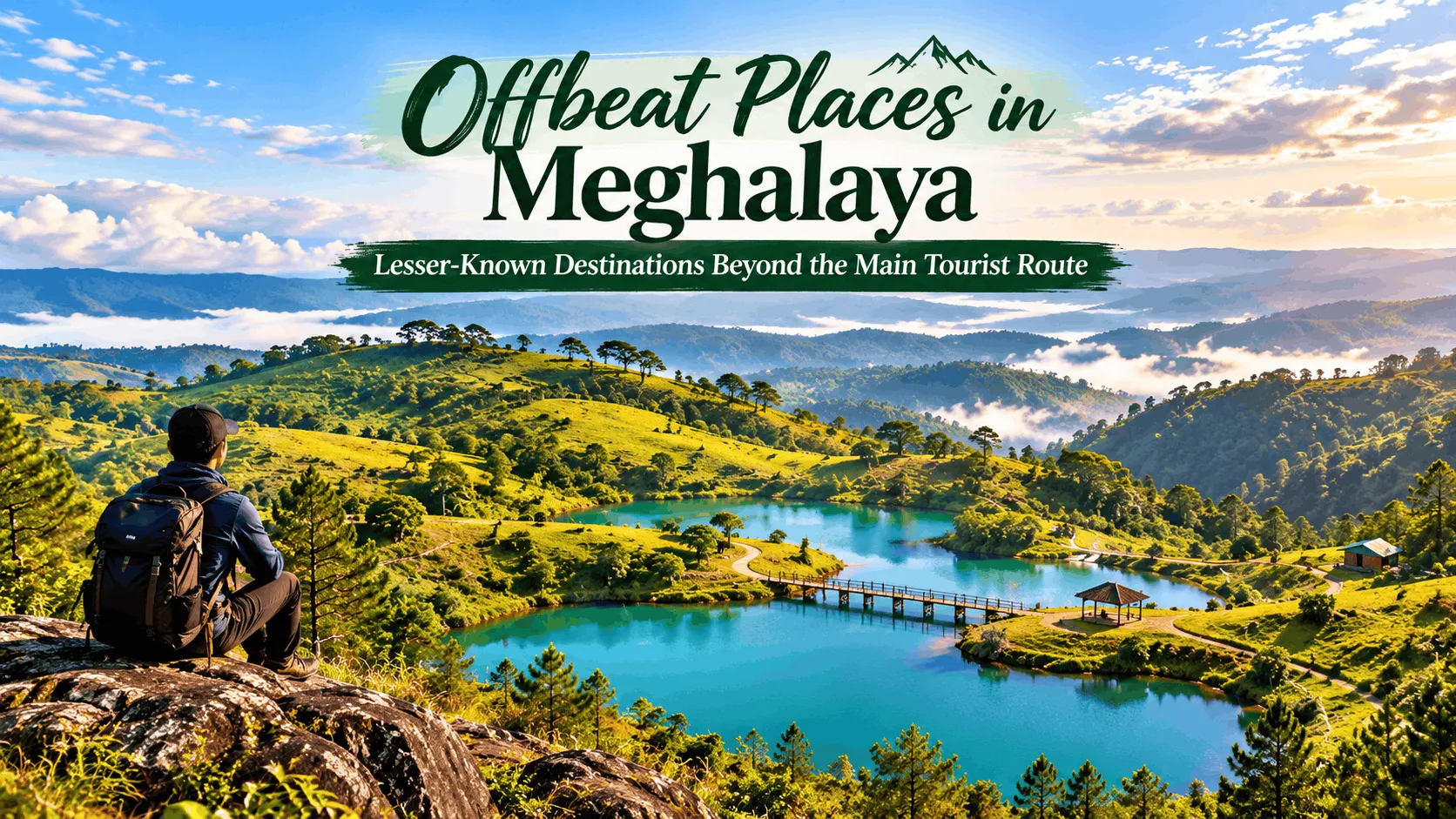
Most first trips to Meghalaya follow a familiar loop: Shillong, Sohra, Dawki and Mawlynnong. It is popular for good reasons, and our Meghalaya Travel Guide covers it in detail. But the state is larger and more varied than that loop suggests. West of Shillong, highland meadows hold small lakes. In the Khasi Hills, ancient stone memorials stand in open country, and one village identifies its people by whistled melodies rather than spoken names. Far to the southwest, in the Garo Hills, a bird sanctuary and a windswept plateau sit well away from the usual routes.
This guide to offbeat places in Meghalaya is for travellers who have time, curiosity and a tolerance for long drives. Every destination below appears on the official Meghalaya Tourism website, and distances, access notes and seasons come from those official pages. Where details are unclear, or where two official pages disagree, we say so rather than guess. Roads, fees and facilities change, so treat this as a planning starting point and confirm locally before you go.

What Makes a Destination ‘Offbeat’?
‘Offbeat’ is relative. None of the places below is secret: each has an official tourism listing. What sets them apart is that they sit outside the best-known circuits, usually because of one or more of these factors:
- Distance from the main loop. Getting there takes a dedicated day or more, not a quick stop.
- Limited public transport. Several places have no direct bus or shared service, so a private vehicle or hired driver is the practical option.
- Fewer facilities. Expect simpler food, basic stays and weaker mobile coverage than in Shillong.
- Cultural or ecological focus. Many of these sites matter as much for community traditions or wildlife as for views.
To keep this guide useful, it leaves out attractions that already have dedicated guides on our site: Sohra and the Nongriat root bridges (see our Cherrapunji Travel Guide), Dawki, Mawlynnong and Jowai. If you are looking for hidden places in Meghalaya beyond those, read on.
Lesser-Known Places to Visit in Meghalaya
Here is a quick overview of the six destinations covered. Distances are as stated on Meghalaya Tourism pages and are approximate.
| Destination | Region | Official distance | Main appeal |
| Mawphanlur | West Khasi Hills | About 70–75 km from Shillong | Highland meadows, small lakes, quiet |
| Kyllang Rock | West Khasi Hills | About 60 km from Shillong | Granite dome with a summit hike |
| Kongthong | East Khasi Hills | About 55–60 km from Shillong | Whistled-name tradition, village trails |
| Mawkyrduk (Mawbynna) megaliths | South Khasi Hills | About 75 km from Shillong | Standing stones and dolmens |
| Siju Bird Sanctuary | South Garo Hills | About 33 km from Baghmara | Birdwatching, forest trails |
| Balpakram National Park | South Garo Hills | Via Baghmara; far from Shillong | Plateau, gorges, wildlife, Garo heritage |
The first four can be reached from Shillong on day trips. The last two belong to the Garo Hills and need a separate, longer journey.
What Makes Each Destination Worth Visiting?
Mawphanlur: meadows and lakes in the West Khasi Hills
Where: West Khasi Hills, roughly 70–75 km from Shillong. The nearest town is Mairang, about 15 km away.
Why go: Meghalaya Tourism describes Mawphanlur as a high-altitude village of rolling meadows dotted with around half a dozen small lakes, with misty mornings and wide skies. It suits travellers who prefer quiet scenery to ticketed sights. The official page also highlights the night sky, since the village sits on open hills.
Trip-planning advice: Treat it as a slow stop rather than a checklist item. Take warm layers, because highland weather changes quickly. Arrange a local guide or companion who knows the area and the language, as the official page advises. Official lodging details are not given, so confirm where to stay before committing to an overnight.
Kyllang Rock: a granite dome above the pines
Where: Near Mairang in the West Khasi Hills, about 60 km from Shillong.
Why go: Kyllang is a large grey granite dome rising from pine forest. Meghalaya Tourism lists its height at about 5,000 feet above sea level and mentions a climbing path with rest stops, views over the Nongkhlaw area, local folklore, and rare white rhododendrons near the base. It is one of the more rewarding short hikes on this list.
Trip-planning advice: The base can be reached by car, followed by an uphill trail to the top. Wear shoes with grip, carry water, and start early so that you are not climbing in fading light. Mawphanlur is listed as a nearby attraction, so the two make a natural pairing for one long day trip from Shillong, though you should check drive times with your driver.
Kongthong: the whistling village
Where: East Khasi Hills, about 55–60 km from Shillong.
Why go: Kongthong is known for Jingrwai Iawbei, a tradition in which each person is given a personal melody, composed by their mother, that serves as their name. The official page also mentions village trails, storytelling and folk music, and nearby root bridges. For many visitors this is the most distinctive cultural stop in the offbeat Meghalaya travel category.
Trip-planning advice: The route involves a scenic road drive followed by a short walk from the roadside. This is a living community, not a stage. Ask your host or guide how visits are normally arranged, whether any contribution is expected, and what is appropriate to photograph. Do not ask residents to perform on demand.
Mawkyrduk (Mawbynna) megaliths: stones that hold memory
Where: Mawkyrduk village, South Khasi Hills, about 75 km from Shillong.
Why go: The site, known locally as Mawbynna, features upright stones (menhirs) and table-like stones (dolmens). Meghalaya Tourism explains that they serve as memorials to the dead and carry deep meaning in Khasi and Jaintia belief. Few sites in the state show the living megalithic tradition so plainly.
Trip-planning advice: A short walk follows the drive. The official page recommends speaking with village elders or a local guide, who may share oral histories about the stones. Treat the site as sacred: do not climb or lean on stones, and ask before photographing people. Note that the official page places the site in the South Khasi Hills but also describes views of the West Khasi Hills landscape, so confirm the exact location with your driver.
Siju Bird Sanctuary: forest, river and birds
Where: South Garo Hills, across the Simsang River near Siju Cave, about 33 km (roughly 1.5 hours) from Baghmara.
Why go: Meghalaya Tourism describes Siju as the state’s oldest wildlife sanctuary. The official page names birds such as the grey peacock pheasant (called the state bird) and grey hornbills, mentions migratory ducks in winter, and notes other wildlife in the area. A short trek through forest trails leads to the sanctuary entrance.
Trip-planning advice: Sightings are never guaranteed, so go for the setting as much as the birds. Hire a local guide. Siju Cave nearby is a wild cave, and the official guidance for caves is to go only with experienced local guides.
Balpakram National Park: the plateau of perpetual winds
Where: South Garo Hills, with Baghmara as the nearest town.
Why go: Balpakram combines table-top plateaus, gorges, limestone caves and forest. It is known as the ‘Land of Perpetual Winds’ and is held by the Garo community to be the resting place of departed souls. The official page lists a wide range of wildlife, including elephants, hoolock gibbons and the rare pitcher plant Nepenthes khasiana, and recommends November to February for birdwatching.
Trip-planning advice: This is the most remote destination here. There is no direct public transport; the official page advises hiring a vehicle from Tura or Baghmara and suggests an SUV because of rough roads. Because of its spiritual meaning for Garo communities, behave with the respect you would show at a place of worship, and follow your guide’s instructions.

How to Reach Each Place
All details below come from official Meghalaya Tourism pages. They give distances more reliably than travel times, so confirm timings with your driver.
- Mawphanlur: The most direct route from Shillong goes via Nongstoin Road, through Nongkhlaw and Markasa. Shared sumos or local taxis may run only as far as Markasa, so a private cab or tour vehicle is the dependable choice.
- Kyllang Rock: Reach it by road from Shillong via the Nongkhlaw–Mairang road. Local transport and private taxis are available from Shillong and Mairang, and the base of the rock can be reached by car.
- Kongthong: Reached by road from Shillong, with shared sumos and taxis mentioned for the route, followed by a short walk from the roadside.
- Mawkyrduk megaliths: Reached via Mawkyrwat Road from Shillong, with shared sumos and taxis mentioned, then a short walk to the site.
- Siju Bird Sanctuary: From Baghmara, hire a cab or shared sumo for the roughly 1.5-hour journey. The official page gives about 450 km and 10–11 hours from Shillong, and about 216 km and 6–7 hours from Guwahati, preferably by private vehicle or overnight sumo.
- Balpakram National Park: The official page gives about 9–10 hours from Shillong, notes no direct public transport, and recommends hiring a vehicle (SUV) from Tura or Baghmara.
One caution: the Siju and Balpakram pages name different highway routes from Shillong, so ask a local driver which road is currently best.
Best Time to Visit Different Areas
| Destination | Best time (official guidance) |
| Mawphanlur | October to May, for clear skies and lake views |
| Kyllang Rock | October to April, for clear weather and hiking |
| Kongthong | October to April |
| Mawkyrduk megaliths | October to April, for clear skies |
| Siju Bird Sanctuary | November to March, for migratory birds |
| Balpakram National Park | October to March; November to February for birdwatching |
For travel outside these windows, Meghalaya Tourism advises checking daily forecasts and paying attention to heavy rain and landslide warnings. Remote roads are the most likely to be affected, so keep your plans flexible.
Suggested 3-Day and 5-Day Offbeat Itineraries
These are planning outlines, not tested schedules. Drive times between stops are not published on the official pages, so confirm them with your driver and drop a stop rather than rush.
3-day Khasi Hills itinerary (Shillong base)
| Day | Plan |
| 1 | Leave Shillong early. Visit Kyllang Rock (about 60 km) and Mawphanlur (about 70–75 km), which are listed as nearby attractions of each other. Return to Shillong. |
| 2 | Day trip to the Mawkyrduk (Mawbynna) megaliths (about 75 km). Allow time to speak with a local guide or village elder. |
| 3 | Day trip to Kongthong (about 55–60 km), including the short walk from the roadside and time in the village. Return to Shillong. |
5-day Garo Hills itinerary (Guwahati or Tura as entry point)
| Day | Plan |
| 1 | Travel toward Baghmara. The official page gives about 6–7 hours from Guwahati by road. Overnight in Baghmara. |
| 2 | Siju Bird Sanctuary (about 33 km from Baghmara, around 1.5 hours each way), with a local guide. |
| 3 | Balpakram National Park by hired SUV, with a guide. |
| 4 | Buffer day for weather, a visit to a nearby Garo village, or rest. |
| 5 | Return journey. |
Combining both regions properly would take more than a week, because the Garo Hills are a long way from Shillong. If you want a wider Northeast plan, our Northeast India Travel Guide is a good starting point.
Accommodation and Transport Considerations
Accommodation. Meghalaya Tourism lists hotels, homestays, guest houses and other stay types on its official accommodation portal. For these remote areas, availability is thinner and harder to verify. The Balpakram page mentions basic homestays and forest rest houses in Baghmara, while the pages for Mawphanlur, Kyllang Rock, Kongthong and Mawkyrduk do not list lodging. Basing yourself in Shillong and making day trips is the lowest-risk option for the Khasi Hills places. Winter is a busy season, so book ahead.
Transport. Shared sumos and taxis are mentioned for some routes, but they rarely line up with a sightseeing plan. A hired car with a driver gives you flexibility to stop, wait and return. For Balpakram, an SUV is recommended. Confirm what the quoted price includes, how waiting time is charged, and whether the driver knows the route.
Local Customs and Responsible Travel
Many of these sites are community-owned or spiritually significant, so the way you behave matters.
- Respect sacred sites. The megaliths and Balpakram have deep meaning for Khasi, Jaintia and Garo communities. Do not climb, move or take anything.
- Ask before photographing. This applies to people, homes and ceremonies, especially in Kongthong.
- Use local guides. The official pages recommend them for almost every destination here, for navigation, language and cultural context.
- Follow village rules. Entry arrangements, contributions and etiquette differ by place and can change.
- Leave no trace. Carry out your waste, stay on trails and avoid disturbing wildlife.
- Support the community. Eat and shop locally where you can.
Meghalaya Tourism also publishes sustainable and responsible travel tips on its official website, which are worth reading before you go.
Safety, Connectivity and Practical Limitations
- Mobile signal can be weak or absent in rural areas and on trails. Download maps, share your plan with someone, and carry cash, because digital payments may not work.
- Weather changes plans. Fog, rain and landslides can slow hill roads, and winter days are short. Aim to finish long drives in daylight.
- Hikes and trails. Kyllang Rock involves an uphill path; Siju involves forest trails. Wear grip shoes and carry water.
- Caves and wildlife areas. Never enter wild caves without an experienced local guide, and keep your distance from wildlife.
- Remote medical help. Facilities are limited far from towns. Carry a basic first-aid kit and any personal medicines.
- Permissions and fees. Check current entry rules, fees and any forest-department requirements locally, especially for Siju and Balpakram. These can change and are not fully listed on every official page.
If you would like help turning a route like this into a trip, contact the Tribal Discovery Tour team to ask what can be arranged.
Frequently Asked Questions
What are the best offbeat places in Meghalaya? It depends on your interests. For landscapes, Mawphanlur and Kyllang Rock stand out. For culture, Kongthong and the Mawkyrduk megaliths. For wildlife and remote nature, Siju Bird Sanctuary and Balpakram National Park.
Are these hidden places in Meghalaya safe to visit? They are listed on the official tourism website, but facilities are limited and connectivity is patchy. Use local guides, check weather and road conditions, and avoid wild caves without expert guidance.
Can I visit these lesser-known places in Meghalaya on a day trip from Shillong? Yes for Mawphanlur, Kyllang Rock, Kongthong and the Mawkyrduk megaliths, based on official distances of roughly 55–75 km. No for Siju and Balpakram, which are in the Garo Hills.
Is public transport available? Shared sumos and taxis are mentioned for some routes, but not all. Mawphanlur and Balpakram have no direct public transport, so a hired vehicle is the practical choice.
When is the best time to explore unexplored places in Meghalaya? Official guidance points mostly to October to April, with Siju best from November to March for migratory birds.
Do I need a permit? We have not verified current permit requirements for these specific sites. Check with Meghalaya Tourism or your guide before travelling, especially for the Garo Hills parks.
Are there unusual places to visit in Meghalaya for cultural travellers? Kongthong, known for its whistled names, and the Mawkyrduk megaliths are two of the clearest cultural examples. Approach both with respect and local guidance.
Conclusion: Plan Slowly, Travel Respectfully
The most memorable offbeat Meghalaya travel experiences tend to involve patience: longer drives, local guides and time to simply be in a place. Choose one or two destinations that fit your season and pace rather than trying to tick off all six. Confirm access, fees and stays before you leave, travel lightly on the communities and landscapes you visit, and remember that these are living places, not just photo stops.
When you are ready to plan, browse the Tribal Discovery Tour tours catalogue for current trip options.