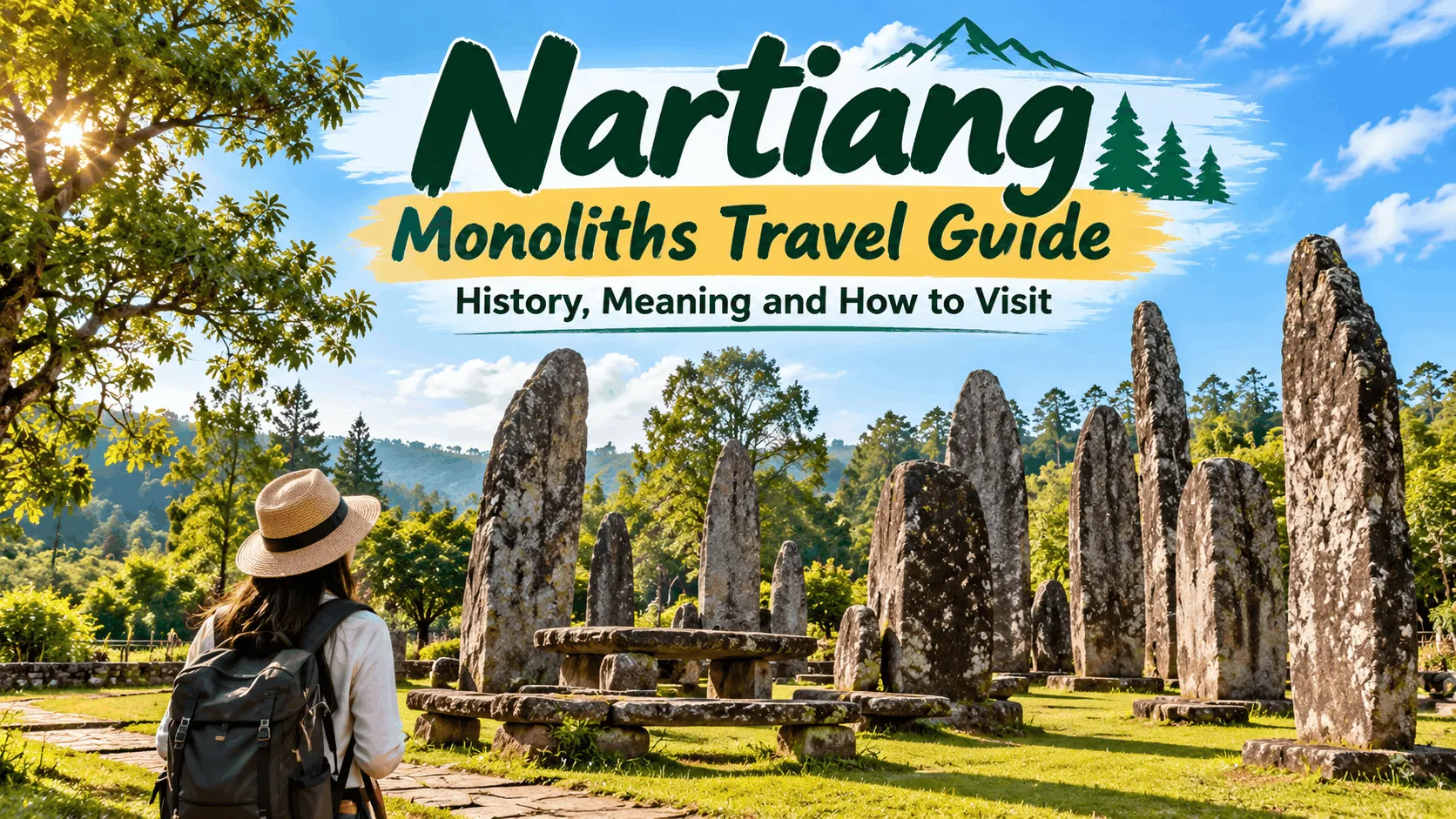
Most visitors to Meghalaya head for waterfalls, living root bridges and the clear waters of Dawki. Far fewer make it to Nartiang, a quiet village in the Jaintia Hills. Yet here stands one of the most remarkable heritage sites in Northeast India: a grove of stones of many sizes, some towering above visitors, raised over several centuries in memory of the rulers, clans and ancestors of the Jaintia people.
The Nartiang Monoliths are not a museum exhibit behind glass. They stand in the open, among trees and grass, in a village that still lives around them. A visit gives you a sense of how memory, kinship and power were expressed in stone in this part of India. This guide explains what the monoliths are, what is known about their history, what to look for at the site, how to reach Nartiang and how to plan a respectful, rewarding visit.
Where Are the Nartiang Monoliths Located?
The monoliths are in Nartiang village, West Jaintia Hills district, Meghalaya. According to the West Jaintia Hills District Administration, the stones lie north of Nartiang market.
Approximate distances, as given by Meghalaya Tourism:
- From Jowai: about 24 km, roughly 40 minutes by road
- From Shillong: about 65 km, roughly 2 to 2.5 hours
- From Shillong Airport (Umroi): about 54 km
- From Guwahati Airport: about 162 km
Road conditions and journey times can change with weather and roadwork, so confirm locally before you set out.
History of Nartiang and the Jaintia Kingdom
What the sources say
Nartiang is closely linked to the history of the Jaintia Kingdom, a kingdom that ruled over parts of the present-day Jaintia Hills and the plains to the south. The Jaintia people of the hills are commonly known as the Pnar.
Nartiang is described in official and heritage sources as having served as a summer capital of the Jaintia rulers. Sources differ on the exact period. Incredible India refers to the 17th century, while other accounts link it to rulers of the late 16th and early 17th centuries. Treat any precise date you encounter as approximate.
The monoliths themselves are attributed to the period between roughly 1500 AD and 1835 AD, according to both the West Jaintia Hills District Administration and Incredible India. Meghalaya Tourism describes some as erected about half a millennium ago, with more added until the mid-19th century.
Who erected the stones
The district administration notes that the tallest menhir was erected by U Mar Phalyngki, described as a trusted lieutenant of the Jaintia king, to commemorate a victory in battle. Other monoliths were raised by U Luh Lyngskor Lamare and by various clans of Nartiang village.
Legends and local tradition
Local stories surround several of the stones, including accounts of the effort needed to raise the tallest one. These are part of the site's cultural memory and are worth hearing from a local guide, but they are oral traditions, not documented history.
What Are the Nartiang Monoliths?
The site is often called the Nartiang Monolith Garden, and it is described by the district administration as the largest concentration of megalithic stones in one area in the region, though monoliths are found across the Khasi and Jaintia Hills.
There are two main types of stone:
Menhirs (Moo Shynrang)
Upright standing stones, locally called moo shynrang. Meghalaya Tourism describes these as dedicated to male ancestors.
Dolmens (Moo Kynthai)
Flat stones laid horizontally, often resting on supporting stones, locally called moo kynthai. These are described as dedicated to women.
The stones vary greatly in size, from modest slabs to tall pillars. Incredible India describes the tallest menhir as about 8 metres high; official tourism pages do not list a height, so treat this as an approximate figure.
Cultural and Historical Significance
The Nartiang Megalithic Stones are significant for several reasons:
- Ancestral remembrance: across the Khasi and Jaintia Hills, monoliths have long been associated with honouring ancestors and clans.
- Royal history: official sources link the site to the kings and nobles of the Jaintia kingdom, commemorating their exploits and important events.
- Social structure: the pairing of standing stones associated with men and flat stones associated with women reflects ideas about lineage and family that remain important in the region.
- Continuity: monoliths are not only historical. Stone memorials are part of a wider tradition in the Khasi and Jaintia Hills.
Interpretations of individual stones vary, and much meaning is carried in oral tradition. If you can, speak with a local guide or elder to understand how the community itself sees the site.
What to See at the Monolith Site
- The tallest menhir: look for the tall upright stone associated with U Mar Phalyngki.
- Rows and clusters of menhirs: notice how stones are grouped, which may reflect family or clan associations.
- Dolmens: look for flat table-like stones beside or in front of upright stones.
- Stone textures: weathering, moss and lichen reveal the age of the site.
- The setting: trees and open ground give the site a calm, almost forest-like feel.
Walk slowly, read any information boards, and take time to look at the stones from different angles.
How to Reach Nartiang from Shillong, Jowai and Guwahati
From Shillong
- By taxi: the most convenient option; hire a car for the day.
- By shared vehicle: Meghalaya Tourism notes that taxis and shared sumos leave from Anjali or Bara Bazaar Stand in Shillong.
- Travel time: about 2 to 2.5 hours for roughly 65 km.
From Jowai
- About 24 km, roughly 40 minutes by taxi or shared vehicle.
- Jowai is a useful base for exploring the Jaintia Hills.
From Guwahati
- By air or train: the district administration lists Guwahati as a gateway; the nearest railway station is in Guwahati.
- By road: travel from Guwahati to Shillong, then continue to Nartiang, or head via Jowai. It is a long day, so many travellers break the journey in Shillong or Jowai.
- Shillong Airport (Umroi): about 54 km from Nartiang, according to Meghalaya Tourism.
Practical note
Meghalaya Tourism advises starting early, as public transport becomes limited by late afternoon. Hiring a local guide or travelling with someone familiar with the area and language is recommended.
Best Time to Visit Nartiang
Meghalaya Tourism suggests October to April, when skies are generally clearer and temperatures milder. The monsoon months bring heavy rain to Meghalaya, which can affect road conditions and make the site muddy, though the landscape is lush.
How Much Time to Spend at the Site
Allow about one to two hours at the monolith garden to walk around and take in the stones at a relaxed pace. If you add nearby attractions, plan a half day or a full day.
Opening hours
Meghalaya Tourism lists the site as open from 6:00 AM to 6:00 PM and advises visitors not to stay beyond closing time.
Entry fee
Official pages do not list an entry fee. Any fee or parking charge should be confirmed locally.
Nearby Places to Visit in the Jaintia Hills
- Nartiang Durga Temple: a temple associated with the Jaintia rulers, located near the monoliths. Incredible India places it about 3 km from the monolith garden. Confirm directions locally, and follow the temple's customs when visiting.
- Krangshuri Falls: listed by Meghalaya Tourism as a nearby attraction.
- Kudengrim Falls: also listed as nearby.
- Lalong and Syntu Ksiar: also listed by Meghalaya Tourism as nearby attractions; ask locally about the best route from Nartiang.
- Jowai town: the administrative centre of the Jaintia Hills and a base for exploring the region.
For more Meghalaya destinations, see our guide to Dawki and the Umngot River and our Cherrapunji travel guide.
Practical Travel Tips and Responsible Visiting
- Start early: shared transport thins out by afternoon.
- Carry cash: card and digital payments may not be available everywhere.
- Wear comfortable shoes: the ground can be uneven or muddy.
- Carry rain protection: weather can change quickly in Meghalaya.
- Respect the stones: do not climb, sit on or lean against the monoliths.
- Do not remove anything from the site.
- Ask before photographing people: respect local residents' privacy.
- Dress modestly, especially if visiting the Durga Temple.
- Leave no litter: carry your waste back with you.
- Hire a local guide if available for context and to support the local economy.
- Check road and weather conditions before leaving Shillong or Jowai.
Suggested Half-Day or Day-Trip Plan
Half day from Jowai
- Morning: drive from Jowai to Nartiang (about 40 minutes).
- Late morning: explore the Nartiang Monolith Garden (1 to 2 hours).
- Midday: visit the Nartiang Durga Temple.
- Afternoon: return to Jowai.
Day trip from Shillong
- Early morning: leave Shillong.
- Mid-morning: arrive at Nartiang and explore the monoliths.
- Late morning: visit the Durga Temple.
- Afternoon: stop at Krangshuri Falls or another nearby attraction, depending on time and road conditions.
- Late afternoon: return to Shillong before dark.
Allow buffer time, as travel times can vary.
For guided trips across the Jaintia Hills and the rest of Meghalaya, explore our Meghalaya tour packages or contact Tribal Discovery Tour to plan your visit.
Frequently Asked Questions
What are the Nartiang Monoliths?
They are a large group of standing stones (menhirs) and flat stones (dolmens) in Nartiang village, West Jaintia Hills, raised in memory of Jaintia kings, nobles, clans and ancestors.
How old are the Nartiang Monoliths?
Official sources date them to roughly 1500 AD to 1835 AD.
What do the standing and flat stones represent?
According to Meghalaya Tourism, standing stones (moo shynrang) are dedicated to male ancestors and flat stones (moo kynthai) to women.
How do I reach the Nartiang Monoliths?
From Shillong, hire a taxi or take a shared vehicle from Anjali or Bara Bazaar Stand. From Jowai, it is about 24 km by road.
What are the opening hours?
Meghalaya Tourism lists 6:00 AM to 6:00 PM. Confirm locally before visiting.
Is there an entry fee?
Official sources do not list one. Confirm locally.
What is the best time to visit Nartiang?
October to April, according to Meghalaya Tourism.
How much time do I need at the site?
About one to two hours for the monoliths; longer if you add nearby attractions.
Plan Your Visit
The Nartiang Monoliths offer a rare, quiet connection to the history of the Jaintia Hills: stones raised across centuries to honour rulers, clans and ancestors, still standing in a living village. Visit with time, curiosity and respect, and pair the trip with nearby temples, waterfalls and the wider Jaintia Hills.
Ready to explore the historical places in Meghalaya beyond the usual routes? Let Tribal Discovery Tour help you plan a trip through the Jaintia Hills and beyond.