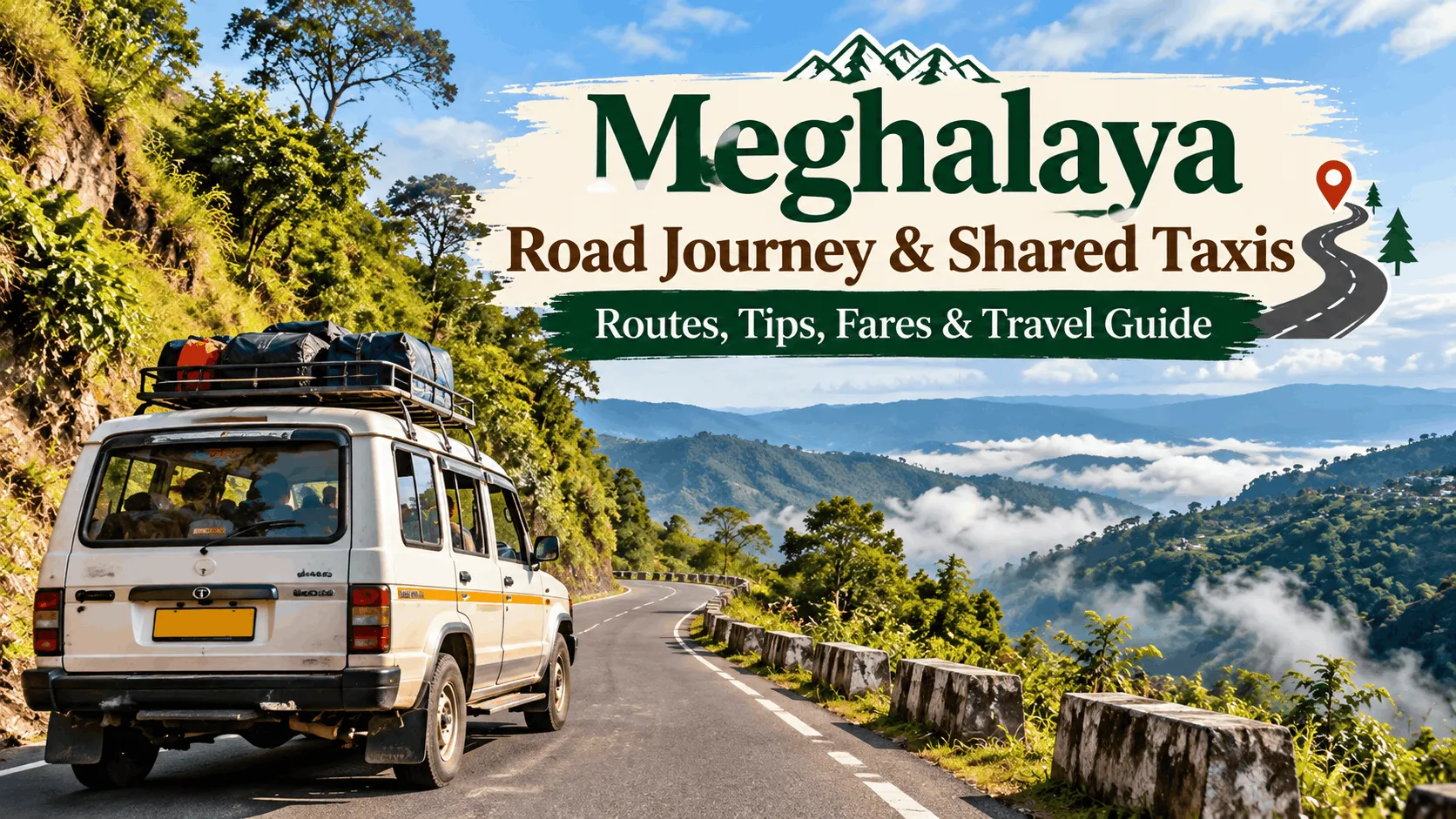
There is no railway line inside Meghalaya. The nearest station is Guwahati, which is well connected to major Indian cities. That means almost all transport in Meghalaya is by road: shared jeeps, buses, taxis and hired cars on winding hill highways.
This guide explains the main options, how they differ and how to plan realistically. It is written for independent travellers. We don't list fixed fares or timetables, because they change with season, demand, weather and negotiation. Where we mention figures, we say where they come from and how to check them.
If you are still choosing destinations, start with our Meghalaya travel guide, then return here to work out how to connect the places on your list.

2. Arriving in the Region: Guwahati, Shillong and Other Gateways
Guwahati (Assam) is the usual gateway. It has the region's busiest airport and the nearest major railhead. Official district information says shared cabs, airport shuttles and Tata Sumos run from the airport to Shillong. Older government-linked pages also mention prepaid taxi counters in the arrivals area. Confirm that these are operating on your arrival date.
Shillong Airport (Umroi) is a small airport roughly 30 to 35 km from the city. Buses and taxis run between Umroi and Shillong. Flight routes there are limited and change often, so check current schedules with the airlines.
If you are combining Meghalaya with Assam or other states, our Northeast India travel guide covers wider routing. Plan your Meghalaya transfers around your arrival time. A late flight into Guwahati may mean staying overnight there rather than driving into the hills in the dark.
3. Getting from Guwahati to Shillong
Transport from Guwahati to Shillong is the journey most visitors make first. The distance is about 100 km, and the district's official page gives 104 km. The main options are:
- Shared Sumo or jeep. These are shared vehicles that typically leave when full. One traveller blog reported that Sumos left from the Khanapara stand. Another source mentions departures near Guwahati railway station and Paltan Bazar. Pick-up points change, so ask your hotel or a station official on the day.
- Bus. The district's official page lists Meghalaya Transport Corporation and Assam State Transport Corporation buses between Guwahati and Shillong, from about 6 am to 5 pm. One traveller reported finding no bus at the terminal when they arrived, so treat bus timings as something to confirm locally.
- Private taxi. This is the most flexible option, especially with luggage or an awkward arrival time.
Journey time varies widely. The official district page gives roughly two hours. Travel media and traveller reports more often say three to four hours. Traffic, roadworks, rain and stops at Umiam Lake all affect it. Plan for the longer figure, and don't book tight onward connections on the same day.
4. Shared Taxis and Shared Vehicles
Shared transport is the backbone of local travel. In Shillong, Police Bazaar and Bara Bazaar (Iewduh) are central hubs, and stands for towns such as Sohra and Dawki sit around Police Bazaar. Shared Sumos on inter-town routes often leave once they are full, so earlier in the day tends to mean more frequent departures.
Advantages: it is usually the cheapest option, you travel with local passengers, and it is a practical way to reach towns and trailheads.
Trade-offs: you may wait for the vehicle to fill, space for luggage can be tight, you can't stop at viewpoints, and last departures of the day can be early. Services thin out in the afternoon and evening.
Practical tips:
- Ask a local or your hotel which stand serves your destination, because stands are not always signposted for visitors.
- Confirm the fare before you board and keep small notes ready.
- Ask where the vehicle will stop at the end. Some terminate at a central stand, not near your accommodation.
- Check the time of the last return vehicle before you head out for a day trip.
- Shared vehicles are rarely wheelchair accessible. One guide notes that public transport in the state is generally not accessible and suggests private hire for travellers with mobility needs.
5. Private Taxis and Hiring a Driver
For sightseeing, many visitors hire a car with a driver by the day or for the whole trip. Official information notes that tourist taxis and Tata Sumos are available for local and long-distance tours.
Advantages: you control the timing, you can stop at viewpoints, and you can combine places that shared transport links poorly, such as a waterfall, a cave and a viewpoint in one day. Splitting the cost among several people can make this competitive with shared options.
Trade-offs: it is more expensive per person for solo travellers, and quality varies between operators.
Before you commit, clarify:
- The total price and what it covers (fuel, tolls, driver's food and lodging, parking, waiting time).
- The vehicle type, and whether it suits your luggage and group size.
- The route and stops, including any you want to add later.
- How extra hours or an extra day are charged.
- Where you will be dropped off, and what happens if a road is closed.
Book through your accommodation or a registered operator, and ask to see a written or messaged quote. We don't recommend individual drivers or companies here. Check recent, verifiable feedback and the operator's registration yourself.
6. Local Transport Within Shillong
Central Shillong is compact enough to walk in parts, though it is hilly and traffic can be dense. For anything further, a Shillong taxi is the simplest choice.
- Local taxis and shared taxis operate on set routes around Iewduh and Police Bazar. A government gazette from 2008 lists route-based local fares, but those figures are far out of date. Ask for the current fare.
- App-based cabs are reported by some guides to operate in Shillong, but coverage is patchy and can change. Download the apps you plan to use, then check whether they work on arrival.
- Meters are not universal. Agree the price before the ride, or confirm that the meter will be used.
- Peak hours and rain slow everything down. Leave margin before a flight or a booked activity.
7. Travelling Between Shillong, Sohra, Dawki, Jowai and Other Destinations
Most travel here is hub-and-spoke from Shillong. Distances below are approximate. Always confirm timings with your driver.
- Shillong to Sohra (Cherrapunji): about 54 km, typically 1.5 to 2 hours. Shared vehicles run from Shillong, and a private car is easier for the cluster of waterfalls and caves nearby. Our Cherrapunji travel guide covers what to see and how long to allow.
- Shillong to Mawlynnong and Dawki: Mawlynnong is roughly 70 to 90 km from Shillong depending on the source, and one summary of Meghalaya Tourism information gives about 82 km from Shillong to Dawki. These are long hill drives, and a hired car is usually the more practical choice.
- Shillong to Jowai: The main town of the Jaintia Hills is reached by road from Shillong, and shared vehicles serve this route. Ask at the Shillong stands for the current departure point.
- Garo Hills (Tura, Nokrek, Balpakram): These are far from Shillong and need a separate plan. Allow extra days for travel and check road and vehicle availability in advance.
Check the Dawki road before you go. In June 2026, a major landslide cut the Shillong–Dawki road, and the East Khasi Hills administration ordered a closure beyond Laitlyngkot village until further notice, with two alternative routes: via Sohra and Sohbar, or via Jowai and Amlarem. We can't confirm the current status, so check with the district administration, your driver or your accommodation shortly before travel.
8. Planning a Meghalaya Road Trip
A Meghalaya road trip rewards slow planning. Roads are scenic but winding, fog and rain are common, and a short distance on the map can mean a long day.
- Self-drive or driver? Hill roads, fog, steep drops and unfamiliar traffic make a local driver the better choice for most visitors. If you do self-drive, take it slowly and keep to daylight.
- Build a buffer. Allow extra time for every leg, with a margin before any flight, train or fixed booking.
- Fewer bases. Staying a night or two in each area reduces long daily drives and lets you start early, when views are often clearer.
- Fuel, cash and signal. Top up fuel in larger towns, carry cash for fees and small purchases, and download offline maps, since mobile signal can drop in rural areas.
- Share your plan. Tell your accommodation where you are going and when you expect to return.

9. Approximate Travel Time: How to Research and Plan Realistically
We avoid giving exact journey times, because published figures vary even between official and traveller sources, as the Guwahati–Shillong example shows. Instead:
- Use distance as a starting point, then ask your driver or host for a realistic range for the day you travel.
- Check a mapping app at the time of day you plan to travel, and compare weekday and weekend estimates.
- Add a buffer of at least 30 to 60 minutes per leg, more in the monsoon.
- Factor in stops. Viewpoints, meals and photo breaks add up.
- Plan around daylight. In winter, days end early in the hills.
- Recheck the day before. Weather and road works can change a plan overnight.
10. Transport in Meghalaya: Costs and Budgeting
Fares in Meghalaya depend on the route, the season, the number of passengers, the vehicle, the weather and how the price is agreed. Older blog posts and government documents carry specific numbers, but they are dated and shouldn't be treated as current. Use these steps instead:
- Ask three sources: your accommodation, a registered operator and a local driver or stand. Compare their answers.
- Request a per-day quote for hired cars, with inclusions listed.
- Confirm price before departure for taxis and shared vehicles. Ask whether the fare is per seat or for the whole vehicle.
- Clarify extras: waiting time, luggage, tolls, parking and late-night surcharges.
- Carry small notes, since drivers may not have change.
- Share a vehicle with other travellers to reduce cost, but only with people you are comfortable travelling with.
A sensible budget has three layers: the arrival transfer, a local transport allowance per day, and a contingency for delays or an extra night.
11. Road Conditions, Monsoon Travel and Safety
Meghalaya's roads are shaped by heavy rainfall and steep terrain, so conditions can change quickly.
- Landslides and closures happen. District disaster authorities have issued advisories in past monsoon seasons telling the public to avoid unnecessary travel to Sohra and recommending diversions.
- Timed restrictions. In 2025, authorities restricted traffic on a section of the Shillong–Dawki highway at set hours, including overnight, and advised against non-essential travel during heavy rain or at night.
- Roadworks. The Shillong–Dawki road has been under widening and repair, with recurring disruptions in the monsoon.
- Fog. A district advisory on the Shillong–Pynursla road warned of poor visibility from dense fog during the monsoon, raising accident risk.
- Avoid night driving on hill roads, particularly in rain or fog.
- Do not assume any route is open in all seasons. Always ask your driver or accommodation about the current situation.
- Emergencies: authorities advise dialling 112.
- Follow official channels such as the district administration and the India Meteorological Department for alerts.
Responsible travel: Respect village rules and fees, don't litter at viewpoints, ask before photographing people, and be patient with local traffic and drivers. Many roads are lifelines for residents and not only tourist routes.
12. Choosing the Best Transport Option for Families, Groups and Solo Travellers
No option is best for everyone. Use the table to weigh the trade-offs.
| Traveller | Often suits | Consider |
| Solo, flexible | Shared vehicles for main routes, plus a taxi when needed | Last return times, waiting for vehicles to fill |
| Couples | Private car for sightseeing days, shared transport for transfers | Cost per person |
| Families with children | Private car with a driver | Child seats are rarely provided, so ask in advance. Plan shorter driving days. |
| Groups of 4 or more | A shared private vehicle, which can compare well on cost | Vehicle size and luggage space |
| Older travellers or limited mobility | Private hire | Access at stops and steps at attractions |
If you would rather not manage the logistics yourself, you can browse our Meghalaya tours, where transport is arranged as part of the plan.
13. Sample Transport Plan for a 3-Day and 5-Day Trip
These are illustrative planning outlines, not confirmed schedules. Check current services, timings, road status and weather.
3-day outline (Shillong and Sohra)
- Day 1: Guwahati to Shillong by shared vehicle or private taxi. Allow for a long transfer.
- Day 2: Shillong to Sohra and back, by private car (flexible stops) or by shared vehicle with an early start.
- Day 3: Local Shillong sights by taxi or on foot, then return to Guwahati with a safe buffer before any onward travel.
5-day outline (adding Dawki and Mawlynnong)
- Day 1: Guwahati to Shillong.
- Day 2: Shillong sights, or a half-day trip such as Laitlum or Mawphlang.
- Day 3: Shillong to Sohra by private car.
- Day 4: Sohra towards Dawki and Mawlynnong, by the route that is open on the day. Plan for a long day, and consider a night nearby.
- Day 5: Return to Shillong and onward to Guwahati. Leave generous margin before any flight or train.
14. Frequently Asked Questions
What is the easiest way to get from Guwahati to Shillong? A private taxi is the simplest, especially with luggage. Shared vehicles and buses are cheaper but depend on departure points and timings, so confirm them locally.
How long does the journey from Guwahati to Shillong take? Official and traveller sources vary, from about two hours to three or four. Plan for the longer end and avoid tight connections.
Are shared taxis available in Meghalaya? Yes. Shared Sumos and similar vehicles run between Shillong and many towns. They often depart when full, so allow flexibility.
Is it better to take a shared or private vehicle? It depends on your budget, schedule and group size. Shared is cheaper but less flexible. Private suits sightseeing, families and groups.
Can I rely on apps for taxis in Shillong? Coverage can be inconsistent. Treat apps as a bonus and have a backup, such as asking your accommodation to call a taxi.
Is it safe to travel by road in the monsoon? Roads can be affected by landslides and fog, and closures happen. Check current advisories, avoid unnecessary travel in heavy rain and don't drive at night.
Is the Shillong–Dawki road open? Status changes. A landslide closed part of it in June 2026. Confirm with your driver, accommodation or the district administration before you go.
How do I avoid overpaying? Ask several sources, agree the fare and inclusions in advance, and confirm whether the price is per seat or per vehicle.
Conclusion
Transport in Meghalaya is easy to manage once you accept that plans need slack. Mix shared and private options to suit your budget and itinerary, agree prices before you set off, confirm drop-off points, check the weather and road status, and avoid night driving on hill roads. With a realistic buffer, travelling around Meghalaya becomes part of the experience, not a source of stress.