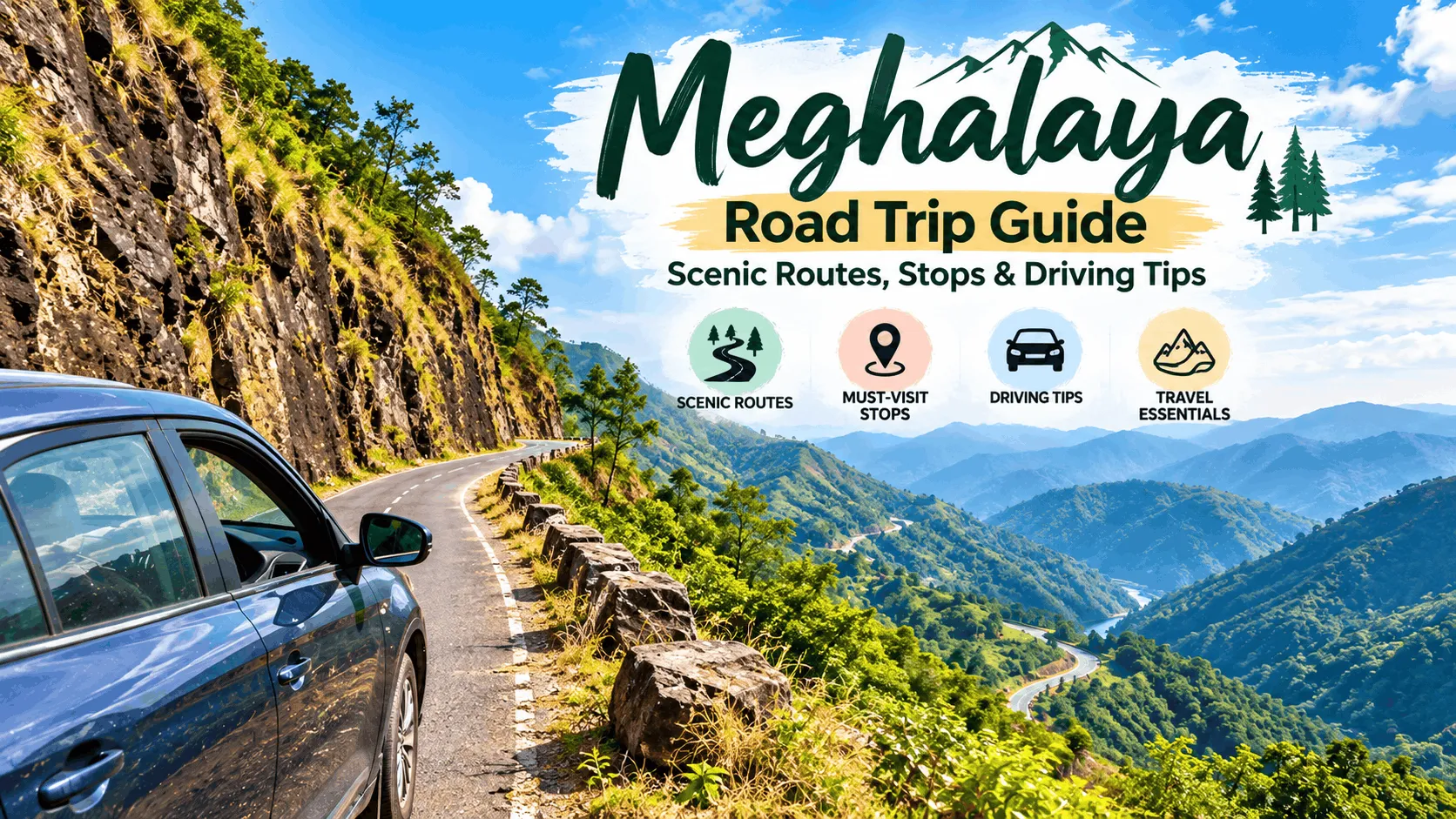
A Meghalaya road trip puts you in control of the best part of the state: the road itself. Highways climb out of the Brahmaputra plains into pine-covered ridges, drop into gorges, and open onto plateau edges where the view can vanish into cloud within minutes. Stopping when a viewpoint is clear, and skipping it when it is not, is what makes driving here so rewarding.
It also asks for realistic planning. Hill roads wind, weather changes fast, and a short distance on the map can fill half a day. This guide covers how to choose a starting point, which routes link the main destinations, how to pace three and five days on the road, and how to drive safely and respectfully. For a broader look at what to see in the state, our Meghalaya Travel Guide covers the attractions. Here, the focus is on the driving.
Road conditions, closures, fuel availability and rules change. Treat every figure below as a starting point, and confirm locally before you leave.
Is a road trip the right way to explore Meghalaya?
For most visitors, yes, with some conditions. Meghalaya's best-known places sit along a handful of roads, and a vehicle lets you stop at viewpoints, cafés and village markets that a fixed schedule would skip. There is no railway in Shillong, and shared vehicles mostly run between towns, so they are less suited to flexible sightseeing.
A road trip suits you if you are comfortable with winding roads, can accept changes of plan, and prefer a few well-chosen stops to a long checklist. It suits you less if anyone in the group gets severely carsick, if your schedule has no slack, or if you are traveling in heavy monsoon weather and cannot afford delays.
You have three broad ways to do it: drive yourself, hire a car with a local driver, or join an organized trip. Each has trade-offs, covered in the self-drive section below.
Planning your starting point and route
Most road trips begin in Guwahati, Assam, the main gateway with the widest choice of flights and the nearest major railhead. Shillong Airport at Umroi, about 30 km from Shillong, has limited routes, so check current flights with airlines.
Guwahati to Shillong
Shillong is about 100 km from Guwahati by road, passing Umiam Lake. Many sources describe the drive as roughly three hours, and traffic can stretch it, especially near Shillong and on weekends. Plan for the longer end of any estimate and confirm timing with your driver or operator for your date.
Because this stretch is the first leg for almost everyone, treat arrival day as a light day. A late flight, a slow drive and a tired group make a poor combination for extra sightseeing.
Why distance alone is misleading
On plains, 100 km might take under two hours. In hills, the same distance can take much longer. Several things add time:
- Bends and gradients keep speeds low, and slower trucks are hard to pass.
- Fog and rain cut visibility and make drivers cautious.
- Villages, markets and school hours bring pedestrians and stopped vehicles onto the carriageway.
- Road works and landslide clearing can cause single-lane waits.
- Viewpoint stops, meals and fuel breaks add up faster than expected.
The Shillong to Sohra (Cherrapunji) road shows this well. It is about 54 km, yet our Cherrapunji guide gives a typical drive of 1.5 to 2 hours each way, before you stop anywhere. A useful habit is to plan by hours of driving, not kilometers, and to cap a day at what everyone can enjoy.

Suggested scenic routes and stops
The routes below are outlines based on published distances and our own site guides. Verify current road status and times before relying on any of them.
Guwahati to Shillong via Umiam Lake
This is the standard entry. The main scenic stop is Umiam Lake, which makes a natural rest break about midway for most travelers. Pull in only at proper parking areas, and keep stops short so you arrive before dark.
Shillong to Sohra (Cherrapunji)
This is the most popular day trip from Shillong. Our guide describes the route as running through the Mawkdok area, where a viewpoint over the Dympep valley is a common stop, and on to Sohra. Fog can reduce visibility sharply on monsoon and winter mornings and often settles in the evening, so aim to leave Sohra before dark. For attractions and opening details once you arrive, see our Cherrapunji travel guide.
Shillong to Dawki
Meghalaya Tourism lists the drive from Shillong to Dawki as roughly 80 km along NH206. Private-car estimates from various travel sources fall around 2.5 to 3 hours each way in normal conditions, with fog a common cause of delays. Meghalaya Tourism also lists visiting hours of 6:00 AM to 6:00 PM for Dawki, which is another reason to leave early. This is a long day trip, so treat it as the main event of that day. If you want to stay near the Umngot river, consider a night at Shnongpdeng or Dawki instead of racing back.
Dawki and Mawlynnong
Mawlynnong lies about 72 km from Shillong according to Meghalaya Tourism, and it is often combined with Dawki. A living root bridge is nearby. Because the two are relatively close to each other but far from Shillong, combining them works best on a day where nothing else is planned.
Beyond the main loop
The Jaintia Hills (Jowai, Krang Suri Falls, Nartiang) and the Garo Hills (Tura, Nokrek, Balpakram) are possible but need more time. The Garo Hills are far from Shillong, and facilities are more limited, so plan them as a separate trip. If you also want to combine Meghalaya with Assam, Nagaland or Arunachal Pradesh, our Northeast India travel guide explains how the region's states fit together and where permits come into play.
A flexible 3-day road trip
This framework uses Shillong as a single base to limit packing and repeated drives. Treat it as a pattern, and swap or drop stops freely.
Day 1: Guwahati to Shillong. Start after breakfast, stop at Umiam Lake, and reach Shillong by mid-afternoon. Spend the evening on a short local outing or simply rest. Driving time: around three hours plus stops.
Day 2: Sohra day trip. Leave early for clearer views. Visit a limited set of stops, such as the Dympep viewpoint, Nohkalikai Falls and Mawsmai Cave, leaving time for a long lunch. Return to Shillong before dusk. Driving time: roughly three to four hours in total, plus stops.
Day 3: Return or add a half-day. Either drive back to Guwahati, leaving a generous buffer before any flight or train, or use the morning for Laitlum or Mawphlang and leave after lunch. Do not schedule a tight departure after a hill drive.
This plan covers the essentials without a long day. If you want Dawki, it needs its own day, which points to the five-day version.
A flexible 5-day road trip
Five days adds Dawki and a buffer day. It still works from one main base, with an optional overnight near the river.
Day 1: Arrive in Shillong. Same as above, with a light evening.
Day 2: Shillong and nearby. Choose one or two short outings, such as Laitlum or Mawphlang, or city sights. This gentle day helps everyone settle in.
Day 3: Sohra. Visit the main viewpoints and caves, and return before dark. Alternatively, stay a night in Sohra if you want to start early at the plateau edge.
Day 4: Dawki and Mawlynnong. Leave early. Allow around three hours each way for Dawki, plus time for the river, a meal and a village stop. If the weather is poor or anyone is tired, replace this day with a rest day. This is the most useful day to keep flexible.
Day 5: Depart. Drive back to Guwahati with a safe margin.
The main risk in a five-day plan is stacking long drives on consecutive days. If you add the Jaintia Hills or more distant sites, extend the trip rather than compress it. A tour operator can also adjust pace and stops; our tours catalogue lists current trip options, and availability should be confirmed directly.

Fuel, food, parking and rest stops
Fuel. Fill up in Guwahati or Shillong before heading to remote areas. Do not assume a station will be open or stocked in smaller towns, and do not run the tank low on hill roads. A simple rule is to refuel when the gauge reaches half before a long leg.
Rest stops. Plan a break about every 60 to 90 minutes. Use proper parking areas, cafés or lakeside pull-ins, and avoid stopping on bends or narrow stretches.
Food and toilets. Facilities at viewpoints and villages can be basic. Carry water and snacks, and use hotel and café toilets in larger towns when you can. Vegetarian travelers should ask clearly about ingredients, since meat features widely in local cooking.
Parking. Shillong's central areas can be congested, so ask your hotel about parking before you arrive. At popular sites, use the designated areas and follow local guidance, even if it means a longer walk.
Daylight. Winter days are short and hill roads are harder after dark. Plan to finish long drives in daylight, and treat your last two hours before sunset as a buffer, not as sightseeing time.
Weather and road-safety considerations
Meghalaya's weather shapes every driving decision. Long-term data point to November to February as the driest months, with cool to cold conditions. The monsoon, roughly June to September, brings very heavy rain in places, poor visibility, slippery surfaces and the possibility of road disruption. Rainfall also varies sharply by location: Sohra receives far more than Shillong.
Key hazards to plan for:
- Rain. Roads can be slick, drains overflow, and stopping distances grow. Reduce speed and keep a large gap from the vehicle ahead.
- Fog and mist. Visibility can drop within minutes, especially at higher viewpoints and in the evening. Slow down, use low-beam headlights, and pull into a safe area if you cannot see.
- Landslides. Heavy rain can cause slides that block or narrow roads. Check conditions before each long leg, and be prepared to wait or turn back.
- Narrow sections and blind bends. Use your horn lightly where local practice calls for it, and never overtake on a bend.
- Night driving. Avoid it where possible.
Check current conditions. Ask your hotel, driver or local operator about road status the evening before each long drive and again in the morning. Official district or state advisories, reliable mapping apps and local contacts are the best sources, and none of them replaces on-the-spot judgment. If conditions are doubtful, shorten the day or stay put.
Avoid risky photo stops. Do not stop on bends, in the middle of the carriageway, or on narrow shoulders for a photograph. Do not step onto the road for a better angle, and keep clear of unprotected edges and wet rock. If a view is worth a photograph, find a designated lay-by or viewpoint, and let following traffic pass before pulling out. A missed picture is better than an accident.
Self-drive vs hiring a driver
Self-drive. Driving yourself gives the most freedom, but it asks the most of you. You will handle unfamiliar hill roads, local traffic habits, parking and navigation in areas with weak signal. Do not assume that a rental vehicle will be available for your dates or in your preferred city, or that rental terms will let you take a vehicle across state lines. Rental policies, permits, insurance and cross-state rules vary and change, so confirm directly with the provider and, where relevant, with the transport authorities of each state you plan to enter. If you bring your own vehicle from another state, check the applicable rules in advance, including documents and any state-specific requirements.
Hired driver. A local driver knows the roads, the pace, the weather patterns and where to stop. This is often the most practical choice for first-time visitors, especially if you want to look at the scenery instead of the bends. Ask what is included, how extra hours or days are charged, how the driver handles bad weather, and whether the vehicle is suitable for your group and luggage.
Organized trip. If you would rather leave the driving and logistics to someone else, an organized trip is another route. Confirm what it includes before booking.
Whichever you choose, make sure the driver is rested, licensed and comfortable with hill conditions. If a driver seems tired, say so and take a break.
Responsible road-trip practices
Roads in Meghalaya pass through villages, markets and farmland, and these are people's homes and workplaces.
- Slow down near villages, schools, markets and bus stops. Expect pedestrians, children and vehicles to appear without warning.
- Give livestock, including cattle, pigs, goats and dogs, plenty of room and time. Do not honk aggressively, which can startle animals.
- Share narrow roads with local traffic. Heavy trucks and shared vehicles have limited room to maneuver, so be patient and yield where it is safer.
- Respect sacred sites and follow village rules on entry and fees.
- Carry your rubbish with you, and do not litter at viewpoints or rest stops.
- Use local guides for caves, forests and treks, and support local eateries and community-run stays where you can.
Road-trip checklist
Before you leave, confirm the following:
- Driver, vehicle and rental terms, including any limits on routes or states
- Valid driving licence, vehicle documents and insurance
- Current road conditions for each leg, and weather for the next two days
- Fuel plan for the longest stretches
- Daily driving hours that fit the group
- Hotel parking and check-in arrangements
- Offline maps, charged phones and a power bank
- Water, snacks, tissues and hand sanitizer
- Rain jacket or poncho, warm layers and shoes with good grip
- Personal medication and a basic first-aid kit
- Cash for small fees
- Current permit or visitor registration requirements, checked on official channels
- Emergency contacts, with your route shared with someone
Frequently asked questions
Can I do a Meghalaya road trip in three days?
Yes, for a focused plan covering Guwahati, Shillong and Sohra. Dawki needs a separate day, so five days gives a more relaxed pace.
How long does it take to drive from Guwahati to Shillong?
The distance is about 100 km, and many sources give roughly three hours. Traffic, weather and stops can add time, so confirm for your travel date.
Is it safe to drive in Meghalaya?
Many visitors drive or hire cars without difficulty, but hill roads, rain, fog and landslides need care. Drive slowly, avoid night driving, check conditions daily, and consider a local driver if you are unfamiliar with mountain roads.
What are the road conditions like?
They vary by route and season, and they change. Main highways are generally busier and more maintained than rural roads, but weather and works can alter conditions at short notice. Check locally before each leg.
Can I rent a self-drive car?
Availability depends on providers and your dates, and we cannot confirm it for you. Ask providers directly about terms, deposits, insurance and any restrictions, including crossing state lines.
Do I need a permit to drive in Meghalaya?
Indian visitors do not need an Inner Line Permit for Meghalaya. Visitor registration requirements have applied at times, so check current rules on official Meghalaya government channels. Foreign visitors should confirm their own requirements.
Conclusion
A good Meghalaya road trip is built around time, not distance. Choose a few bases, set modest daily driving limits, check the weather and road status each day, and keep a buffer for fog, rain and slow traffic. Start early, finish in daylight, and skip a stop whenever conditions or energy run low.
Drive with care around villages, animals and local traffic, and never trade safety for a photograph. Whether you drive yourself, hire a local driver or join an organized trip, confirm the details directly before you go, because roads, rules and availability change.