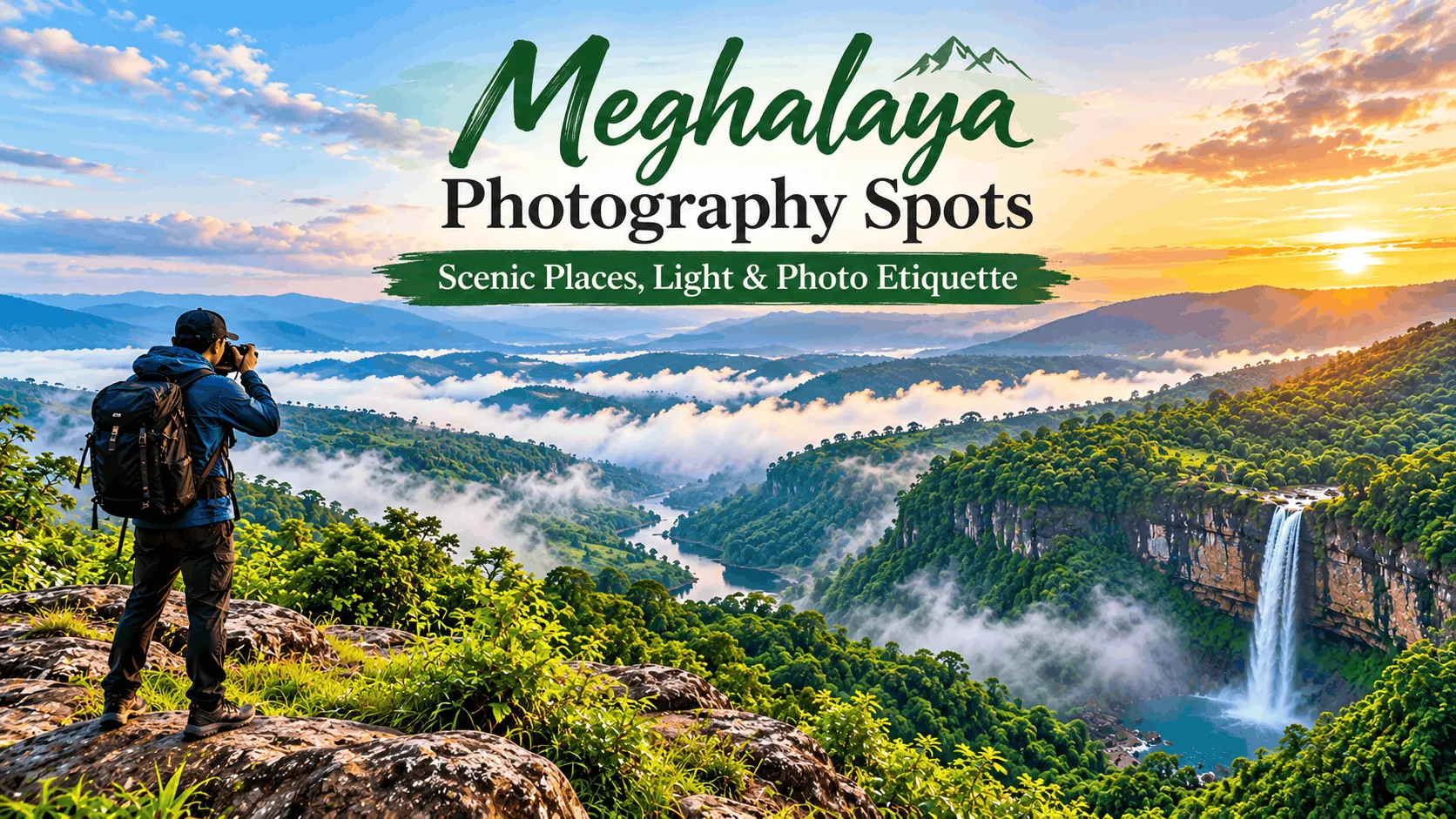
Meghalaya is a compact state with an unusual range of subjects: cloud-filled gorges, waterfalls, forest paths, clear rivers, rolling plateau and villages where life moves at a local pace. It is called the "abode of clouds", and the clouds matter to photographers. One moment a valley opens up below you, and the next it disappears into mist.
This guide covers Meghalaya photography spots as types of scene and places worth researching, how light and weather affect your pictures, what gear works, and how to photograph people and communities respectfully. It is practical advice, not a promise of conditions. Weather, access rules and fees change, so confirm details locally before you go.
The short answers:
- When? It depends on the look you want. Drier months usually give clearer views. The monsoon gives full waterfalls and lush green, with more cloud and rain.
- How long? Three days covers Shillong and Sohra, and five adds Dawki and a village.
- What gear? A smartphone works well. A camera with a wide lens, a small tripod and rain protection helps if you want more control.
- Most important rule? Ask before photographing people, and never take risks near edges or water for a picture.

2. Best Types of Photography Experiences in Meghalaya
Rather than a checklist of famous names, think about the kind of picture you want.
- Big landscapes. Plateau edges, canyons and valleys that open and close with the weather.
- Waterfalls. Dramatic and highly seasonal.
- Forest and root bridges. Green, dim and detailed, good for patient, close work.
- Water and reflections. Rivers, lakes and misty mornings.
- Villages and rural life. Fields, houses, paths and markets, where respect matters most.
Pick two or three of these for your trip rather than trying to shoot everything. It keeps your days slower and your pictures more focused.
3. Meghalaya Photography Spots: Landscape Locations to Research
These places are popular with visitors and are good starting points for research. Check current access, rules and weather for each before you plan around it. Our Meghalaya travel guide covers each destination in more detail.
Shillong photography spots
- Ward's Lake and the city. Cathedrals, cafés and Iewduh (Bara Bazaar) market give street and architectural subjects. Ask before photographing market traders.
- Umiam Lake. A reservoir on the road from Guwahati, useful for water and hill views.
- Shillong Peak. Meghalaya Tourism lists it as the city's highest point, about 10 km away. Check access rules before you plan a visit.
- Elephant Falls. A waterfall close to the city.
- Don Bosco Centre for Indigenous Cultures. A museum of Northeast India's cultures. Photography rules inside vary, so ask at the entrance.
Around Shillong
- Laitlum Canyons. Meghalaya Tourism describes it as about 24 km from Shillong, with views over ridges and gorges. It is best on clear days, and edges can be dangerous.
- Mawphlang Sacred Grove. A forest preserved by the Khasi community. Meghalaya Tourism notes it as a draw for photographers, especially for macro and moss work, and advises arranging a local guide.
Sohra (Cherrapunji) photography spots
- Nohkalikai Falls, which Meghalaya Tourism gives as about 340 m high, and Seven Sisters Falls, plus escarpment viewpoints over the plains.
- Our Cherrapunji travel guide covers distances and what to see.
Further out
- Nongriat and the Double Decker root bridge. Reached by a long stone-step descent.
- Dawki and the Umngot river, and Shnongpdeng. Clear water in drier months.
- Mawlynnong. A village known for its cleanliness, with a living root bridge nearby.
- Jowai and the Jaintia Hills. Krang Suri Falls and the Nartiang monoliths.
Treat each of these as a lead to research, not a guarantee. Access, closures and conditions change.
4. Waterfall Photography: Composition, Weather and Safety
Meghalaya waterfall photography is highly seasonal. Falls are fuller during and just after the monsoon, and much reduced in winter. Cloud can hide a view that looked clear an hour earlier.
Composition
- Include scale. A railing, a path or a distant viewpoint shows how big the fall is.
- Use the foreground. Ferns, rocks or wet leaves add depth.
- Try both looks. A slower shutter softens the water and a faster one freezes it. On a smartphone, try the long-exposure or live-photo option if your phone has one.
- Watch the light. Overcast or soft light often suits waterfalls better than harsh midday sun.
- Protect your lens. Spray and mist drift further than you expect. Carry a microfibre cloth.
Safety rules
- Photograph from official viewpoints and behind barriers.
- Never go past barriers, onto wet rock or near edges for a better angle.
- Do not cross flooded streams or approach swollen rivers.
- Don't put a tripod or yourself on slippery ground near a drop.
- Obey closures and local guides, and leave if the weather turns.
No photograph is worth an accident.
5. Living Root Bridges and Forest Photography
Living root bridges are grown from tree roots over many years and are cared for by local communities. They are some of the state's most photographed subjects. The best-known, the Double Decker bridge at Nongriat, is reached by a route Meghalaya Tourism describes as about 3 km down roughly 3,500 stone steps, and the climb back up is demanding.
Practical tips
- Expect low light. Forest shade is dim, so a steady hand, a higher ISO or a small tripod helps.
- Go wide, then detail. A wide shot shows the bridge in context, and close-ups show roots, moss and textures.
- Shoot from the path. Don't block narrow bridges or trails while you set up, and let others pass.
- Be patient with crowds. Take turns, and photograph other angles while you wait.
- Look for small things. Droplets, ferns and mushrooms often make better pictures than the main view.
Respect the bridges. Follow local rules on access and crowd limits, and don't climb railings, strip roots or carve into them. Steps and wet roots are slippery, so keep both hands free for balance on steep sections.
6. Hills, Rivers, Lakes and Rural Landscapes
- Hills and canyons. Look for layers: ridges fading into haze give depth. Keep a safe distance from edges, even when the view tempts you closer.
- Rivers. The Umngot near Dawki is known for its clarity, which is usually best in the drier months and often murkier in the monsoon. Boating depends on water levels. Wear the life jacket provided, and protect your camera from spray.
- Lakes and reservoirs. Calm mornings and evenings give the best reflections.
- Villages and fields. Slow down. Walk, watch and ask. The best rural photographs usually come from conversation first and a camera second.
- Near the international border. The Dawki area is close to the border with Bangladesh. Don't photograph security installations or personnel, and follow any instructions you are given.
7. Cultural Photography and Respectful Portraits
People are not scenery. Meghalaya is home to several communities, including the Khasi, Jaintia (Pnar) and Garo, each with its own customs, and households and villages differ. Don't make assumptions about what is acceptable.
For portraits
- Ask first, in person, with a smile, and in English or Khasi if you can.
- Accept no. A refusal needs no explanation.
- Show the picture if the person is interested.
- Spend a little time first. A conversation usually gives a better portrait than a quick snap.
- Be careful with children. Ask a parent or guardian.
- Don't treat people as props. Avoid staging or paying for poses unless it is a clear, respectful arrangement.
- Share your thanks. If you promise a copy, send one.
For cultural sites and events
- Do not assume all cultural or sacred sites allow photography. Some restrict photography or video, or require a guide.
- Major festivals include Shad Suk Mynsiem (Khasi), Behdienkhlam (Jaintia) and Wangala (Garo). Dates vary each year, and some ceremonies are community events, not tourist attractions. Confirm dates locally, and ask before attending or photographing.
- Never photograph rituals, funerals or private moments without clear invitation.
8. Best Light and Weather Considerations
Light
- Mornings are often clearer than afternoons, especially in the drier months.
- The region lies far east, so the sun rises and sets earlier than in much of India. Use a sunrise and sunset app for your dates rather than relying on remembered times.
- Soft, overcast light flatters waterfalls, forest and portraits. Harsh midday sun makes strong contrast, so look for shade or shoot details.
Seasons (general patterns, not forecasts)
| Period | What to expect | Photography notes |
| About November to February | Driest months in long-term data, cool to cold | Clearer views, smaller waterfalls, clear river water |
| About March to May | Warming, more showers | Greener landscapes, storms and cloud build |
| About June to September | Monsoon, very heavy rain in places | Full waterfalls, mist and green, with poor visibility and slippery paths |
| About October | Rain easing but still common | Green landscapes with improving views |
Weather reality. Mist can hide a view or make it. Check current forecasts, from the India Meteorological Department and local advice, before heading out, and keep a plan B for each day. Conditions differ widely between Shillong and the wetter southern edge around Sohra.
9. Camera Gear and Smartphone Photography Tips
Smartphone
- Clean the lens often, since mist and fingerprints soften images.
- Use the wide and ultra-wide lenses for landscapes, and the main lens for details.
- Tap to set focus and exposure, and lower exposure slightly for bright skies.
- Carry a power bank. Cold and heavy use drain batteries quickly.
Dedicated camera
- Wide-angle zoom for landscapes and forests, and a standard or short telephoto for details and layers.
- Small tripod for forest and low-light work, used only on stable ground.
- Polarising filter to reduce glare on wet leaves and water, and an ND filter if you want long exposures in daylight.
- Spare batteries and cards. Keep batteries warm in a pocket in cooler weather.
- Lens cloths and a rain cover.
Drones. Check the current legal and local rules before you bring or fly one. India regulates drones nationally and publishes an airspace map with green, yellow and red zones, and permission is needed in some zones. Local, community and sacred sites may also have their own rules and expectations about privacy. We can't confirm what applies to any specific location, so verify it before you fly, and don't fly if in doubt.

10. Protecting Cameras from Rain, Mist and Humidity
- Keep gear in dry bags or sealed zip bags with a few silica gel packets.
- Use a rain cover or a plastic bag with a hole for the lens in showers.
- Avoid changing lenses in rain or mist. Do it inside a bag or vehicle.
- Beat condensation. Moving from a cool, damp place into a warm room can fog a lens. Leave gear sealed in its bag until it reaches room temperature.
- Dry gear overnight with the bag open, not sealed, once you are somewhere dry.
- Back up often. Wet, slippery paths are hard on gear.
11. Composition Tips for Forests, Hills and Waterfalls
- Forests. Look for lines such as paths, roots and trunks. Isolate one bright leaf or path against dark green, and use mist to separate layers.
- Hills. Layer ridges, and wait for cloud to move. Include a small human figure, building or path for scale, preferably from a safe distance.
- Waterfalls. Use foreground elements, vary shutter speeds, and photograph from different safe viewpoints.
- Mist. Expose carefully so whites don't turn grey. A slight plus on exposure compensation can help.
12. Responsible Photography and Local Etiquette
- Ask permission before photographing people, homes, ceremonies and private spaces.
- Follow posted rules. Some sites charge separate camera or video fees, restrict video, or require guides. Amounts and rules change, so confirm on the spot.
- Stay on paths and out of closed or restricted areas.
- Never block roads or stop on narrow hill roads. Ask your driver to pull into a safe spot.
- Don't stand on unstable edges or lean over barriers.
- Leave no trace. Carry out your rubbish.
- Take nothing from sacred sites. Mawphlang's community, for example, forbids cutting trees.
- Think before you geotag. For fragile, community-managed or sacred places, consider sharing a general location instead of an exact one.
The same etiquette applies across the region. Our Northeast India travel guide offers broader context for photography etiquette in Northeast India, where customs vary from state to state and community to community.
13. Planning a Photography-Focused 3-Day or 5-Day Trip
These are illustrative frameworks, not confirmed schedules. Check access, weather, road status and opening times before you commit, and allow time for slow hill roads.
3-day outline (Shillong and Sohra)
- Day 1: Arrive in Shillong. Easy evening in the city, with Ward's Lake and the market.
- Day 2: Early start for Sohra: waterfalls, viewpoints and, if time allows, a cave or park. Keep the afternoon flexible for cloud.
- Day 3: Laitlum or Mawphlang if open, then a buffer before any onward travel.
5-day outline (adding Dawki and a village)
- Day 1: Arrive in Shillong.
- Day 2: Shillong sights, plus Mawphlang with a local guide if conditions allow.
- Day 3: Sohra.
- Day 4: Dawki or Shnongpdeng, and Mawlynnong, if roads and river conditions allow. Ask about the current road status first.
- Day 5: Return, leaving a generous buffer.
Planning principles
- Use fewer bases and more daylight, and avoid night driving on hill roads.
- Do the weather-sensitive spots first, and keep a spare half day.
- Hire a local driver who knows safe stopping places.
If you would rather have transport and local guidance arranged, you can browse our tours. We don't claim that any tour is photography-specific, so check each tour page and ask the team whether it can suit your plans.
14. Frequently Asked Questions
What are the best Meghalaya photography spots? It depends on what you like to shoot. Popular starting points include Sohra's waterfalls and viewpoints, Nongriat's root bridges, Dawki's river, Laitlum's canyon views, Mawphlang's sacred grove, and Shillong's lakes and markets. Check access and conditions for each.
When is the best time for photography in Meghalaya? Drier months usually give clearer views, and the monsoon gives full waterfalls and green landscapes with more cloud. No month guarantees particular conditions.
Can I fly a drone in Meghalaya? Verify the current national rules, the airspace zone and any local or community restrictions before you fly. Don't assume permission, and don't fly near people, sacred sites or sensitive areas.
Do I need to pay a camera fee? Some sites charge separate camera or video fees, and amounts change. Ask at the entrance and carry small notes.
Is it okay to photograph local people? Only with their permission. Ask first, accept a refusal, and be especially careful with children and private moments.
Conclusion
The best Meghalaya photography spots reward patience more than speed. Choose a few types of scene, plan around light and weather you can't control, protect your gear from rain and humidity, and keep safety and respect ahead of any picture. Ask before photographing people, follow local rules at community sites, and leave a place as you found it. Do that, and you'll bring home better photographs and better memories.