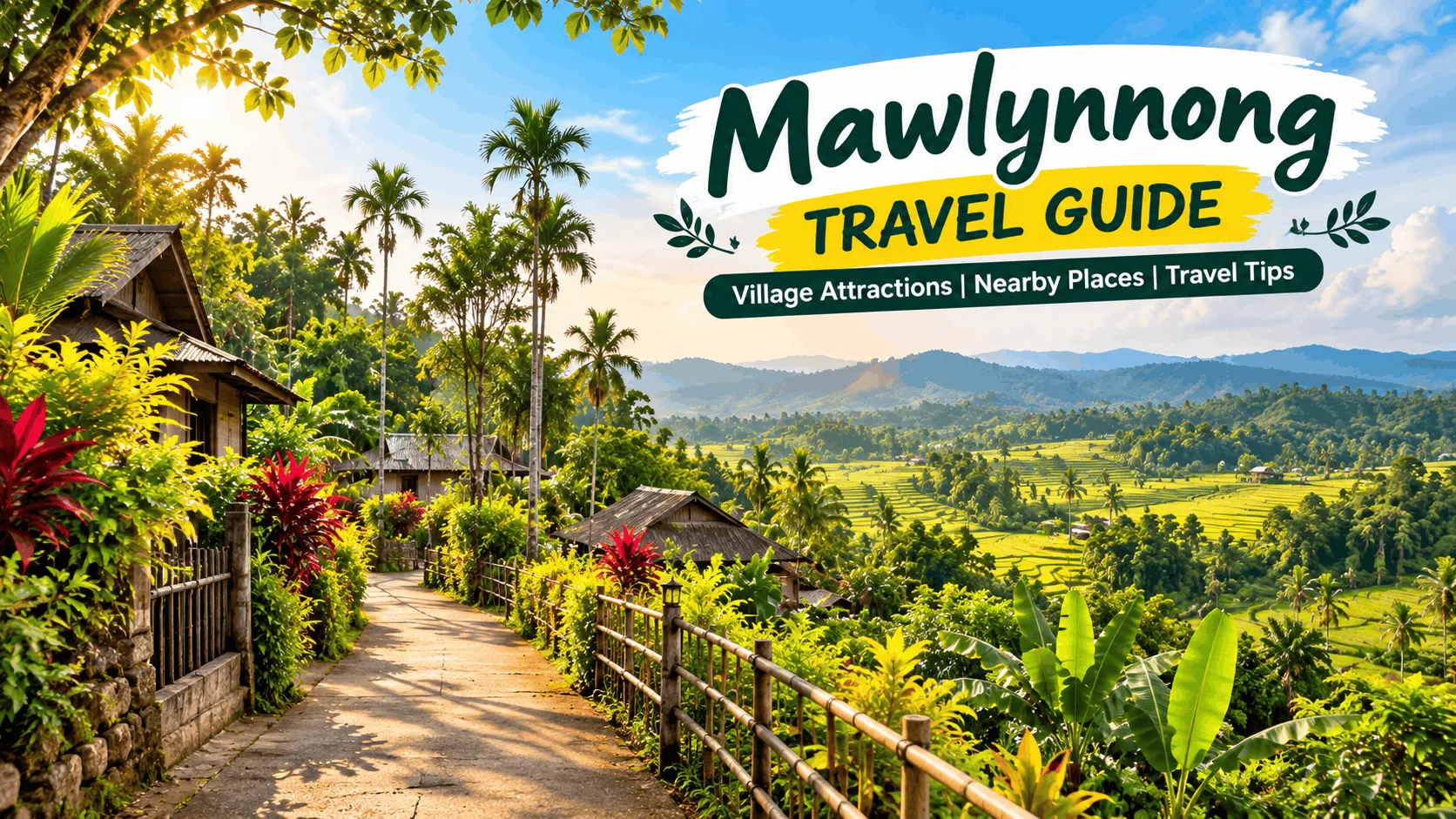
Mawlynnong is a small Khasi village in Meghalaya's East Khasi Hills, close to the India–Bangladesh border. It is known for its community-led approach to cleanliness, its gardens and bamboo structures, a nearby living root bridge, and views over the Bangladesh plains. It is usually visited as a day trip from Shillong, often combined with Dawki, though staying a night in a local homestay gives a quieter experience. Mawlynnong is a living village, not a showpiece, so visit respectfully.
This guide covers what to see in and around Mawlynnong, how to get there, where to stay and how to behave as a guest.

Where is Mawlynnong?
Mawlynnong lies on Meghalaya's southern edge in East Khasi Hills district, near the Bangladesh border. Meghalaya Tourism describes it as about 76 km from Shillong (another Meghalaya Tourism page gives about 72 km), while a 2017 Outlook Traveller guide gave figures between 80 and 92 km depending on the section. Treat the distance as roughly 70 to 90 km by road, depending on route, and confirm with your driver.
The village is approached through Pynursla, a town on the road south from Shillong.
What makes Mawlynnong notable
Mawlynnong became widely known after Discover India magazine described it as the "cleanest village in Asia" in 2003, a title Meghalaya Tourism still uses in its promotion. More useful for visitors than the title is how the village got its reputation.
According to a 2017 Outlook Traveller report:
- Bamboo baskets are placed outside homes and along paths to collect waste.
- Organic waste is composted and used as manure.
- Residents share cleaning duties.
- Littering is discouraged, and the village has restricted plastic use.
These are community practices, and visitors are expected to follow them. Rules may have changed since 2017; follow any signs and instructions from villagers.
Mawlynnong is home to a small Khasi community. Its neat paths, flowering gardens, bamboo structures and traditional homes are part of daily life, not a tourist set.
Village attractions
Village walk
The main experience is simply walking the paths, past gardens, homes and bamboo structures. Keep to public paths and do not enter compounds or gardens without an invitation.
Church of the Epiphany
Meghalaya Tourism describes the Church of the Epiphany as built over a century ago. It is an active place of worship: dress modestly, keep quiet, and do not visit during services unless invited.
Sky View (bamboo viewpoint)
Meghalaya Tourism lists the Sky Viewpoint, a bamboo tower overlooking the Bangladesh plains. Climbing it requires care; avoid it in strong wind or rain, and supervise children closely. (Entry fee and opening hours: verify locally.)

Living root bridge (near Riwai)
A single-decker living root bridge, grown from the roots of rubber fig trees, lies a short walk from the village. Meghalaya Tourism refers to it as the Nohwet Living Root Bridge; other guides call it the Riwai root bridge, after the nearby village of Riwai. The walk involves steps and can be slippery in rain.
- Follow local rules on access and crowd limits.
- Do not climb on railings or damage roots.
- (Entry fee and timings: verify locally.)
Treehouse and other viewpoints
Guides have described a bamboo treehouse near the church with views over the plains, and other streams and viewpoints in the area. Ask villagers which are open and safe to visit.
Nearby places
| Place | Why visit | Planning note |
| Dawki and the Umngot river | Boat rides on a river known for clear water in the drier months | Commonly combined with Mawlynnong; see our Dawki travel guide |
| Pynursla | Town on the approach road | Shared transport from Shillong may terminate here |
| Kongthong | Village listed by Meghalaya Tourism as nearby | Confirm access and visitor arrangements locally |
| Sohra (Cherrapunji) | Waterfalls, caves and root bridge treks | A separate day or overnight trip; see our Cherrapunji travel guide |
Meghalaya Tourism also lists Nohkalikai Falls (in Sohra) among nearby attractions, but Sohra is a separate journey and is best visited on another day.
How to reach Mawlynnong
From Shillong
- Hired car or taxi: the most practical option, especially for a day trip or if combining with Dawki. Agree the route, stops and what is included in advance.
- Shared transport: Meghalaya Tourism states that shared sumos or taxis run from Shillong to Pynursla, with private cabs or local transport onwards to Mawlynnong. Departure times and frequency are not published; ask in Shillong.
- Travel time: not stated here, because it varies with traffic, road conditions and weather. Start early.
From Dawki
Mawlynnong and Dawki are in the same broad area near the border and are often visited together. We have not verified a specific distance or travel time between them; ask your driver, and plan the order of stops so you are not driving after dark.
From Guwahati
Travel to Shillong first (about 100 km by road), then continue to Mawlynnong. Doing Guwahati to Mawlynnong and back in one day is a very long journey; an overnight in Shillong or Mawlynnong is more comfortable.
Nearest airports and railhead
- Shillong Airport (Umroi): Meghalaya Tourism gives it as about 103 km from Mawlynnong. Flights are limited.
- Guwahati: the main air and rail gateway for Meghalaya.
For combining Mawlynnong with travel in Assam and other states, see our Northeast India travel guide.
Day trip planning
Mawlynnong day trip from Shillong
- Leave Shillong early.
- Village walk, Church of the Epiphany and Sky View.
- Living root bridge near Riwai.
- Return to Shillong before dark.
Mawlynnong and Dawki in one day
- Leave Shillong early.
- Mawlynnong in the morning, when it is often quieter.
- Root bridge.
- Dawki for boating in the afternoon, if conditions allow.
- Return to Shillong.
This is a long day. If daylight is short (winter) or the weather is poor, choose one place or stay overnight.
Overnight stay
Staying in Mawlynnong lets you see the village early in the morning or late in the afternoon, after day-trippers leave, and splits the driving into shorter days.
If you prefer a planned trip, our Meghalaya Budget Tour (Shillong, Dawki and Mawlynnong) covers Mawlynnong over four days.
Best time to visit
- Year-round: Meghalaya Tourism describes Mawlynnong as visitable year-round.
- Post-monsoon and winter (roughly October to February): generally better for outdoor activities and clearer views. Book accommodation ahead, as winter is busy.
- Monsoon (roughly June to September): heavy rain, slippery paths and possible landslides on roads. Pack rain gear and check road conditions. The village is green and lush, but views may be limited.
- Weekends and holidays: busier with day visitors.
Attractions such as viewpoints and the root bridge may close temporarily in bad weather or for maintenance.
Where to stay
- Homestays and guesthouses in Mawlynnong: simple, family-run stays. Rooms are limited, so book in advance, especially in winter and on weekends.
- Shillong: the widest choice, if you prefer a day trip.
- Dawki and Shnongpdeng area: riverside camps and homestays if combining with the Umngot river.
Before booking, confirm: meals, bathroom facilities, hot water, power backup and check-in times. We have not listed specific properties or prices.
Food
- Homestays often provide home-cooked meals; confirm in advance.
- Small eateries may be available in the village; options can be limited.
- Carry snacks and water, especially if you have dietary restrictions.
- Ask about ingredients if you are vegetarian, as meat is common in Khasi cooking.
Village etiquette
Mawlynnong is a home first and a destination second.
- Use the bins. Follow the village's waste practices, and carry out anything you cannot dispose of properly.
- Avoid single-use plastic.
- Stay on public paths; do not enter gardens, compounds or homes uninvited.
- Dress modestly, especially near the church.
- Keep noise down.
- Respect Sundays: Sunday is widely observed as a day of worship in Meghalaya's Christian communities; activities and services may be limited.
- Follow local rules at viewpoints and the root bridge.
- Pay any local fees without bargaining.
Photography
- Ask before photographing people, especially children and elders.
- Do not photograph inside homes or private gardens without permission.
- Avoid photographing worshippers at the church.
- Be careful on viewpoints and bridges; do not lean over edges or block narrow paths.
- Drones: check current regulations and local rules, especially near the border, before flying.
Responsible tourism
- Support local homestays, guides and eateries.
- Avoid peak-hour crowding at the root bridge.
- Do not pick flowers or plants from gardens.
- Do not damage the root bridge or bamboo structures.
- Do not approach the international border or photograph security installations.
Details to verify before you travel
- Entry fees and timings for the Sky View and root bridge (a 2017 report gave fees, but these may have changed)
- Current village rules on plastic, waste and visitor behaviour
- Shared transport options between Shillong, Pynursla and Mawlynnong
- Homestay availability and facilities
- Road conditions, especially in the monsoon
- Accessibility of nearby attractions such as Kongthong
Frequently asked questions
Where is Mawlynnong? In East Khasi Hills district, Meghalaya, near the India–Bangladesh border. Meghalaya Tourism gives the distance from Shillong as about 76 km (another of its pages says 72 km).
How do I reach Mawlynnong from Shillong? By hired car or taxi, or by shared transport to Pynursla and then a local cab onwards, according to Meghalaya Tourism. Confirm current options locally.
Can I visit Mawlynnong and Dawki in one day? Yes, they are often combined, but it makes for a long day from Shillong. Start early, or stay overnight.
What are the main attractions in Mawlynnong? The village walk, the Church of the Epiphany, the Sky View bamboo viewpoint over the Bangladesh plains, and the living root bridge near Riwai.
Can I stay overnight in Mawlynnong? Yes. Simple homestays and guesthouses operate in the village; rooms are limited, so book ahead.
Is Mawlynnong open in the monsoon? Meghalaya Tourism describes it as visitable year-round, but rain makes paths slippery and roads slower, and some attractions may close temporarily. Check conditions before you go.
Conclusion
Mawlynnong offers a quiet look at a Khasi village that has made cleanliness and care for its surroundings part of daily life. Walk its paths, visit the root bridge and viewpoint, combine it with Dawki if time allows, and above all, behave as a respectful guest so the village remains a pleasant home for those who live there.