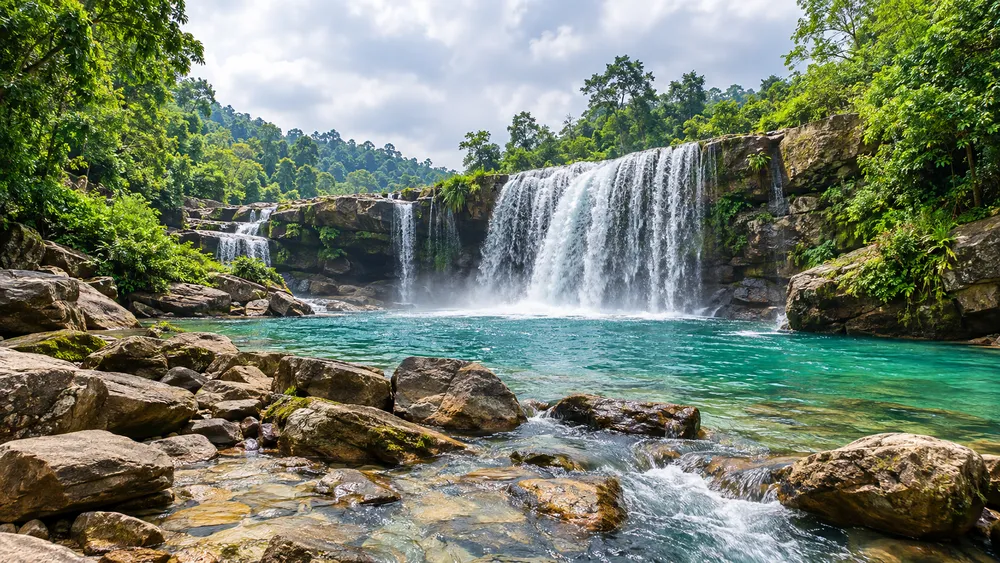
Krang Suri Falls sits in the West Jaintia Hills district of Meghalaya, a short drive from Jowai, known for the turquoise colour of its pool at the base of a forested cliff. It's become one of the more visited waterfalls in the Jaintia Hills, and for most travellers doing a Meghalaya road trip beyond the usual Shillong-Cherrapunji loop, it's the main reason to route through Jowai in the first place.
The falls themselves are reached by a short walk down from a parking area, with the pool and surrounding rock face forming the main draw rather than a single dramatic drop. Paired with the rest of the Jaintia Hills — Nartiang's monoliths, Thadlaskein Lake, or a stop at Phe Phe Falls — Krang Suri fits naturally into a day built around this side of Meghalaya rather than the more commonly covered West Khasi Hills route.
Why Visit Krang Suri Falls?
The waterfall's colour is genuinely the standout feature — a clear, turquoise pool set against a rock face and green forest, which photographs well without needing much embellishment. It isn't the tallest or most dramatic waterfall in the region, but the setting is compact and easy to take in over an hour or two, which makes it approachable in a way some of Meghalaya's more remote falls aren't.
It works well as part of a Jaintia Hills day because the surrounding area has enough else nearby — monoliths, a lake, other waterfalls — to build a full day around, rather than driving out for a single stop and back. For travellers looking to see a different side of Meghalaya beyond Shillong and Cherrapunji, Krang Suri and the Jaintia Hills generally offer that without requiring a major detour.
Where Is Krang Suri Falls?
Krang Suri Falls is in the West Jaintia Hills district of Meghalaya, near the town of Jowai, which functions as the practical base and gateway for visiting the falls. Distances cited for the route vary by source — commonly somewhere around 30 km from Jowai, and roughly 90 to 100 km from Shillong — so treat these as approximate rather than fixed until you've confirmed the specific route with your driver or a current map.
Jowai itself sits along the road most travellers use to connect Shillong with Dawki and the India-Bangladesh border area, which makes it possible to build Krang Suri into a longer loop rather than a there-and-back trip.
How to Reach Krang Suri Falls
From Shillong: The most common approach, generally covered by private taxi or shared vehicle along the Jowai road, continuing on to the falls itself. Total driving time is commonly cited at around 2 to 3 hours to Jowai, with a further stretch to reach the falls parking area.
From Jowai: A shorter drive of roughly half an hour to 45 minutes by private vehicle, depending on the exact route and road conditions.
From Guwahati: For travellers coming directly from Assam rather than via Shillong, the route runs through Shillong or a more direct road connection depending on your starting point; this is a longer day than the Shillong-Jowai leg alone.
Final approach: From the parking area, a set of steps leads down to the falls, described in most visitor accounts as manageable but slippery when wet, particularly during and after rain.
(Bus and shared-taxi schedules, and current fares for private vehicles, aren't included here since they change and vary by operator — confirm locally or through a Shillong/Jowai-based operator before your trip.)
Best Time to Visit Krang Suri Falls
Monsoon (June–September): Water flow is at its strongest, but the trail down to the falls gets more slippery, visibility can suffer in heavy rain, and any swimming or water access is more likely to be restricted for safety. Road conditions on the approach can also be affected.
Post-monsoon (October–November): Often considered one of the better windows — strong water flow carried over from the monsoon, combined with clearer skies and improving trail conditions.
Winter (December–February): Water flow tends to be lower, and the water itself colder, but the trail is generally drier and safer, and this is a comfortable season for visiting even if swimming feels less appealing given the temperature.
Spring (March–April): A reasonable middle ground — moderate water levels, generally clear weather, and good visibility for photography.
Summer (April–June): Warmer and more humid, with water levels beginning to rise again as the monsoon approaches later in the season.
Whatever season you visit, actual swimming access on any given day depends on current water levels and site management decisions, not just the calendar — treat any season as a "likely, but confirm on arrival" situation rather than a guarantee.
Things to Do at Krang Suri Falls
- View and photograph the falls and pool from the surrounding rock and viewing areas
- Walk the steps down from the parking area at your own pace, particularly if the stones are wet
- Swim in the pool, where officially permitted and conditions allow — this is commonly cited as available with life jackets, but confirm current rules on arrival rather than assuming
- Rent a life jacket or boat if these services are being offered that day
- Spend time simply sitting by the water rather than treating the visit as a quick photo stop
Swimming should only be attempted where it's officially allowed and staff or signage indicate it's safe that day — water levels and conditions can change with recent rainfall, and this isn't a spot to enter the water against posted guidance or staff instruction.
How Much Time Do You Need?
Short visit (1–1.5 hours): Enough to walk down, view and photograph the falls, and walk back up, if you're combining Krang Suri with several other Jaintia Hills stops in one day.
Half-day (3–4 hours): Allows time to swim if conditions permit, relax by the water, and take the visit at an unhurried pace, plus the drive from Jowai.
Full day: Combines Krang Suri with one or two nearby Jaintia Hills attractions — Nartiang Monoliths or Thadlaskein Lake, for instance — built around a base in Jowai or a day trip from Shillong.
Most travellers find a half-day at the falls themselves, combined with one other stop, to be a comfortable pace rather than trying to fit in everything the Jaintia Hills has to offer in a single day.
Places to Visit Near Krang Suri Falls
Nartiang Monoliths: A significant collection of megalithic stones associated with the Jaintia kings, located a reasonable drive from Jowai and a common pairing with Krang Suri on a Jaintia Hills day.
Thadlaskein Lake: A lake near Jowai with its own local history and a quieter, easy-to-visit setting, useful as a shorter add-on rather than a full separate outing.
Phe Phe Falls: Another waterfall in the West Jaintia Hills area, near Jowai, offering a second waterfall stop for travellers with more time, though it involves its own separate trek and access considerations.
Rather than turning this into a broader Meghalaya checklist, these three genuinely sit close enough to Krang Suri to combine realistically within a Jaintia Hills day or two.
Krang Suri Falls Itinerary
One-day itinerary (from Shillong):
- Morning: Drive from Shillong to Jowai, continuing to Krang Suri Falls
- Late morning to early afternoon: Time at the falls, including swimming if conditions allow
- Afternoon: Stop at Nartiang Monoliths or Thadlaskein Lake on the way back
- Evening: Return to Shillong
Optional two-day Jaintia Hills itinerary:
- Day 1: Travel from Shillong to Jowai, visiting Krang Suri Falls in the afternoon; overnight in Jowai
- Day 2: Visit Nartiang Monoliths and Thadlaskein Lake in the morning, with Phe Phe Falls as an optional add-on for travellers with extra time, before continuing on to Dawki or back to Shillong
Build in extra time on both plans if the roads are wet, since driving times in this region are more weather-dependent than a flat estimate suggests.
Entry, Rules and Visitor Information
Krang Suri Falls is commonly reported as operating with a modest entry fee (often cited around ₹50) and set daily visiting hours, with life jacket rental available separately for anyone planning to swim. Parking is generally available near the entrance, with the walk to the falls itself being the final stretch.
(Entry fees, opening hours, swimming rules, and parking arrangements can change without much notice, and figures reported online vary between sources. Confirm current entry rules, fees, and whether swimming is permitted that day directly on arrival, or through a local operator in Jowai before you go.)
Practical Travel Tips
- Wear proper grip footwear. The steps down to the falls are frequently described as slippery, especially in or after rain.
- Carry rain protection regardless of season, since weather in the Jaintia Hills can shift quickly.
- Bring a change of clothes if you're planning to swim, along with a way to keep valuables dry.
- Carry cash for entry fees and any equipment rental, since digital payment isn't reliable at the site.
- Expect patchy mobile connectivity in the immediate area around the falls.
- Check road conditions before heading out, particularly during and after monsoon rains.
- Don't swim if conditions look unsafe or if told not to, regardless of what you've read in advance — water levels and site decisions can change day to day.
- Carry out your own litter and avoid leaving plastic or food waste at the site — this is a natural area, not a managed park with heavy cleanup infrastructure.
- Respect the site's local significance. Some accounts describe the area as locally regarded with a degree of reverence, so keep noise and behaviour considerate.
Frequently Asked Questions
Where is Krang Suri Falls? Krang Suri Falls is in the West Jaintia Hills district of Meghalaya, near the town of Jowai.
How do I reach Krang Suri Falls? By road via Jowai, most commonly by private taxi from Shillong or a shorter drive directly from Jowai, followed by a walk down steps from the parking area.
How far is Krang Suri Falls from Shillong? Commonly cited as roughly 90 to 100 km, though figures vary by source — confirm the current route distance with your driver.
How far is it from Jowai? Often cited as around 30 km, though again this varies slightly across sources.
What is the best time to visit Krang Suri Falls? October to November for strong water flow with clearer weather, or winter and spring for calmer, more manageable conditions. Avoid peak monsoon if possible, given slippery trail conditions and potential access restrictions.
Can you swim there? Swimming is commonly available with life jackets when conditions and site rules allow, but this should always be confirmed on arrival rather than assumed in advance.
How much time is required? A short visit takes about an hour to 90 minutes; a half-day allows a more relaxed visit, including swimming if permitted.
Is Krang Suri suitable for families? Yes, for families comfortable with a walk down (and back up) a set of steps, though supervision is important near the water, especially with children.
What should I carry? Grip footwear, rain protection, a change of clothes if swimming, cash, and any personal essentials, since facilities at the site are limited.
What places can be combined with Krang Suri? Nartiang Monoliths, Thadlaskein Lake, and Phe Phe Falls are the most realistic pairings within the Jaintia Hills.