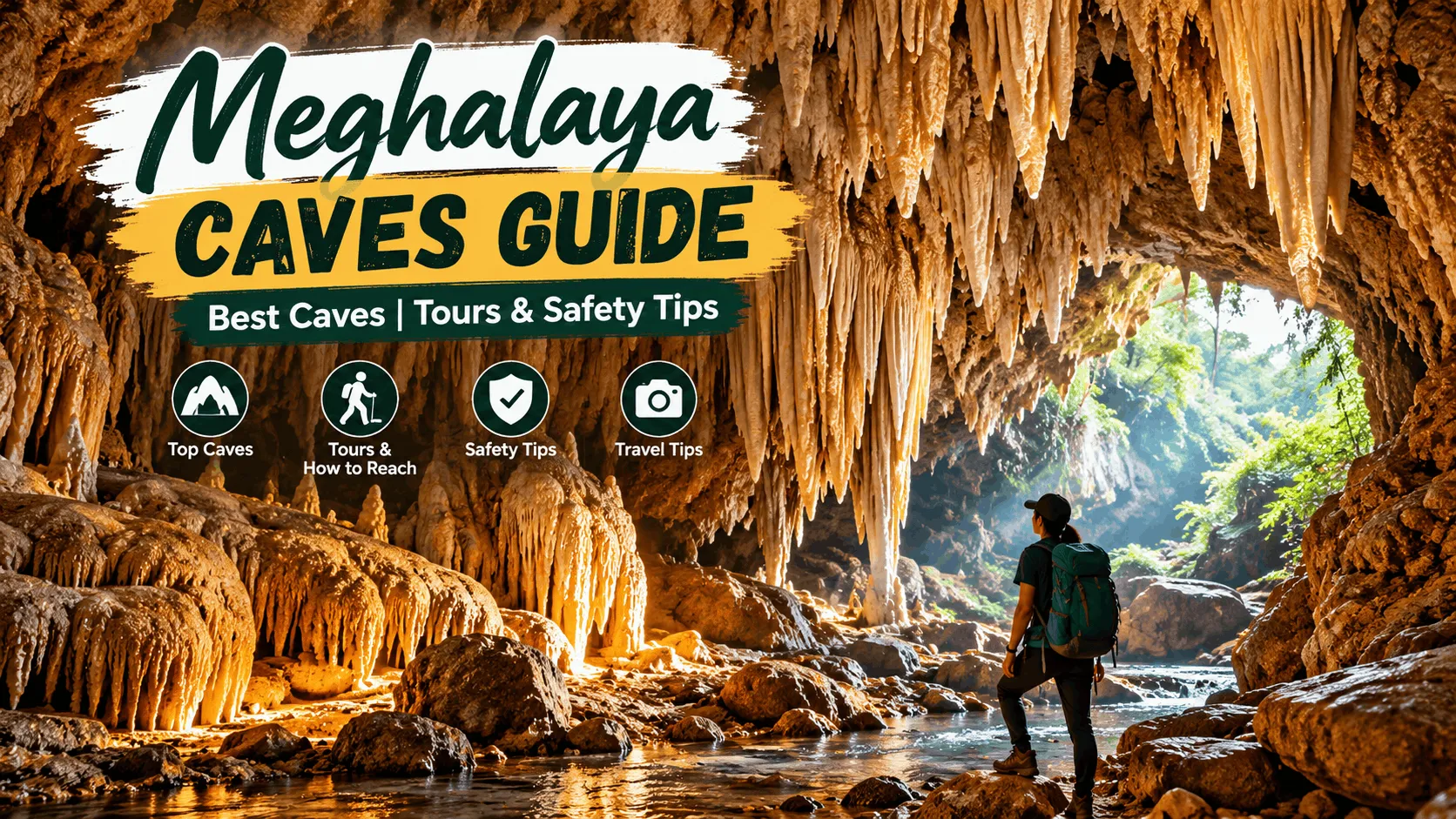
Meghalaya has one of the largest known cave networks in India. The Meghalaya Adventurers' Association (MAA), which has led cave exploration in the state since 1994, had recorded around 1,580 caves and cave sites by 2015, with more than 400 km of passages explored. Only a handful are set up for ordinary visitors. Show caves near Sohra (Cherrapunji), such as Mawsmai and Arwah, have lit paths suited to most travellers. Others, including Krem Liat Prah, Krem Mawmluh and Krem Puri, are wild caves for experienced cavers on guided expeditions only.
This guide explains how Meghalaya's caves formed, which ones visitors can realistically see, and how to explore safely and responsibly. Access to any cave can change with rainfall, safety restrictions or local decisions, so confirm current conditions before you go.

How Meghalaya's caves formed
Most of Meghalaya's caves are limestone caves. Over very long periods, rainwater, slightly acidic from absorbing carbon dioxide, seeps into cracks in limestone and slowly dissolves the rock. Meghalaya's very high rainfall, especially along the southern edge of the plateau, has helped create extensive underground passages, river caves and chambers.
Inside, dripping water deposits minerals that build up into speleothems:
- Stalactites: hanging down from the ceiling.
- Stalagmites: rising from the floor.
- Columns: where the two meet.
- Flowstone and gours: sheets of mineral deposit and natural rim dams in flowing water.
Not every cave is limestone. Krem Puri, near Laitsohum in East Khasi Hills, was mapped by an MAA-led team and reported in 2018 as the world's longest known sandstone cave, at about 24.5 km.
A cave with a place in geological time
In 2018, the International Commission on Stratigraphy ratified the Meghalayan Age, the most recent division of the Holocene epoch, beginning about 4,200 years ago. Its reference marker is a stalagmite from Krem Mawmluh (Mawmluh Cave) near Sohra, which records a major climate event. Mawmluh is a wild cave, not a show cave.
Two kinds of caves: show caves vs wild caves
| Show caves | Wild (expedition) caves | |
| Examples | Mawsmai, Arwah, Mawjymbuin | Krem Liat Prah, Krem Mawmluh, Krem Chympe, Krem Puri, Siju (beyond entry sections) |
| Access | Paths, often lighting, short routes | Unlit, long passages, water, crawls, climbs |
| Who can visit | Most visitors with reasonable mobility | Experienced cavers with specialist guides and equipment |
| Arrangements | Usually visit on arrival; confirm opening locally | Organised expeditions or specialist operators only |
| Risk | Slippery floors, low ceilings, crowds | Flooding, getting lost, falls, hypothermia, low air quality |
Never enter a wild cave on your own or without an experienced, locally arranged guide, and never enter a cave that is closed or restricted.
Notable caves in Meghalaya
Mawsmai Cave, near Sohra (show cave)
- Location: East Khasi Hills, about 6 km from Sohra town and about 58 km from Shillong, according to Meghalaya Tourism.
- What to expect: an illuminated route of about 150 m through limestone formations, reached by a short forest walk. Meghalaya Tourism describes it as manageable even for beginners.
- Things to note: some sections are narrow and low; floors can be wet. It is popular, so expect queues at busy times.
- Best time: Meghalaya Tourism suggests October to April for dry, cool weather.
- Verify: opening hours and fees are not listed by Meghalaya Tourism; it suggests confirming through its helpline.
Mawsmai is often visited alongside Sohra's waterfalls and viewpoints. For planning a day around Sohra, see our Cherrapunji travel guide.
Arwah Cave, near Sohra (show cave)
- Location: near Sohra in East Khasi Hills; Meghalaya Tourism lists it among attractions near Nohkalikai and Mawsmai.
- What to expect: travel guides describe a paved forest path to the entrance and a lit walkway inside, with fossil traces visible in the limestone walls.
- Verify: current access, lighting, fees and opening hours. Published listings differ.
Mawjymbuin Cave, Mawsynram (show cave)
- Location: Mawsynram, East Khasi Hills, on the southern edge of the plateau.
- What to expect: a short cave known for a large dome-shaped stalagmite, which some visitors regard as sacred.
- Things to note: local rules on religious activity inside the cave have been reported to change. Follow instructions from the village council and volunteers, and do not light anything inside.
- Verify: current access rules and opening times.
Siju Cave, South Garo Hills (partly accessible river cave)
- Location: near Siju village beside the Simsang River, in the Garo Hills.
- What to expect: a limestone river cave of about 4.8 km, known as a "bat cave" and long studied for its cave life.
- Things to note: going beyond the entrance involves water and darkness; a local guide is essential. The Garo Hills are far from Shillong, so plan for a separate trip.
Krem Mawmluh, near Sohra (wild cave)
- Location: Khasi Hills, near Sohra.
- What to expect: a cave of about 7.2 km with water-filled sections requiring wading and low ceilings. Home to the Meghalayan Age reference stalagmite.
- Access: experienced cavers with specialist guides only. Limestone mining nearby has damaged parts of the cave in the past.
Krem Liat Prah, East Jaintia Hills (expedition cave)
- Location: Shnongrim Ridge, East Jaintia Hills.
- What to expect: described as the longest natural cave in South Asia. Published lengths vary as exploration continues (about 31 km in one source, about 34 km in another). It includes a huge passage nicknamed the "Aircraft Hangar".
- Access: expedition caving only; not a walk-in attraction.
Krem Chympe, Jaintia Hills (expedition cave)
- Location: between Khaddum and Sielkan villages in the Jaintia Hills.
- What to expect: a river cave of about 12.4 km with around 50 natural rimstone dams up to several metres high, and a large bat colony.
- Access: expedition caving only.
Krem Puri, East Khasi Hills (expedition cave)
- Location: near Laitsohum, East Khasi Hills.
- What to expect: reported as the world's longest known sandstone cave, at about 24.5 km, with fossil finds reported by explorers.
- Access: an exploration and research site, not a sightseeing stop.

Cave tours and guided exploration
For show caves
Most visitors explore Mawsmai and Arwah independently, but a local guide can explain the formations and help you find quieter times. Meghalaya Tourism recommends travelling with a local guide or someone familiar with the area.
For adventure caving
If you want to go beyond show caves:
- Use specialist operators or local guides with real caving experience, safety equipment and knowledge of the specific cave.
- Ask what is included: helmets, headlamps, spare lights, protective clothing and first aid.
- Check the guide's experience in that cave and in current water conditions.
- Expect to get wet, crawl, wade and climb.
- Go only when conditions are suitable; guides may cancel because of rain.
We have not listed operators, fees or schedules. Check recent reviews and confirm arrangements directly.
Combining caves with other trips
- Sohra area: Mawsmai and Arwah fit easily into a day of waterfalls and viewpoints.
- Mawsynram: combine Mawjymbuin with a day trip from Shillong.
- Jaintia Hills: caving trips are usually separate expeditions; the region also includes Dawki and the Umngot river (see our Dawki travel guide).
- Garo Hills: Siju needs its own trip.
If you prefer a planned trip that includes Sohra, our Meghalaya Explorer tour (Shillong, Dawki and Cherrapunjee) covers the Sohra area; ask whether cave visits can be included.
Cave safety tips
Footwear and clothing
- Shoes with good grip; cave floors are often wet and smooth.
- Clothes you do not mind getting wet or muddy.
- In wild caves, protective clothing and a helmet provided by your operator.
Lighting
- Carry a headlamp or torch even in lit show caves, in case of power cuts.
- In wild caves, each person needs a reliable headlamp and backup lights.
Slippery surfaces and low ceilings
- Move slowly and watch where you step.
- Mind your head in low sections.
- Hold handrails where provided.
Water levels and rain
- Heavy rain can raise water levels quickly, especially in river caves.
- Never enter a cave during or just after heavy rain unless a qualified guide says it is safe.
- In the monsoon, show caves may be wetter and some may close.
Guided access and restrictions
- Follow signs, barriers and staff instructions.
- Never enter closed, gated or restricted caves.
- Stay with your group and do not wander off marked routes.
Photography
- Use flash sparingly and avoid shining lights at bats.
- Do not touch formations to steady a camera.
- Do not block narrow passages while taking photos.
Emergency precautions
- Tell someone outside your plans and expected return time before any wild cave trip.
- Carry water, a snack and a small first-aid kit.
- Know your limits; turn back if you feel unwell or claustrophobic.
- Mobile signal does not work underground.
Responsible cave tourism
Caves are fragile, and many formations take thousands of years to grow.
- Do not touch formations; skin oils can stop them growing.
- Do not break, remove or collect stalactites, rocks, fossils or anything else.
- Do not disturb bats or other cave life; keep noise low and lights off them.
- Do not leave litter, including food scraps.
- Do not write or carve on cave walls.
- Respect sacred sites and local rules, such as those at Mawjymbuin.
- Support local guides and communities who look after the caves.
Limestone mining has damaged caves in Meghalaya in the past. Responsible visitors help show that caves are worth more intact.
When to visit Meghalaya's caves
- Roughly October to April: generally drier, with lower water levels and easier access. Meghalaya Tourism suggests October to April for Mawsmai.
- Monsoon (roughly June to September): caves are wetter, river caves can flood, and some may close. Check locally before visiting.
What may change and needs current verification
- Opening hours and entry fees for Mawsmai, Arwah and Mawjymbuin
- Rules on religious activity at Mawjymbuin
- Closures due to rain, maintenance or safety
- Guide and operator availability for adventure caving
- Lengths of explored caves, which change as exploration continues
For combining Meghalaya's caves with travel elsewhere in the region, see our Northeast India travel guide.
Frequently asked questions
Which caves in Meghalaya can ordinary visitors see? Show caves such as Mawsmai and Arwah near Sohra, and Mawjymbuin at Mawsynram, are set up for general visitors. Most others are wild caves for experienced cavers with guides.
Is Mawsmai Cave safe for beginners? Meghalaya Tourism describes it as manageable even for beginners. It has an illuminated route of about 150 m, but floors can be wet and some sections are narrow and low.
What is the longest cave in Meghalaya? Krem Liat Prah in East Jaintia Hills, described as the longest natural cave in South Asia. Published lengths vary as exploration continues.
Can I go caving in Krem Liat Prah? Only on organised expeditions with experienced cavers and specialist equipment. It is not a walk-in tourist cave.
What should I wear to visit a cave in Meghalaya? Shoes with good grip, clothes that can get wet or muddy, and a headlamp or torch. For wild caves, your operator should provide a helmet and other safety gear.
Are Meghalaya's caves open during the monsoon? Some show caves may stay open but be wetter and more slippery; river caves can flood, and some caves may close. Check locally before visiting.
Conclusion
Caves in Meghalaya range from easy, illuminated show caves near Sohra to vast expedition systems that are still being mapped. Choose a cave that matches your experience, go in the drier months if you can, carry a light and good shoes, follow local rules and guides, and leave every formation exactly as you found it.