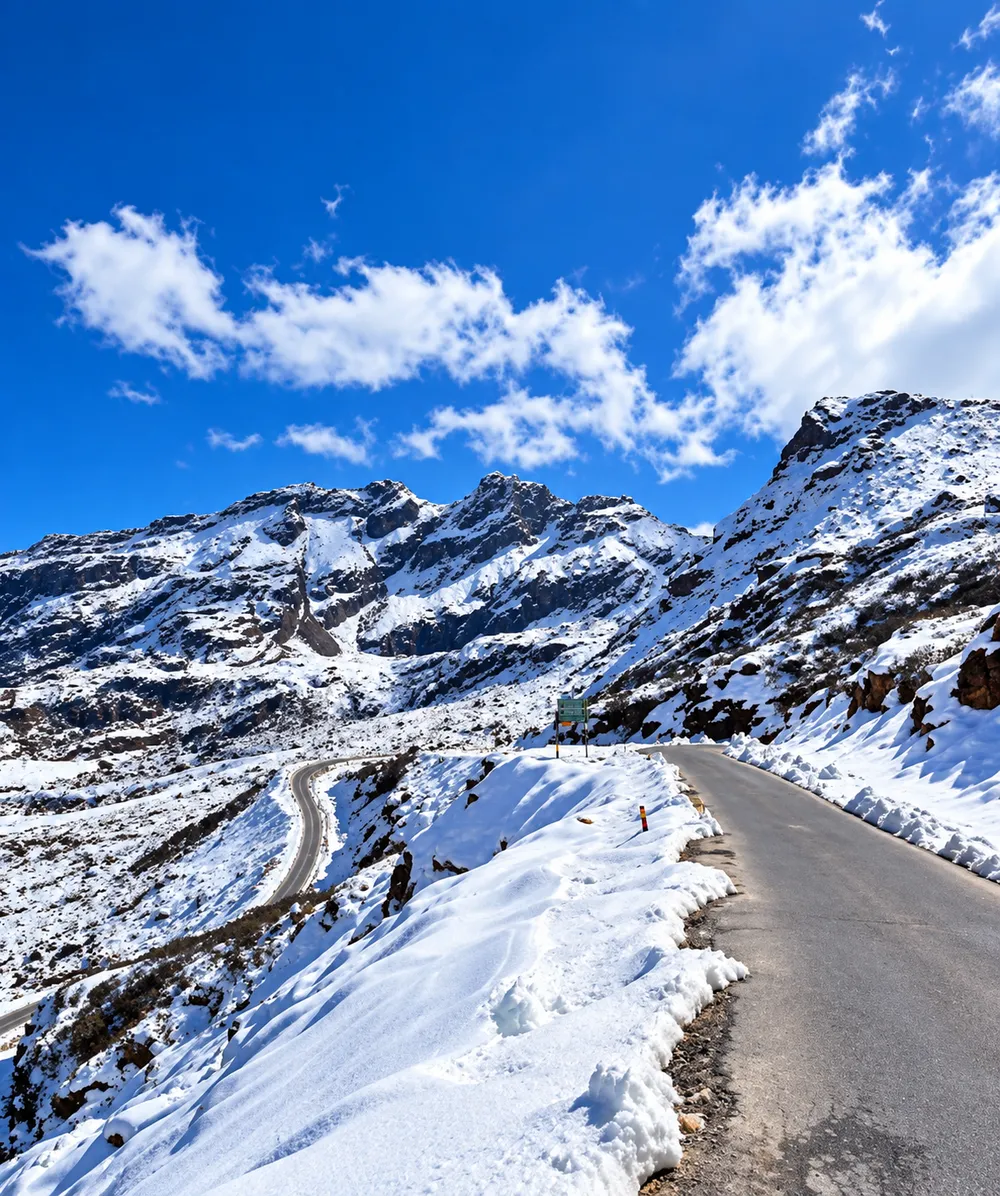
Bumla Pass is a high-altitude border crossing between Tawang district in Arunachal Pradesh and Tsona County in Tibet, sitting close to 15,200 feet. It's one of the most-asked-about add-ons to a Tawang trip, usually covered as a single long day out from Tawang town rather than a stop on the way to anywhere else. Because it sits directly on the India-China border, a visit here comes with its own permit process, its own restrictions, and a genuine possibility that access can be limited on short notice depending on the situation at the border.
This guide covers where Bumla Pass actually is, how the permit process works, when to go, and what a realistic day trip looks like. Given how much of this depends on current army clearance and road conditions on the day, treat the practical details here as a planning baseline, not a guarantee, and confirm the specifics locally before you commit a full day to the trip.
Why Visit Bumla Pass?
The appeal is straightforward: it's a genuinely remote, high-altitude stretch of the Himalaya, and reaching it means standing at one of the few points in India where you can look across an open, unfenced border. The drive up passes a string of high-altitude lakes, some of them frozen for much of the year, which are as much a part of the trip as the pass itself.
There's also a layer of history here. Bumla was a route into India used during events surrounding the 1962 war, and the pass functioned as a closed frontier for over four decades before reopening for limited border trade in 2006. None of that needs dramatizing. What draws most travellers is simpler: the scale of the landscape, the altitude, and the fact that this is a working military border, not a monument built for visitors.
It works best as an extension of a Tawang trip rather than a stop on its own, since the town is the only realistic base for arranging the permit and the vehicle.
Where Is Bumla Pass?
Bumla Pass sits north of Tawang town, close to the Line of Actual Control that separates Arunachal Pradesh from Tibet. It's roughly 37 km from Tawang by road, on a route that climbs steadily from the town toward the border.
It's separate from Sela Pass, which lies on the road between Dirang and Tawang and is typically crossed on the way into or out of Tawang district rather than visited as a day trip from Tawang town itself. Travellers sometimes conflate the two because both are high-altitude passes in the same district, but they sit on different roads and serve different purposes in a Tawang itinerary.
Bumla Pass From Tawang
The road from Tawang to Bumla is about 37 km, climbing from Tawang's own altitude of around 10,000 feet to Bumla's roughly 15,200 feet. Given the elevation gain and the state of a mountain border road, this drive takes noticeably longer than the distance alone would suggest, and total time for the round trip — including checkpoints, permit verification, and time at the pass — generally fills most of a day.
(Exact one-way driving time varies with weather, checkpoint queues, and current road condition, so it's worth asking your operator or hotel in Tawang for a current estimate rather than relying on a fixed number.)
Bumla Pass Permit Requirements
Getting to Bumla Pass involves more than the standard Arunachal Pradesh entry permit, and it's worth understanding the layers separately.
Inner Line Permit (ILP): All non-resident Indian citizens need an ILP to enter Arunachal Pradesh in the first place, applied for online through the state's eILP portal or in person at a Deputy Commissioner's office or Arunachal Bhawan. This gets you into the state and district, not to Bumla itself.
Special Bumla permit: A separate permit specifically for Bumla Pass is required on top of the ILP. This is issued through the Office of the Deputy Commissioner in Tawang and must be stamped by the Indian Army before it's valid — checkpoints along the route verify both the permit and the vehicle used. Because this permit is typically tied to a specific vehicle registration, changing vehicles at the last minute can invalidate it.
Foreign nationals: Access for foreign nationals is considerably more restricted, and in practice foreign tourists are often not permitted to visit Bumla Pass at all, even with a valid Protected Area Permit (PAP) for Arunachal Pradesh generally. This is one of the most important things to confirm directly with a registered tour operator or the DC's office before building it into an itinerary.
Vehicle requirements: Many operators require an Arunachal Pradesh-registered vehicle for the Tawang-to-Bumla leg specifically, separate from whatever vehicle brought you into Tawang.
(Permit rules, required documents, and access for foreign nationals can change with little notice given the border-area sensitivity, and the office may not process new permits on weekends. Confirm current requirements directly with the DC's office in Tawang or a registered local operator before you travel, and try to arrive in Tawang with a day or two of buffer before you plan to visit Bumla.)
Best Time to Visit Bumla Pass
Winter (December–February): Heavy snow is common at this altitude, and the pass can be closed to visitors during and after significant snowfall. This is the least reliable season to plan around, even though it's also when the landscape is at its most dramatic.
Spring (March–May): Conditions generally improve as snow starts to clear, though the higher stretches near the pass can still see late-season snow. Visibility tends to be better than in winter.
Summer (June–August): Milder at this elevation than lower parts of Arunachal Pradesh, but this overlaps with the monsoon in much of the region, which can affect the roads leading up to Tawang itself.
Monsoon (June–September): Rain and cloud cover across the wider Tawang region can affect both road conditions and visibility at the pass. Landslides on approach roads are a realistic risk in this window.
Autumn/Post-monsoon (September–November): Often considered one of the better windows, with clearer skies and stable weather before winter snow sets in.
Across all seasons, access to Bumla is ultimately gated by current army clearance on the day, not just the calendar. Even in a good-weather month, don't treat a Bumla visit as guaranteed until you have your permit confirmed in Tawang.
Places to Visit Near Bumla Pass
Sangetsar Lake (also called Madhuri Lake): A lake formed by a landslide-triggered earthquake, sitting a short distance off the main Bumla road. It's a common stop either on the way to Bumla or as a standalone destination if a Bumla permit isn't available that day, and doesn't require the same special permit.
Other high-altitude lakes en route: The Tawang region has a large number of glacial lakes, and several are visible from or near the Bumla road, some frozen for much of the year. These are best treated as scenic stops along the route rather than separate destinations requiring their own planning.
PT Tso and nearby viewpoints: Additional lakes and viewpoints sit close to the route, though exact accessibility depends on the season and current road conditions.
A realistic day trip typically combines the drive to Bumla itself with a stop at Sangetsar Lake, either on the way up or back.
How to Reach Bumla Pass
Bumla is reached exclusively by road from Tawang town — there's no other practical starting point. The general process:
- Arrange your Bumla permit through your hotel, a registered local operator, or directly at the Tawang DC's office, ideally as early in your Tawang stay as possible given potential processing delays.
- Arrange a vehicle that meets the registration requirement for the route (commonly an Arunachal Pradesh-registered vehicle, confirmed with your operator).
- Start early — the round trip, including checkpoints, takes most of a day, and mountain roads are best driven in daylight.
- Expect multiple checkpoints where your permit and vehicle details are verified.
Most visitors do this through a local tour operator in Tawang rather than arranging it independently, mainly because operators already have relationships with the permit process and appropriate vehicles.
(Current pricing for vehicle hire and any operator fees isn't included here since it varies by season and operator — get a quote directly in Tawang.)
Altitude and Travel Preparation
Bumla sits above 15,000 feet, which is high enough that altitude effects are a real consideration for most travellers, regardless of fitness level. A few general points, in generic terms:
- Acclimatize gradually. Spend at least a day or two in Tawang (itself around 10,000 feet) before attempting the trip up to Bumla, rather than arriving and heading straight up.
- Stay hydrated throughout the day, more than feels necessary at altitude.
- Dress in warm layers. Temperatures at Bumla are significantly colder than in Tawang town, even when the weather looks clear.
- Avoid overexertion once at altitude — this isn't a hiking destination, and unnecessary physical strain adds to altitude stress.
- Watch for symptoms like persistent headache, dizziness, nausea, or shortness of breath beyond mild exertion, and treat any of these as a reason to descend rather than push on.
- Seek professional medical help promptly if symptoms are more than mild or don't improve — this isn't something to manage by guesswork at altitude, and it isn't medical advice, just a prompt to take it seriously.
What to Pack for Bumla Pass
- Heavy layered clothing, including a windproof outer layer
- Warm gloves and thermal socks
- A warm hat or head covering
- Sunglasses (glare at altitude, especially with snow, is significant)
- Sunscreen, even in cold weather
- Water for the full day
- Basic snacks, since options along the route are limited
- Any personal medication you might need, carried with you rather than left at your hotel
Suggested Tawang and Bumla Itinerary
Day 1: Arrive in Tawang. Rest and begin acclimatizing. Sort out your Bumla permit application through your hotel or a local operator.
Day 2: Local Tawang sightseeing — Tawang Monastery, the war memorial, and nearby sights at a relaxed pace, while your permit is processed.
Day 3: Full-day trip to Bumla Pass, with a stop at Sangetsar Lake on the way up or back. Start early and plan to be back in Tawang by evening.
Day 4: Buffer day or onward travel, useful in case Bumla access was delayed or unavailable on Day 3.
Building in a spare day is worth it. Between permit processing and weather-dependent access, a Bumla trip is one of the more schedule-sensitive parts of a Tawang itinerary.
Practical Travel Tips
- Sort your ILP before arriving in Tawang — the Bumla permit is a separate, additional step on top of it.
- Apply for the Bumla permit early in your Tawang stay, since DC office processing and weekend closures can cost you a day.
- Confirm foreign-national access directly with a registered operator if this applies to you, rather than assuming a general Arunachal permit covers Bumla.
- Expect no or very limited mobile connectivity near the border.
- Carry cash for the trip — card and UPI payments aren't reliable in this area.
- Photography restrictions apply at and near the border post; follow the instructions of army personnel at the site rather than assuming general tourist photography rules apply.
- Keep your permit and ID on you at all times during the drive — checkpoints are frequent.
- Be ready for the trip to be called off on short notice due to weather or the border situation, and have a backup plan (Sangetsar Lake alone, or another day in Tawang) in mind.
Frequently Asked Questions
Where is Bumla Pass? Bumla Pass is a high-altitude border crossing between Tawang district in Arunachal Pradesh, India, and Tsona County in Tibet, at an elevation of roughly 15,200 feet.
How far is Bumla from Tawang? About 37 km by road from Tawang town.
Do I need a permit to visit Bumla Pass? Yes. Beyond the standard Arunachal Pradesh Inner Line Permit, a separate special permit for Bumla is required from the Tawang DC's office and must be stamped by the Indian Army.
How do I visit Bumla? Through a permitted vehicle from Tawang, arranged either independently through the DC's office or via a registered local tour operator, who usually handles both the permit and vehicle requirements.
Can foreigners visit Bumla Pass? Access for foreign nationals is significantly restricted and often not permitted at all, even with a valid Protected Area Permit for Arunachal Pradesh. Confirm directly with a registered operator before planning around it.
What is the best time to visit Bumla Pass? September to November and March to May tend to offer more stable conditions, though access ultimately depends on current weather and army clearance regardless of season.
Does Bumla get snow? Yes, heavy snowfall is common in winter, and the pass can be closed to visitors during and after major snow.
Is Bumla open throughout the year? It's generally accessible across seasons when conditions allow, but access can be restricted at short notice due to weather or the situation at the border — it isn't a guaranteed year-round destination.
What should I wear to Bumla Pass? Heavy warm layers, a windproof outer layer, gloves, thermal socks, and sunglasses — temperatures at this altitude are considerably colder than in Tawang town.
Can Bumla be covered as a day trip from Tawang? Yes, it's typically done as a single long day trip from Tawang, often combined with a stop at Sangetsar Lake.