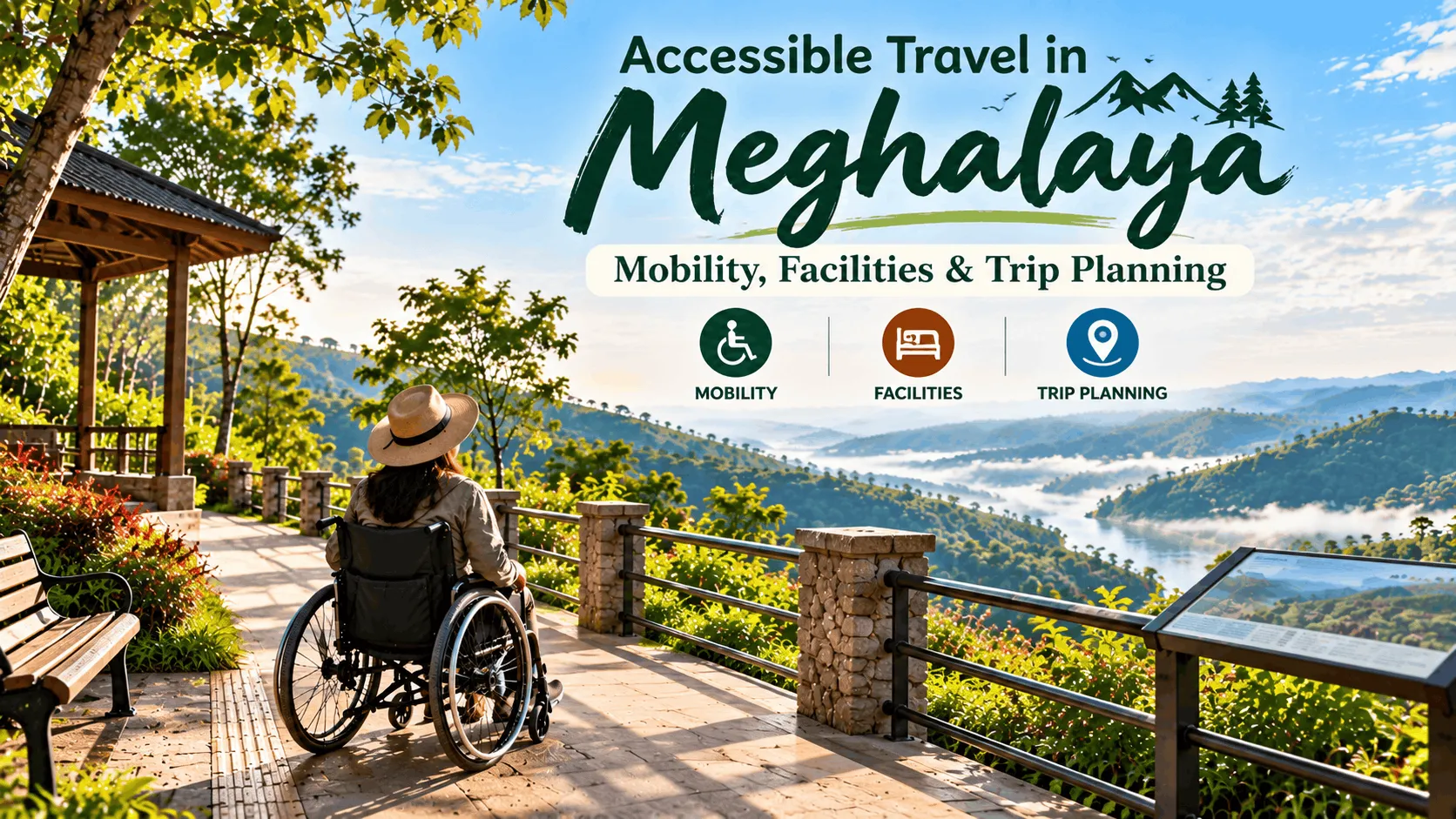
Meghalaya is a state of hill roads, stone steps, wet rock and sudden fog. Those features draw visitors, and they also decide whether a given day out works for a wheelchair user, someone who tires quickly on slopes, a blind or low-vision traveler, a deaf or hard-of-hearing traveler, or a family bringing an older relative. Accessible travel in Meghalaya is possible with planning, but it depends on details no general guide can promise for you.
This guide helps you ask better questions: what to ask hotels and drivers, how to read an attraction description for hidden barriers, and how to build an itinerary that holds up when the weather changes. It does not hand out "accessible" labels. Published access audits for the state's main attractions are hard to find, and a label without evidence can leave you at the bottom of a staircase. Where we describe a place, we stick to what is publicly documented and tell you what to confirm.
We use both person-first ("a traveler with a disability") and identity-first ("a disabled traveler") phrasing, because people prefer different forms. Use whichever suits you.
Understanding accessible travel in Meghalaya
Meghalaya Tourism's traveler-type page says travel in Shillong for seniors and people with disabilities is manageable with good preparation. It advises choosing a hotel or homestay with elevators and wheelchair access, and recommends local guides for remote destinations such as Sohra, Mawlynnong and Dawki. That is a starting point, not a guarantee for any particular door, path or boat landing.
The terrain explains why. Many well-known sights on this gorge-cut plateau involve steps, slopes or wet surfaces. Disability groups in Shillong have publicly described footpaths that are narrow, uneven and blocked by poles and hawkers, and buses that are not wheelchair friendly. Treat pavements and public transport as unreliable until a provider tells you otherwise, and plan door-to-door movement by private vehicle where you can.
Access varies by property, road, attraction and season. A hotel can have a ramp at the front and a narrow bathroom door at the back, and a path that is firm in February can be slick in July. "Accessible" only helps with specifics: which feature, measured how, confirmed by whom and when.
Difficulty ratings need the same care. Our Cherrapunji travel guide calls the Nohkalikai Falls viewpoint an easy stop near the road, yet notes steps to lower viewing areas. "Easy" describes effort for a typical walker, not whether a wheelchair can reach the railing.

Planning around individual access requirements
Write down what you need before you contact anyone. A short access profile gets better answers than "is it accessible?"
If you use a wheelchair, note whether it is manual or powered, its width and length, and whether you transfer independently or with help. Ask providers for clear door widths in centimeters rather than a yes or no. Powered chair users should add battery type, charging time and the adapter they need, since power cuts happen and sockets can be limited.
If you walk with a stick, crutches or a walker, or have limited stamina, the questions are about step counts, steepness, distance between rests and how slippery a surface gets.
Blind and low-vision travelers may care most about lighting, handrails, edge barriers and guides who describe the surroundings. Deaf and hard-of-hearing travelers may want every arrangement confirmed in writing, a visual or vibrating alert in the hotel room, and an agreed way to communicate with drivers and guides. Autistic travelers and people with sensory sensitivities may need quiet rooms and advance notice of what happens next. We assume nothing about any of these needs. You know yours, so state them clearly.
Choosing accommodation: questions to ask
Options range from city hotels in Shillong to small properties in Sohra, village homestays and seasonal riverside camps near Dawki and Shnongpdeng. Shillong has the widest choice, Sohra a smaller one, and Nongriat basic facilities with steep access. Fewer options means fewer fallbacks, so verify first.
Ask about the whole route from the vehicle to your bed. Hill properties are often terraced, with stairs between the car park, reception, dining area and rooms.
- Entry: Is there a step-free route from where a vehicle can stop to reception, the room and the dining area? For ramps, ask about gradient, width, surface and handrails. A ground-floor room is not automatically step-free.
- Lifts: What are the interior dimensions, and does it work during power cuts?
- Room: What is the clear door width, the space beside the bed and the bed height? Ask for a photo or short video of the actual room.
- Bathroom: What is the door width, is there space to turn a chair, and are there grab bars? Is the shower step-free, and is a seat available? Ask about hot water too, since hill nights are cold.
- Arrival and lighting: How close can a vehicle get, and is the last stretch paved, gravel or steps? How is lighting at night, and are there visual alerts for guests who cannot hear an alarm?
- Assistance: Who is on duty overnight, and what help is realistically available? Do not assume staff can lift a person or a chair, and ask what they will not do.
A short message works well:
Hello, I plan to stay from [dates]. I use a [manual/powered] wheelchair, [width] cm wide. Could you tell me the clear door width of the room and bathroom, whether there is a step-free route from where a car can stop to the room, whether the shower is step-free, and whether you have power backup? Please send a photo or video of the exact room, and say so if something is unavailable.
Save the reply, and treat a vague answer as unconfirmed.
Transport and vehicle arrangements
Most visitors arrive through Guwahati in Assam, about 100 km by road from Shillong. Shillong Airport at Umroi, roughly 30 km from the city, has limited routes. If you fly, request mobility assistance when you book and share your chair and battery details.
On the ground, a hired car with a driver is the most practical way to combine several places, and it gives you control over where you stop and how long you rest. It is not automatically suitable, though. Ask for the vehicle type, seat height and door opening, whether a folding chair fits in the boot, and whether the driver is comfortable helping with transfers. Purpose-built wheelchair-accessible vehicles appear to be rare in the state. If you need a ramp or lift, ask the operator to name a specific vehicle, and plan on a standard car if they cannot.
Shillong to Sohra is about 54 km and 1.5 to 2 hours on a winding road where fog can cut visibility. Ask where toilet stops are, and plan long drives to finish in daylight, since winter days are short. For each stop, ask how close the driver can park and whether the last stretch is level and paved.
Mobile signal can be weak in rural areas, so agree a check-in plan with your driver. If you are combining Meghalaya with other states, plan each part separately, since facilities and permit rules differ. Our Northeast India travel guide covers the wider region.
Evaluating attractions and walking routes
Many of Meghalaya's best-known places are defined by their terrain, and some will not suit every traveler.
Read descriptions for access words: steps, descent, narrow, crouch, slippery, uneven, boarding. Meghalaya Tourism describes the route to the Double Decker living root bridge at Nongriat as about 3 km down roughly 3,500 stone steps, with a demanding climb back. A route of that kind rules out wheelchair use and is hard going for many other travelers. Mawsmai Cave has narrow passages and low ceilings where visitors may need to crouch. Boat rides on the Umngot river near Dawki depend on water levels and involve getting on and off at the river's edge, so ask how boarding works. Mawphlang Sacred Grove has forest paths and is best visited with a local guide.
Sites described as easy, such as the parks near Sohra, still need questions. For each attraction, ask:
- How far is it from where a vehicle can stop, and what is the surface (paved, gravel, packed earth, stone steps, wet rock)?
- Is there a step-free route, and does it reach the same view as the stepped route?
- How wide is the path, and are there handrails or edge barriers?
- Where are the seats, the shelter and the nearest usable toilet, and how does the route look after heavy rain?
Ask for a recent photo or video of the route, not a promotional shot. If nobody can describe the surface and gradient, treat the site as unverified. Agree rest points with your guide in advance, and consider a portable folding seat if benches are scarce. Fog can remove the visual cues low-vision travelers use, so ask about barriers at viewpoints over gorges.

Weather, terrain and seasonal considerations
Long-term India Meteorological Department averages put Sohra at about 11,176 mm of rain a year against about 2,100 mm in Shillong, so a route verified in one season can behave very differently in another.
November to February is the driest stretch, with clearer views, cold evenings, shorter days and more visitors. March to May brings warmer weather and increasing showers. June to September is the monsoon: waterfalls are full, but paths are slippery, visibility drops, boating at Dawki can be suspended and landslides can disrupt roads. October still sees showers.
For access, surface is the main question. Wet stone, mud and algae affect crutches, canes, walkers and wheelchair tires alike, and a ramp that is manageable when dry can be hazardous in rain. Ask providers about conditions for your dates, and about heating and hot water in the cold months.
Remote areas have limited facilities. The Garo Hills, Nongriat and some riverside camps sit far from Shillong's larger options, so ask how far the nearest medical facility is, carry your regular medication plus extra days of supply, and pack spares for any equipment you depend on.
No month suits everyone. Choose the season whose trade-offs you can accept, and check weather and road advice before travel and each morning. Our Meghalaya travel guide has a fuller season-by-season breakdown.
Working with tour operators and local providers
A good operator can choose stops, time visits and arrange local guides. Tour listings, ours included, describe a standard route. Unless a listing names specific access features, assume none are guaranteed and ask for a custom plan.
Ask any operator or local provider:
- Have they arranged trips for travelers with similar needs, and what did they change?
- Can they check the stops beforehand and report on surfaces, steps and toilets?
- What help is available for transfers and rests, and what will they not do?
- What is the plan, and what are the rebooking terms, if a road, path or boat is unusable?
- Will every stop's access details appear in the written itinerary?
Many sites are community managed, so ask your operator to arrange access and fees with the village or site manager in advance, and follow local rules.
Pay attention to how providers answer. A specific "there are steps at the main entrance, but we can bring the vehicle to the side gate" is more trustworthy than a cheerful "no problem." If you get only reassurance, ask for measurements or photos. When you are ready to compare itineraries, browse our tours and ask what can be adapted. Confirm every arrangement in writing before you pay a deposit.
Building a flexible itinerary
Flexibility is the cheapest accessibility feature you can add yourself.
- Plan one main activity a day and leave the rest open, with a midday rest and slow mornings.
- Give each main activity a researched backup, such as another viewpoint or an indoor option, and confirm its access too.
- Use fewer bases to cut driving days. If a Sohra property fails your checks, Shillong has more choice and works as a base for day trips.
- Add spare days in the monsoon or on routes that depend on a river or road.
- Decide each morning with your driver or guide whether the plan still suits the weather and your energy.
If a plan feels rushed, drop a stop rather than add a long drive.
A practical accessibility checklist
Use this before paying a deposit and again a week before travel.
Accommodation
- Step-free route confirmed from drop-off to room, dining area and toilet
- Door widths, bed height, shower type and grab bars confirmed in measurements
- Lift size and power backup confirmed, if needed
- Photos or video of the exact room and route received
- Night staffing, alerts, lighting and charging points confirmed in writing
Transport
- Vehicle type, seat height and boot space confirmed
- Driver briefed on transfers and rests
- Drop-off points near each stop confirmed as close and level
- Airline assistance requested
Attractions
- Distance, surface, gradient and width of each route confirmed
- Steps, narrow sections, boarding points, seating, toilets and edge barriers identified
- Recent condition report or video received
- Backup activity researched for each main stop
Trip
- Every arrangement confirmed in writing
- Weather and road advice checked shortly before travel
- Medication and spares packed with extra days of supply
Frequently asked questions
Is Meghalaya wheelchair accessible?
There is no single answer, because access varies by property, route and season. Meghalaya Tourism advises choosing lodging with elevators and wheelchair access, and disability groups have raised concerns about footpaths and public transport in Shillong. Verify each hotel, vehicle and attraction yourself.
Can wheelchair users visit living root bridges?
It depends on the bridge and the route to it. The Nongriat trail is thousands of stone steps, so it does not work for wheelchair use. For other bridges, ask about the approach and surface first.
What is the best time for accessible travel in Meghalaya?
No month is best for everyone. November to February usually brings firmer surfaces and clearer views, with colder evenings. The monsoon brings slippery paths. Choose by trade-off.
Can I bring an assistance animal?
We have no confirmed policies for hotels, vehicles or attractions. Ask every provider in advance and keep the answer in writing.
Conclusion
Accessible travel in Meghalaya rewards travelers who ask specific questions, keep plans flexible and treat every claim as something to check. The terrain is part of the appeal and part of the challenge, and the right trip depends on your requirements, the season and the providers you choose.
Ask for measurements and photos, and keep a backup for every main activity. If you would like to talk through an itinerary, get in touch and we will tell you plainly what we can and cannot confirm.